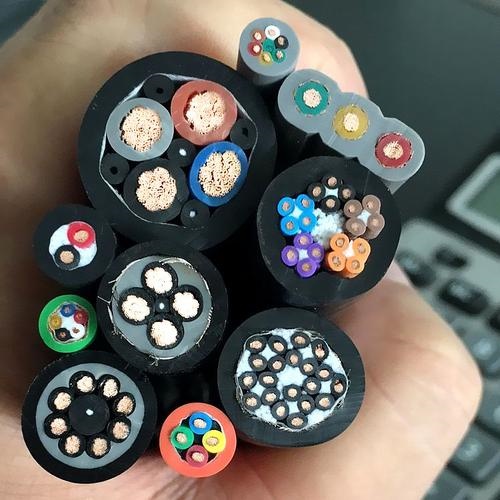
Robot Combined Multi-Core Cable — Flexible Multi-Conductor PUR Cable with Concentric Core Stranding for Industrial Robot Power Distribution, Control, and Sensor Wiring
Robot & Automation Cables /Composite Robot Cables

Robot Combined Multi-Core Cable — Flexible Multi-Conductor PUR Cable with Concentric Core Stranding for Industrial Robot Power Distribution, Control, and Sensor Wiring

Robot combined multi-core cable: flexible multi-conductor PUR cable with concentric core stranding for industrial robot power distribution, control wiring, and sensor connections. IEC 60228 Class 6 extra-fine stranded copper (0.22–16 mm², 4–36 cores). Multiple core sizes combined in one cable — power cores (1.5–16 mm²) + control cores (0.75–2.5 mm²) + signal cores (0.22–0.50 mm²). TPE insulation. PUR jacket — oil, coolant, and weld-spatter resistant. 300/500 V and 0.6/1 kV. For robot arm internal wiring where multiple individual cables can be replaced by one combined multi-core cable. CE, RoHS compliant.

Key Features

Multiple conductor sizes combined in one cable — power (1.5–16 mm²), control (0.75–2.5 mm²), and signal (0.22–0.50 mm²) cores in a single concentric assembly
IEC 60228 Class 6 extra-fine stranded bare copper — maximum flexibility for routing through narrow robot arm cable paths and connector backshells
Concentric core stranding with filler elements — round, compact cross-section for even bending and torsion; symmetrical stress distribution
Numbered core identification per VDE 0293 — all cores permanently marked; different cross-section groups clearly distinguishable
TPE core insulation — 90°C temperature class; superior flex life compared to PVC; resistant to oil and coolant absorption
PUR TMPU outer jacket — oil, coolant, and weld-spatter resistant; provides mechanical protection for the core assembly
Flexible for routing, not torsion-rated — designed for robot arm internal wiring where bending flexibility is required but continuous torsion is not the primary stress
CE, RoHS compliant; ISO 9001 manufactured

Applications

Robot controller-to-arm wiring — combined multi-core cable replacing multiple individual cables between robot controller and arm junction boxRobot arm internal power distribution — multi-core power cable distributing power from arm base to servo drives at each axisRobot sensor and actuator wiring — combined cable for proximity sensors, limit switches, solenoid valves, and indicator lights on robot end-of-arm toolingRobot I/O wiring — combined cable carrying digital I/O signals between robot controller distributed I/O modules and sensors/actuatorsRobot auxiliary equipment — combined cable for robot cell peripheral devices: part present sensors, clamp confirmations, light curtains

Technical Specifications

Conductor Material Bare copper, IEC 60228 Class 6 extra-fine stranded
Conductor Cross-Section — Power 1.5 mm², 2.5 mm², 4 mm², 6 mm², 10 mm², 16 mm²
Conductor Cross-Section — Control 0.75 mm², 1.0 mm², 1.5 mm², 2.5 mm²
Conductor Cross-Section — Signal 0.22 mm², 0.34 mm², 0.50 mm²
Total Core Count 4–36 cores (mixed sizes)
Core Identification Number-printed per VDE 0293; different size groups clearly distinguishable
Core Insulation TPE (thermoplastic elastomer); 90°C; oil-resistant; excellent flex life
Core Stranding Concentric layers with non-hygroscopic filler elements; different size cores in dedicated layers
Inner Sheath (Optional) TPE or PVC
Outer Jacket PUR TMPU; 1.5–3.0 mm; halogen-free; black or grey
Rated Voltage — Power 0.6/1 kV (U₀/U)
Rated Voltage — Control/Signal 300/500 V (U₀/U)
Test Voltage — Power 3 500 V AC, 5 minutes
Test Voltage — Control/Signal 2 000 V AC, 5 minutes
Temperature — Flexing -30°C to +80°C
Temperature — Fixed -50°C to +90°C
Minimum Bend Radius (Flexing) 7.5× cable outer diameter
Minimum Bend Radius (Fixed) 4× cable outer diameter
Oil / Coolant Resistance IEC 60811-404
Flame Retardant IEC 60332-1-2
Certifications CE, RoHS

Detailed Description

"Combined" vs "Composite" — Understanding the Robot Cable Hierarchy

The terms are not interchangeable. They describe different levels of cable integration:

Cable TypeWhat It CombinesSpecial FeaturesBest For
Combined Multi-CoreMultiple conductor sizes in one cable (power + control + signal)Concentric stranding; Class 6 copperGeneral robot arm wiring; power distribution + I/O
Composite (Power+Signal+Data)Power + shielded signal pairs + data bus elementsSZ stranding; torsion-rated; impedance-controlled data pairsComplete robot wiring harness; high-torsion axes
TorsionOptimized for torsional stressSZ lay; anti-torsion fillers; ±180°/m ratedAxis 4/5/6 wrist segments
ManipulatorEnd effector connectionsCompact; flexible; connector-readyRobot wrist to gripper/weld gun

The combined multi-core cable is the workhorse — it replaces multiple individual single-type cables with one multi-type cable. It is not torsion-rated (no SZ stranding) and does not include impedance-controlled data elements. It is the right choice for the robot arm segments that flex but do not twist — the upper arm and forearm (axes 1–3), the cable run from the robot base to the arm junction box, and the robot cell interconnections.

Core Size Grouping — Why Mix Sizes?

A robot arm requires different conductor cross-sections for different functions:

  • Servo motor power: 4–16 mm² — carries 10–40 A per phase
  • Motor brake: 0.75–1.5 mm² — 24 V DC, <2 A
  • Sensors (proximity, temperature): 0.22–0.50 mm² — signal-level currents <100 mA
  • Solenoid valves: 0.75–1.5 mm² — 24 V DC, 0.5–2 A
  • Digital I/O: 0.50–0.75 mm² — 24 V DC, signal-level
Running separate cables for each of these functions creates a bulky, tangled harness. The combined multi-core cable assembles all core sizes into one cable — the power cores (larger cross-section) are in the inner concentric layer, the control and signal cores (smaller cross-section) are in the outer layers. The filler elements maintain roundness and separate the different size groups.

Yichi Combined Multi-Core Cable Manufacturing

  • Custom core size combinations: The customer specifies the required core sizes and counts. Our engineering team designs the cross-section to optimize roundness and minimize OD — a cross-section drawing is provided for approval
  • Size group identification: The numbering system (VDE 0293) groups cores by size — e.g., cores 1–4 are 4 mm² power, cores 5–8 are 1.5 mm² control, cores 9–16 are 0.5 mm² signal. Clear grouping simplifies termination
  • Class 6 verified: Every production batch is sampled for strand count — Class 6 requires significantly more individual wire strands per cross-section than Class 5. Verified under microscope at 20× magnification
  • TPE insulation oil resistance: TPE (thermoplastic elastomer) is specified instead of PVC for robot applications because PVC absorbs oil and coolant over time — swelling, softening, and losing dielectric strength. TPE's oil absorption is <5% compared to PVC's 20–30% after extended exposure

Product Inquiry

Product: Robot Combined Multi-Core Cable — Flexible Multi-Conductor PUR Cable with Concentric Core Stranding for Industrial Robot Power Distribution, Control, and Sensor Wiring

Add technical specifications (optional)

The more detail you provide, the faster and more accurate our quotation.

No file chosen

PDF, Office, image or CAD file — up to 5 MB

Need Help?

Certifications

ISO 9001
Quality
CE
European
RoHS
Environmental
TÜV
Certification

Need a Quote for This Product?

Send us your requirements and receive a detailed quotation within 24 hours.