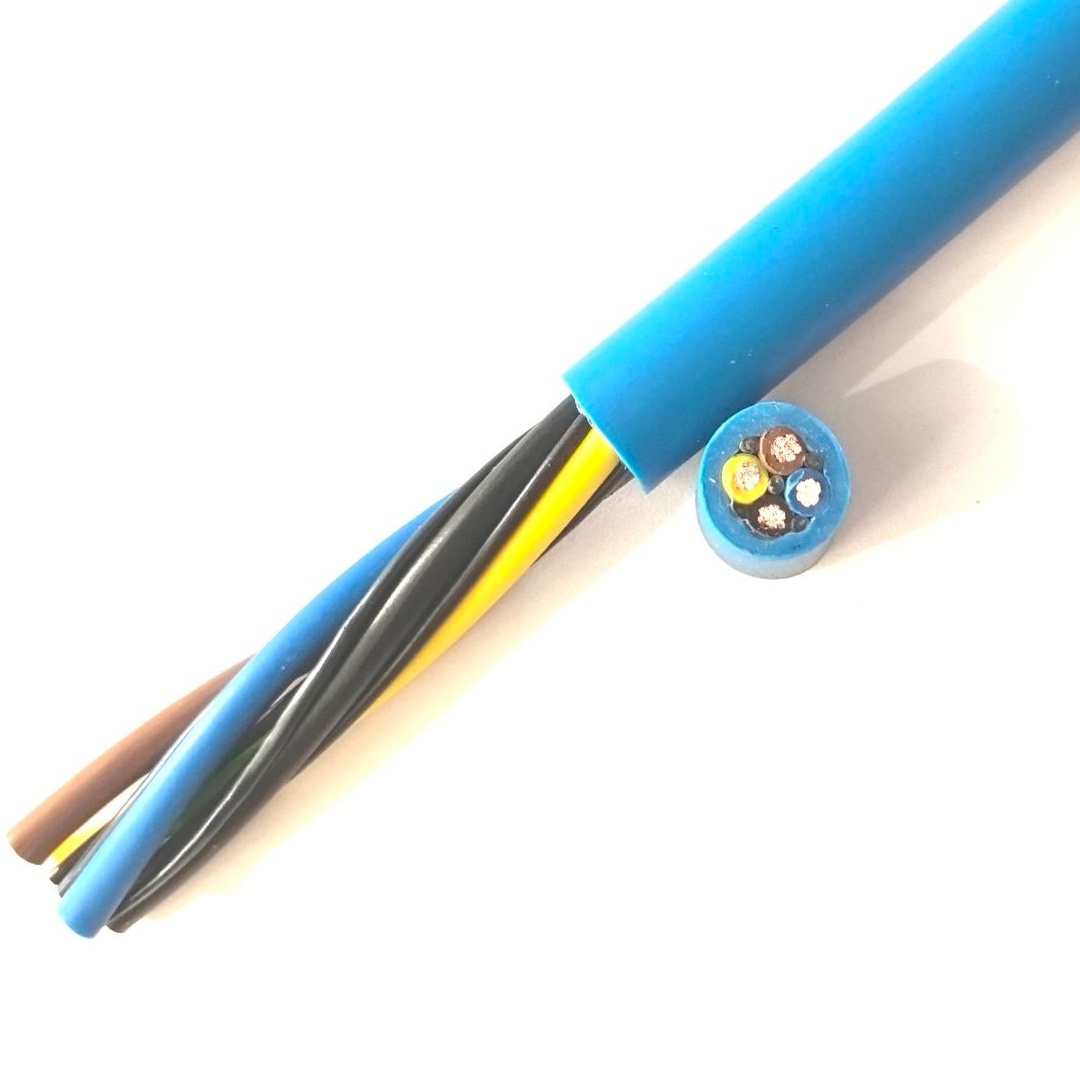
Detailed Description
The Manipulator Cable Segment — Small Cable, Critical Role
The robot manipulator cable is the final cable segment in the robot's electrical chain — the short cable from the wrist flange (axis 6 output) to the end effector. It is typically 0.5–2.0 meters long. Despite its short length, it is one of the most failure-prone cables on the robot because of the operating conditions:
- Tight bend radii: The cable exits the wrist flange, makes a 90–180° bend, and enters the end effector — with a bend radius as small as 30–50 mm on smaller robots (≤20 kg payload)
- Constant motion: The end effector moves and rotates continuously during the robot cycle. The cable flexes with every robot motion — not the large-scale bending of the arm axes, but small-amplitude, high-frequency flexing at the wrist-to-tool interface
- Direct exposure: The manipulator cable is the most exposed cable on the robot — closest to the workpiece, the weld arc, the cutting chips, and the coolant spray. It is the first cable to show jacket damage from the operating environment
- Mechanical contact: The cable contacts the tooling, the workpiece, and occasionally the fixture during robot motion. Jacket abrasion is a leading cause of manipulator cable failure
Core Allocation for Common End Effectors
| End Effector Type | Core Count | Typical Core Allocation | Cross-Section |
|---|---|---|---|
| Pneumatic gripper (2-jaw) | 4–6 | 2× gripper open/close solenoid; 2× part present sensor | 0.5–0.75 mm² |
| Pneumatic gripper (3-jaw) | 6–8 | + 2× second solenoid valve for centering | 0.5–0.75 mm² |
| Electric gripper | 8–12 | 4× motor power; 2× encoder; 2× brake; 2× status I/O | 0.5–1.5 mm² |
| Vacuum cup (single) | 4 | 2× ejector valve; 2× vacuum sensor | 0.5 mm² |
| Vacuum cup array (multiple) | 8–12 | 4× valve bank; 4× zone sensors; 2× blow-off valve | 0.5–0.75 mm² |
| Weld gun (spot welding) | 12–16 | 4× gun close/open solenoid; 2× tip dress; 2× water flow; 4× I/O | 0.75–1.5 mm² |
| Tool changer | 8–12 | 2× lock/unlock solenoid; 2× tool ID; 2× tool present; 4× spare | 0.5–1.0 mm² |
| Vision camera | 6–8 | 2× camera power; 4× GigE data pairs (if not fiber) | 0.34–0.5 mm² |
For end effectors that require shielded signals — encoder feedback on electric grippers, vision camera data, or sensitive analog sensors — the shielded version (Robot Manipulator Shielded Cable) should be specified.
Yichi Manipulator Cable Manufacturing
- Compact OD design priority: For robot wrist routing, every millimeter of cable diameter matters. Our design process minimizes OD by optimizing conductor lay length, filler cross-section, and jacket wall thickness while maintaining electrical and mechanical specifications
- PUR jacket thickness balanced: The jacket must be thick enough for abrasion resistance but thin enough for flexibility at tight bend radii. Typical wall thickness is 1.2–2.0 mm for manipulator cables — thinner than arm cables (1.5–3.0 mm) because the primary mechanical stress is flexing, not crush or impact
- Connector compatibility verified: Manipulator cables are typically terminated with circular connectors (M12, M23, M27, or robot-manufacturer-specific). Cable OD is matched to the connector backshell entry diameter — a cable that is 0.5 mm oversize will not fit in the connector
- Marking at wrist end: Cable identification is printed on the jacket at the wrist end (not buried in the arm) so that the cable type is visible during end effector changeover and maintenance