Detailed Description
What Is Alarm & Security Cable?
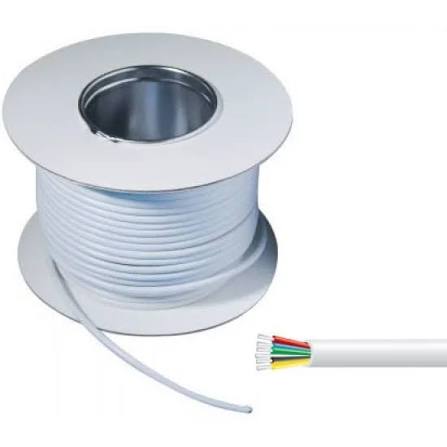
Alarm and security cable is a multi-core, low-voltage (300/500 V rated) cable designed specifically for the wiring of intruder alarm systems, burglar alarms, and associated building security equipment — PIR detectors, door contacts, glass break sensors, alarm keypads, and external sounders. It is the cable that a security system installer pulls through ceiling voids, down wall cavities, and along skirting boards to connect every detector and device back to the central alarm control panel.
The cable is defined by its core count (the number of separately insulated conductors in one cable) and the alarm industry's standard wiring topology: a multi-core cable carries all the circuits required for a single detector location in one cable run — the +12 V DC supply (2 cores), the normally-closed alarm loop (2 cores), and the normally-closed tamper loop (2 cores) — six cores in total. The installer runs a single 6-core cable from the alarm panel distribution point to each detector, connects the relevant cores to the detector terminals and the junction box terminals, and the detector is wired. This is simpler, cleaner, and more reliable than running three separate 2-core cables to each detector.
6-Core vs 8-Core — The Standard Alarm Cable Configurations
| Core Count | Typical Usage | Cores and Functions |
|---|---|---|
| 2-core | Simple magnetic door contacts with no tamper | 1 pair: alarm loop (normally closed) |
| 4-core | Door contacts with tamper, panic buttons | 1 pair: alarm loop + 1 pair: tamper loop |
| 6-core | Standard PIR detector connection | 1 pair: +12 V DC supply + 1 pair: alarm loop + 1 pair: tamper loop |
| 8-core | Dual-tech detectors (PIR + microwave), detectors with onboard sounders, or spare capacity | 2 pairs: alarm circuits (PIR and microwave) + 1 pair: tamper + 1 pair: 12 V DC supply |
| 12-core | Combined detector, sounder, and access control at one location | Multiple alarm, tamper, power, and data circuits |
6-core is the standard for residential and light commercial alarm installations — every PIR detector receives a 6-core cable from the alarm panel. 8-core is specified for higher-specification installations where dual-technology detectors are used (requiring separate alarm circuits for the PIR and microwave elements) or where detectors incorporate onboard sounders or strobes (requiring additional cores for the sounder trigger and 12 V supply).
Why Choose Yichi Alarm & Security Cables
- BS 4737 / EN 50131 compatible — the correct cable for alarm systems: The cable's conductor cross-section, core count, voltage rating, and screening options are designed for the electrical requirements of intruder alarm systems per the UK and European standards. The end-of-line resistor values, the loop resistance limits, and the tamper circuit requirements are accounted for in the cable's electrical specification
- Screened or unscreened — select for the installation's EMI environment: Screened cable (overall aluminum/polyester foil + drain wire) for alarm installations where the cable route shares a tray or conduit with mains power cables, or where the alarm system specification requires a continuous screen from the panel to each detector for false alarm immunity. Unscreened for dedicated alarm cable routes — lower cost and easier termination
- Industry-standard colour coding — red, black, yellow, blue, green, white: The 6-core colour code that alarm installers expect. No need to consult a core numbering chart or meter-out each core — the colour tells the installer the core's function at a glance. Standard colour coding reduces wiring errors and speeds up installation and commissioning
- PVC or LSZH — select for the building's fire safety requirements: Standard PVC for commercial and residential installations; LSZH for public buildings, schools, hospitals, and any installation where the fire safety policy requires halogen-free cable in escape routes. Both options manufactured with the same core configuration, colour coding, and electrical performance
- Compact OD for concealed installation: The thin-wall insulation and compact core assembly produce the small cable diameter that alarm installers need to conceal the cable in door frames, window reveals, skirting boards, and surface mini-trunking. The cable is designed to be hidden — its primary installation environment is inside the building fabric