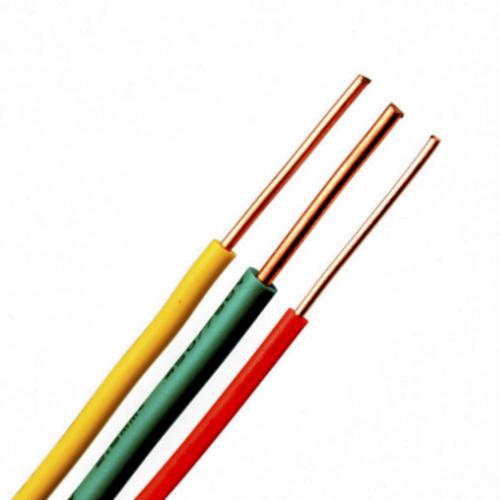
Electrical Wire (General Purpose) — IEC 60227 / UL 1007/1015 Single-Core PVC Insulated Hookup Wire for Internal Equipment Wiring, Control Panel Connections, Electronic Assembly, and General Low Voltage Electrical Interconnection
Power & High Voltage Cables /General Purpose Wiring (300–600V)

Electrical Wire (General Purpose) — IEC 60227 / UL 1007/1015 Single-Core PVC Insulated Hookup Wire for Internal Equipment Wiring, Control Panel Connections, Electronic Assembly, and General Low Voltage Electrical Interconnection

Electrical wire general purpose: single-core PVC insulated hookup wire, 300/500V or 600V. Copper Class 1/2/5, 0.5–120 mm² (AWG 20–4/0). IEC 60227 / UL 1007/1015/1569. For equipment internal wiring, control panels, electronic assembly, appliance harnesses. Flame retardant VW-1. CE, RoHS, UL recognized.

Key Features

Multi-standard compliance — IEC 60227 (international), UL 1007 (300 V, 80°C), UL 1015 (600 V, 105°C), UL 1569 (300 V, 105°C), CSA TR-64 — one wire covers the major international and North American equipment wiring standards, simplifying procurement for global OEMs
Solid (Class 1), stranded (Class 2), and flexible (Class 5) bare copper or tinned copper conductor — solid for automated PCB insertion and wire-wrap terminations; stranded for manual routing in control panels; flexible for equipment doors and moving harness connections
PVC insulation with 70°C (IEC), 80°C (UL 1007), or 105°C (UL 1015/1569) ratings — select the temperature class for the expected operating environment; 105°C PVC covers the majority of equipment internal wiring requirements including proximity to power semiconductors and transformers
Cross-section range 0.5–120 mm² — AWG 20 to AWG 4/0 for North American designs; the full metric/IEC and AWG cross-section spectrum in a single wire product family
Standard solid colors and color-stripe identification — available in white, black, red, blue, yellow, green, brown, grey, orange, violet, and green-yellow; stripe and number printing on request for complex harness identification
Flame retardant PVC compound — VW-1 (UL 1581 vertical flame) and IEC 60332-1-2; the PVC jacket self-extinguishes when the flame source is removed, preventing flame propagation along wire bundles inside equipment enclosures
UL recognized component (UL 1007/1015/1569) — simplifies UL end-product listing for OEM equipment; use of UL recognized internal wiring eliminates the need for additional wiring approval during the equipment certification process
Compact overall diameter for high-density wiring — thin-wall insulation construction (Type TR-64 per UL for 300 V ratings) minimizes wire OD for dense wiring in control panels, junction boxes, and equipment chassis

Applications

Control panel and switchgear internal wiring — point-to-point connections between terminals, relays, contactors, PLC I/O modules, and circuit breakers in industrial control panels and low voltage switchgear assembliesElectrical/electronic equipment assembly — internal wiring of power supplies, inverters, motor drives, UPS systems, and industrial electronics where point-to-point wiring with single-core hookup wire is usedAppliance wiring harnesses — internal connections in washing machines, refrigerators, air conditioners, and commercial kitchen equipment where the wire operates at appliance-rated temperaturesAutomation and machinery control wiring — sensor, solenoid, and actuator connections inside machine control enclosures; stranded conductor for routing flexibility around moving machine elementsLighting fixture internal wiring — connections between ballast/driver, lampholder, and terminal block inside luminaires; high-temperature 105°C PVC for enclosed fixtures with elevated internal ambientInstrumentation and measurement equipment — low-current signal wiring for process transmitters, panel meters, and data acquisition systems where clean, reliable point-to-point connections are requiredPCB-to-chassis interconnection — solid or stranded wire for connecting PCB-mounted terminal blocks to chassis-mounted connectors, switches, and panel components in electronic equipment

Technical Specifications

Standards — International IEC 60227-3: PVC insulated cables of rated voltages up to 450/750 V — single-core non-sheathed for internal wiring; HD 21.3 S3; VDE 0281-3
Standards — North America UL 1007 (300 V, 80°C); UL 1015 (600 V, 105°C); UL 1569 (300 V, 105°C); UL 1007/1569 Style 1569 (300 V, 105°C); CSA TR-64 (300 V, 90°C); all UL recognized component
Type Designation — Solid BV (IEC: 60227 IEC 01); H07V-U (harmonized); UL 1007/1015 solid
Type Designation — Stranded BVR (IEC: 60227 IEC 02); H07V-R (harmonized); UL 1015 stranded
Type Designation — Flexible RV (IEC: 60227 IEC 06); H05V-K (≤1 mm²) / H07V-K (≥1.5 mm²) (harmonized); UL 1007/1569 flexible
Rated Voltage — IEC Types 300/500 V (RV, H05V-K ≤1 mm²); 450/750 V (BV, BVR, H07V-K ≥1.5 mm²)
Rated Voltage — UL Types 300 V (UL 1007, UL 1569); 600 V (UL 1015)
Conductor Material Bare copper (standard) or tinned copper (for humid/corrosive environments and soldered terminations); Cu-ETP, ≥99.95% purity
Conductor Class — IEC Class 1 (solid), Class 2 (stranded), Class 5 (flexible); IEC 60228
Conductor Strata — UL/AWG Solid and stranded per UL 1581; typical strand counts: 7-strand (AWG 20–18), 19-strand (AWG 16–10), 37-strand (AWG 8), 65-strand (AWG 6), 105-strand (AWG 4–2)
Conductor Cross-Sections — Metric (IEC) 0.5, 0.75, 1.0, 1.5, 2.5, 4, 6, 10, 16, 25, 35, 50, 70, 95, 120 mm²
Conductor Sizes — AWG (UL) AWG 20 (0.52 mm²), AWG 18 (0.82 mm²), AWG 16 (1.31 mm²), AWG 14 (2.08 mm²), AWG 12 (3.31 mm²), AWG 10 (5.26 mm²), AWG 8 (8.37 mm²), AWG 6 (13.3 mm²), AWG 4 (21.2 mm²), AWG 2 (33.6 mm²), AWG 1/0 (53.5 mm²), AWG 2/0 (67.4 mm²), AWG 3/0 (85.0 mm²), AWG 4/0 (107 mm²)
Insulation — PVC (IEC) PVC type TI1 (70°C) or TI2 (90°C) per IEC 60227-1
Insulation — PVC (UL) Semi-rigid PVC; 80°C (UL 1007), 105°C (UL 1015/1569); the PVC compound is formulated for different temperature ratings through plasticizer selection and stabilizer addition
Insulation Thickness — IEC 450/750 V (H07V-K) 0.7 mm (1.5 mm²); 0.8 mm (2.5–6 mm²); 1.0 mm (10–16 mm²); 1.2 mm (25–35 mm²); 1.4 mm (50 mm²); per IEC 60227-1
Insulation Thickness — UL 1015 (600 V) 30 mils / 0.76 mm (AWG 20–16); 30 mils / 0.76 mm (AWG 14–10); 45 mils / 1.14 mm (AWG 8–2); 60 mils / 1.52 mm (AWG 1–4/0); per UL 1581
Insulation Thickness — UL 1007 (300 V) 16–17 mils / 0.41 mm (AWG 20–16); for applications where space is at a premium and voltage stress is 300 V or less
Insulation Colors (Standard) Black, white, red, blue, yellow, green, brown, grey, orange, violet, green-yellow (bi-color); other colors on request
Maximum DC Conductor Resistance at 20°C — Solid (BV) Per IEC 60228 Class 1; 39.0 Ω/km (0.5 mm²) to 4.61 Ω/km (4 mm²)
Maximum DC Conductor Resistance at 20°C — Stranded (BVR) Per IEC 60228 Class 2; 12.1 Ω/km (1.5 mm²) to 0.153 Ω/km (120 mm²)
Maximum DC Conductor Resistance at 20°C — Flexible (RV/H07V-K) Per IEC 60228 Class 5; 39.0 Ω/km (0.5 mm²) to 0.161 Ω/km (120 mm²)
Insulation Resistance at 20°C ≥10 MΩ·km (IEC, at 20°C); ≥500 MΩ·1000 ft (UL, at 15.6°C)
Test Voltage (IEC — 450/750 V) 2 500 V AC / 5 min (routine, finished wire)
Dielectric Withstand (UL) 2 500 V AC / 1 min (UL 1015); 1 500 V AC / 1 min (UL 1007/1569); per UL 1581
Spark Test (In-Line) 6 kV AC (300 V rated UL types); 10 kV AC (600 V rated UL types); 100% in-line spark testing per UL 1581 for recognized component wire
Temperature Range — PVC 70°C (IEC BV/BVR) -15°C to +70°C
Temperature Range — PVC 80°C (UL 1007) -20°C to +80°C
Temperature Range — PVC 105°C (UL 1015/1569) -20°C to +105°C
Minimum Bend Radius — Solid Conductor 3× wire OD for terminal connection bend; do not re-bend
Minimum Bend Radius — Stranded/Flexible 2× wire OD for routing in equipment; 5× wire OD for repeated handling
Flame Retardant UL VW-1 (UL 1581); IEC 60332-1-2; the PVC compound is inherently flame-retardant
Oil Resistance — PVC 105°C Limited; PVC absorbs mineral oil and softens over time; for oil-exposed environments, specify UL 1015 with oil-resistant PVC or use silicone/XLPE wire
Stripability The insulation strips cleanly from the conductor without leaving residue on the copper; important for automated wire processing and crimping in harness manufacturing
Ampacity (Typical, 30°C Ambient, Single Wire in Free Air) Per NEC Table 310.17 / IEC 60364-5-52; e.g., AWG 14 (2.08 mm²) ≈ 35 A (105°C PVC, free air); AWG 10 (5.26 mm²) ≈ 55 A; de-rate for bundling and enclosure ambient per applicable code
Certifications CE, RoHS; UL recognized component (File E-number on request); CSA; VDE, HAR marking on request

Detailed Description

What Is General Purpose Electrical Wire?

General purpose electrical wire is a single-core insulated conductor used for the internal wiring of electrical and electronic equipment — it is the wire that connects terminal A to terminal B inside a control panel, an appliance, a power supply, or an electronic assembly. Unlike building wiring cable (which is pulled through conduit and fixed in place), general purpose wire is handled by equipment assemblers — it is cut to length, stripped, crimped or soldered, and routed through equipment chassis, wire ducts, and cable ties.

The wire is defined by two distinct international standards families:

  • IEC 60227 (and harmonized HD 21): Covers PVC insulated single-core wires for equipment wiring at 300/500 V (light duty, ≤1 mm²), 450/750 V (standard), and the associated temperature ratings (70°C TI1, 90°C TI2). The designations RV, H05V-K, and H07V-K are the IEC equipment-wire types.
  • UL 1581 / UL 1007 / UL 1015 / UL 1569: Cover recognized component wire for the North American market. UL 1007 is 300 V / 80°C, UL 1015 is 600 V / 105°C, UL 1569 is 300 V / 105°C. These are the standard wires inside every UL-listed industrial control panel, appliance, and electronic product sold in North America.
For a global OEM, specifying wire that meets both IEC and UL requirements simplifies procurement — one wire SKU serves both European and North American equipment builds. Yichi electrical wire is manufactured to meet both standards families from a single production line.

Conductor Class Selection — Solid, Stranded, or Flexible?

Conductor ClassIEC DesignationFlexibilityTypical ApplicationTermination Method
Class 1 (Solid)BV, H07V-URigidPCB insertion, wire-wrap, automated harness assemblySolder, wire-wrap, screw clamp (no ferrule needed)
Class 2 (Stranded)BVR, H07V-R, UL 1015 strandedSemi-flexibleControl panel point-to-point wiring ≥2.5 mm²Screw clamp, crimped lug, spring clamp
Class 5 (Flexible)RV, H07V-K, UL 1007/1569FlexibleEquipment door hinges, moving harnesses, tight routingFerrule + screw clamp, crimp terminal

Class 5 flexible conductor is the most common for general equipment wiring because it combines good current-carrying capacity with the flexibility needed to route wires neatly inside equipment enclosures. The fine stranding (single wire diameter 0.20–0.41 mm depending on cross-section) allows tight bends without conductor damage. For cross-sections of 10 mm² and above in control panels, Class 2 stranded is typically used because the conductor is stiff enough to hold its shape after forming, which keeps the panel wiring neat and serviceable.

UL vs IEC — Voltage and Temperature Designations Compared

ParameterIEC 60227 (RV/H07V-K)UL 1015UL 1007
Rated voltage300/500 V (≤1 mm²); 450/750 V (≥1.5 mm²)600 V300 V
Temperature rating70°C (TI1) or 90°C (TI2)105°C80°C
Flame testIEC 60332-1-2UL VW-1 (vertical flame)UL VW-1
ConductorClass 1, 2, or 5 bare copperStranded or solid bare/tinned copperStranded bare/tinned copper
Cross-section range0.5–120 mm²AWG 20–4/0 (0.52–107 mm²)AWG 20–16 (0.52–1.31 mm²)
Primary marketEurope, Asia, IEC countriesNorth America, global OEMNorth America, electronics

An important practical distinction: UL 1015 at 600 V and 105°C is the most versatile single specification — it meets or exceeds the voltage and temperature requirements of most equipment internal wiring applications. If a design must use a single wire type across all internal connections, UL 1015 (with IEC 60227 compliance verified) is the recommended specification. For high-density, low-voltage wiring where space is the primary constraint (e.g., dense control panels with thousands of terminations), UL 1007 or IEC H05V-K thin-wall construction reduces the wire cross-section without compromising safety.

Practical Considerations for Equipment Wiring

  • Ferrules (cord end terminals): Flexible (Class 5) conductors terminated in screw-clamp terminals should always be fitted with a ferrule — a thin-walled copper tube crimped over the stripped conductor end. The ferrule contains the individual fine strands, prevents them from splaying when the screw is tightened, and protects them from damage. Ferrules are color-coded by cross-section per DIN 46228
  • Stripping length: The insulation strip length must match the terminal depth. For screw-clamp terminals, the stripped length should be the terminal depth plus 0.5–1.0 mm — enough for full conductor insertion without exposed copper outside the terminal. For ferrules, the strip length equals the ferrule barrel length
  • Wire marking: Every wire in a control panel or equipment assembly should be identified at both ends. Wire markers can be heat-shrink sleeves, clip-on numbered rings, or printed labels. The identification must remain legible for the service life of the equipment — ink that fades or adhesive that fails after years of operation defeats the purpose of wire identification
  • Bundling and ampacity de-rating: When multiple wires are bundled together inside a wire duct, the mutual heating reduces each wire's ampacity. Per IEC 60364-5-52, a bundle of 5–7 current-carrying wires requires a de-rating factor of approximately 0.6. A 2.5 mm² wire rated 25 A in free air becomes a 15 A wire when part of a 7-wire bundle. Panel designers must account for this de-rating when sizing wire cross-sections in high-density wiring ducts
  • Temperature derating: PVC insulation has a maximum continuous conductor temperature rating that must not be exceeded. The actual conductor temperature in operation is the sum of the ambient temperature inside the equipment enclosure plus the temperature rise from I²R heating in the conductor. For equipment with internal ambient above 40°C, the wire ampacity must be de-rated or a higher temperature class insulation (105°C or silicone) specified

Why Choose Yichi General Purpose Electrical Wire

  • Dual IEC + UL compliance from a single source: Yichi wire is manufactured and tested to IEC 60227 and UL 1007/1015/1569 standards, supported by UL recognized component listings. One wire part number for global equipment builds — no dual sourcing for different markets
  • Full conductor spectrum: Class 1 solid, Class 2 stranded, and Class 5 flexible conductors in metric (0.5–120 mm²) and AWG (20–4/0) sizes — the complete range for any equipment wiring specification
  • 105°C PVC as standard for UL 1015: The 105°C insulation rating provides margin for equipment internal temperature rise and allows more ampacity per conductor cross-section compared to 70°C or 80°C PVC — a smaller wire can carry the same current, reducing panel weight and wiring duct fill
  • 100% in-line spark testing: Every meter of wire is spark-tested at 6–10 kV AC during production — not a sample test. Any pinhole or thin spot in the insulation is detected and the wire is cut out before it reaches the packaging reel
  • UL recognized component — simpler equipment certification: When your equipment uses UL recognized wiring (UL 1007/1015/1569), the wire is accepted without additional testing during the UL end-product listing process. We provide the UL file number and test data for your certification submission
  • Custom color coding, striping, and printing: Standard solid colors or custom color codes for complex harness builds; longitudinal stripe for multi-color identification; sequential meter marking on request for cut-to-length manufacturing in harness production lines

Product Inquiry

Product: Electrical Wire (General Purpose) — IEC 60227 / UL 1007/1015 Single-Core PVC Insulated Hookup Wire for Internal Equipment Wiring, Control Panel Connections, Electronic Assembly, and General Low Voltage Electrical Interconnection

Add technical specifications (optional)

The more detail you provide, the faster and more accurate our quotation.

No file chosen

PDF, Office, image or CAD file — up to 5 MB

Need Help?

Certifications

ISO 9001
Quality
CE
European
RoHS
Environmental
TÜV
Certification

Need a Quote for This Product?

Send us your requirements and receive a detailed quotation within 24 hours.