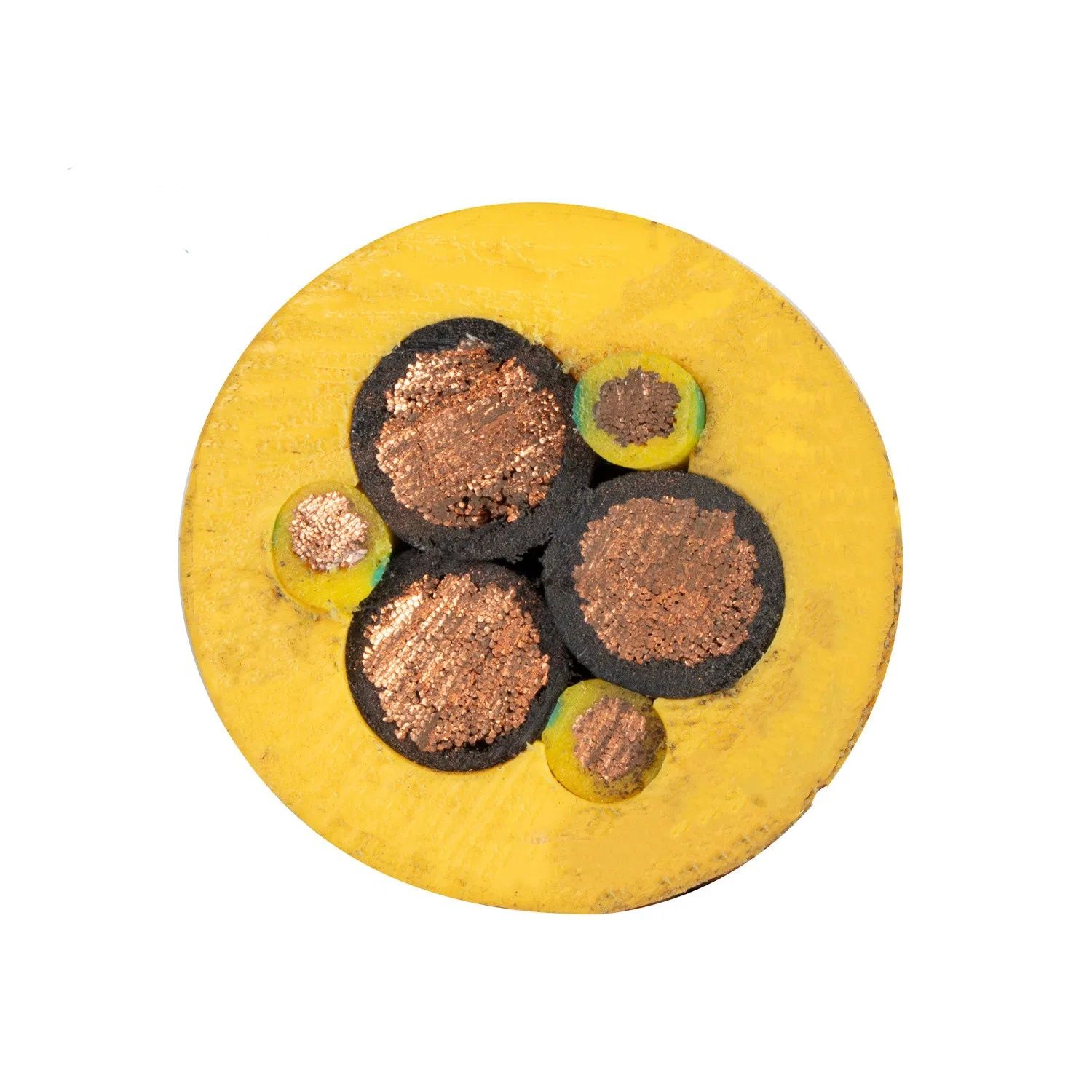
Detailed Description
Jumbo Drill Rig — The Underground Workhorse
A jumbo drill rig is the primary development machine in underground mining and tunneling. It is a large articulated carrier with 1–3 hydraulically positioned drilling booms. Each boom carries a percussive or rotary-percussive rock drill that creates blast holes in the tunnel face.
The machine's electro-hydraulic power pack (typically 55–200 kW) drives the hydraulic pumps that power the drills, boom positioning, and carrier traction. The trailing cable delivers electrical power from the mine's distribution system to the machine as it advances the tunnel face — typically 3–5 meters per blast cycle.
The cable environment is physically demanding:
- Water everywhere: Drilling uses water for dust suppression and bit cooling. The tunnel floor is permanently wet
- Rock debris: Blast rock fragments on the tunnel floor abrade the cable jacket
- Continuous boom movement: The articulated booms reposition between every drill hole — the cable flexes continuously
- Confined space: The tunnel is typically 4–6 meters wide — the cable is frequently run over or caught between the machine and tunnel wall
Ground Check — MSHA's Non-Negotiable Requirement
Every underground trailing cable for mobile mining equipment must include a ground check conductor per MSHA 30 CFR Part 18. The ground check circuit is a safety interlock:
- The ground check conductor runs through the cable alongside the power conductors
- At the machine end, it connects to the equipment frame (ground)
- At the power source end, a ground check relay monitors circuit continuity
- If the ground path is interrupted — by cable damage, loose connection, or equipment fault — the relay opens and disconnects power to the machine
The ground check conductor is separate from the main ground conductors — it is a dedicated monitoring circuit, not a current-carrying path.
Why Yellow?
The bright yellow jacket with reflective stripe is not aesthetic — it serves a specific safety function in the underground environment:
- Headlamp visibility: In a dark tunnel illuminated only by machine headlights and personal cap lamps, a yellow cable reflects light far better than a black one — operators can see where the cable is and avoid driving over it
- Pinch-point awareness: The reflective stripe makes the cable visible when it is between the machine and the tunnel wall — the most common pinch point
- Damage identification: Yellow shows cuts, abrasion, and wear immediately — black hides early damage until the conductors are exposed
Water-Blocked Construction — Preventing Internal Corrosion
Underground cables operate in a permanently wet environment. Standard cable construction allows water to wick along the spaces between conductor strands (capillary action), traveling from a jacket breach point deep into the cable core. This internal moisture causes:
- Conductor corrosion: Even tinned copper eventually corrodes under sustained moisture exposure
- Insulation degradation: EPR absorbs water over time, reducing dielectric strength
- Tracking paths: Moisture + conductive mining dust creates surface tracking paths that lead to insulation failure
Why Choose Yichi Drilling Rig Cable?
- MSHA certified manufacturing: Full compliance with 30 CFR Part 18 — jacket, ground check, and flame testing
- Water-blocked as standard: Every underground cable includes water-blocking elements — preventing the internal corrosion that silently degrades cables in wet mines
- Yellow jacket with reflective stripe: Underground visibility standard — not a catalog option, our standard configuration
- Ground check conductor included: Dedicated monitoring circuit in every underground trailing cable — MSHA mandatory
- Flexible stranding: Class 5/6 tinned copper with short lay length — withstands the continuous boom articulation of jumbo drilling operations