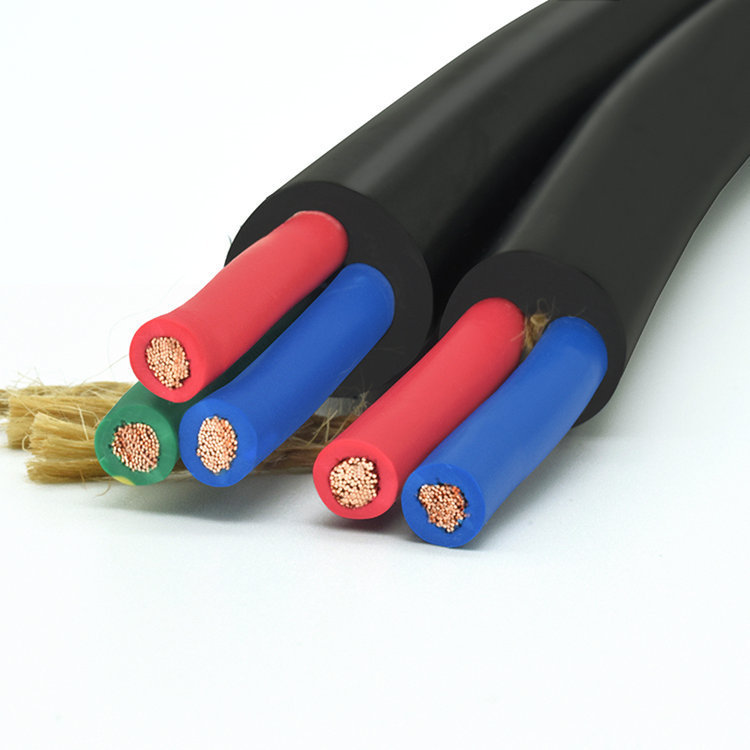
Heavy Duty Rubber Cable — IEC 60245 / HD 22 Rubber Insulated Heavy-Duty Flexible Cable with EPR Insulation and CR/CPE Sheath (NSSHÖU / TYPE W / G-GC Types) for Mining, Construction, Shipyard, and Heavy Industrial Mobile Equipment Power Supply at 0.6/1 kV
Power & High Voltage Cables /Heavy Duty Rubber Series

Heavy Duty Rubber Cable — IEC 60245 / HD 22 Rubber Insulated Heavy-Duty Flexible Cable with EPR Insulation and CR/CPE Sheath (NSSHÖU / TYPE W / G-GC Types) for Mining, Construction, Shipyard, and Heavy Industrial Mobile Equipment Power Supply at 0.6/1 kV

Heavy duty rubber cable: EPR insulated, CR/CPE sheathed, 0.6/1 kV. IEC 60245, TYPE W, G-GC, NSSHÖU types. Class 5 copper, 1.5–300 mm², 1–5 cores. For mining, construction, shipyards, heavy mobile equipment. Oil, weather, abrasion, impact resistant. -40°C cold-flex. CE, RoHS.

Key Features

EPR (ethylene propylene rubber) core insulation rated 90°C — the standard insulation for heavy-duty rubber cables because of its high dielectric strength (20–25 kV/mm), excellent flexibility, and resistance to compression and mechanical deformation under the weight of vehicles and equipment running over the cable
CR (polychloroprene/neoprene) or CPE (chlorinated polyethylene) heavy-duty outer sheath — Shore A 60–70; the thick-walled rubber sheath provides the mechanical toughness that defines this cable class: resistance to cutting, tearing, abrasion, oil, weather, and flame
0.6/1 kV rated voltage — the standard voltage class for industrial power, covering 400 V, 480 V, and 690 V three-phase systems used in mining, construction, and shipyard power distribution
IEC 60245 heavy-duty rubber cable types (IEC 60245-4) and North American TYPE W (UL 1650) and G-GC (UL 1650 with ground check) — dual-standard compliance for global mining and construction projects with mixed international and North American equipment
Flexible Class 5 stranded bare copper or tinned copper conductor — fine stranding provides the flexibility to coil, uncoil, and route the cable repeatedly on construction sites and in mines without conductor fatigue; tinned copper for corrosion resistance in wet mining and marine environments
Tensile reinforcement options — aramid fiber or steel wire braid for cables that are pulled, dragged, and suspended; the tensile elements carry the pulling force so the copper conductors carry only current
Weather, UV, and ozone resistant CR/CPE sheath — outdoor-rated for permanent exposure; the rubber sheath does not crack from UV exposure, does not become brittle in cold weather (to -40°C), and resists the ozone produced by high-voltage electrical equipment
Cold-flex rated to -40°C (CR) or -50°C (CPE) — rubber retains flexibility at sub-zero temperatures where PVC is glass-brittle; essential for Arctic mining, cold-region construction, and winter shipyard operations

Applications

Mining power distribution — heavy-duty rubber cable for trailing power supply to electric rope shovels, draglines, drills, continuous miners, and longwall shearers at 0.6/1 kV to 6.6 kV with Type 241/440/441 mining cable designationsConstruction site power — main power distribution cable from the site transformer or generator to the site distribution board; run across the ground, under vehicle traffic, exposed to weather, concrete splashes, and construction debrisShipyard and dock power supply — shore-to-ship power cable for vessels under repair or construction; the rubber sheath withstands salt water spray, oil from ship machinery, and the mechanical abuse of being dragged across steel decks and quaysidesTunnel boring and underground construction — heavy-duty rubber cable for tunnel boring machines (TBM), roadheaders, and auxiliary equipment in underground works where the cable is subject to water, mud, falling rock fragments, and continuous mechanical movementHeavy mobile equipment — power cable for mobile crushers, screening plants, mobile conveyor systems, and aggregate processing equipment in quarries and open-pit mines; the cable must survive being dragged behind moving equipment over sharp rock surfacesDredging and marine construction — flexible rubber cable for cutter suction dredgers, barge-mounted excavators, and floating plant in marine construction where the cable floats or is submerged and must resist seawater corrosionEmergency and temporary power — heavy-duty rubber cable for emergency generator connection, disaster relief power distribution, and temporary grid bypass where the cable is deployed rapidly, often on unprepared ground, and must function reliably in all weather conditions

Technical Specifications

Standards — International IEC 60245-4: Rubber insulated cables — cords and flexible cables for rated voltages up to and including 450/750 V — tough rubber sheathed flexible cables; covers 60245 IEC 66 (YCW type), 60245 IEC 81 (heavy duty mining)
Standards — North America UL 1650 (Portable Power Cable, TYPE W); UL 1650 with ground check (TYPE G, G-GC); CSA C22.2 No. 96 (Portable Power Cable); MSHA 30 CFR Part 18 (mining, on request)
Standards — National GB/T 5013.4 (YC, YCW types, China); VDE 0250-812 (NSSHÖU type, Germany); DIN VDE 0250-814 (heavy rubber); BS 6195 / BS EN 50525-2-21 (UK)
Rated Voltage (U₀/U) 0.6/1 kV (standard industrial); 450/750 V for smaller cross-section types; 1.8/3 kV and 3.6/6 kV on request for medium voltage mining cable
Conductor Material Bare copper or tinned copper; IEC 60228 Class 5 (flexible); stranded with short lay length for maximum flexibility
Conductor Cross-Sections 1.5, 2.5, 4, 6, 10, 16, 25, 35, 50, 70, 95, 120, 150, 185, 240, 300 mm²
Core Count 1-core (single-phase, DC); 2-core (single-phase with earth); 3-core (three-phase no neutral); 4-core (3P+PE); 5-core (3P+N+PE); custom core counts on request
Core Insulation — EPR Ethylene propylene rubber (EPR); rated 90°C continuous; 250°C short-circuit; the standard insulation for heavy-duty rubber cables because EPR combines high dielectric strength with the mechanical flexibility and compression recovery that rubber applications demand
Core Identification Color code: black, red, blue (L1/L2/L3), white or light blue (N), green-yellow (PE); numbered on request; the colors must remain identifiable after the cable has been exposed to mud, oil, and abrasion — rubber insulation coloring is compound-integral, not surface-applied
Core Assembly — 3-Core and Above Concentric stranding with anti-torsion filler elements; the cores are cabled with a lay length that balances flexibility with mechanical stability — too short a lay length reduces flexibility; too long a lay length allows the cores to separate under tension
Inner Sheath (Optional) CR or CPE rubber; provides additional protection between the core assembly and the outer sheath; also serves as a bedding layer for tensile braid application
Tensile Reinforcement (Optional) Aramid fiber (Kevlar) braid or galvanized steel wire braid; applied between the inner and outer sheath; carries the cable's tensile load during pulling and suspension — the copper conductors carry zero tension
Tensile Load Rating (Reinforced) Up to 15 kN depending on reinforcement type and cable diameter; sized per cable weight, length, and installation method per IEC 60245 design guidelines
Outer Sheath — CR (Neoprene) Polychloroprene rubber; Shore A 60–70; black; the standard heavy-duty rubber cable sheath; provides excellent resistance to oil, weather, ozone, flame, and mechanical abuse; the reference sheath material for mining and construction cable
Outer Sheath — CPE Chlorinated polyethylene rubber; Shore A 60–70; black; alternative to CR with improved low-temperature performance to -50°C and equivalent oil/weather/flame resistance
Sheath Thickness (Heavy Duty) Significantly thicker than standard flexible cable: 2.0 mm (small cables) to 6.0 mm (large cables); the heavy wall provides the mechanical protection that defines this cable class
Maximum DC Conductor Resistance at 20°C Per IEC 60228 Class 5; 13.3 Ω/km (1.5 mm²) to 0.0654 Ω/km (300 mm²) for bare copper
Insulation Resistance at 20°C — EPR ≥1 000 MΩ·km (at 500 V DC, 1 min)
Test Voltage (AC) — Routine 3 500 V AC / 5 min (0.6/1 kV types); per IEC 60245
Temperature Range — Moving / Flexing -40°C to +60°C (CR sheath); -50°C to +60°C (CPE sheath)
Temperature Range — Fixed -50°C to +85°C (CR); -50°C to +90°C (CPE)
Minimum Bend Radius (Moving) 6× cable OD (flexing, coiling, uncoiling); the rubber jacket accommodates this bend radius without kinking or sheath cracking
Minimum Bend Radius (Fixed Routing) 4× cable OD
Oil Resistance — CR/CPE Sheath IEC 60811-404; excellent — rubber sheathed cable can operate in contact with mineral oils, hydraulic fluids, and diesel fuel without sheath degradation
Weather / UV Resistance Excellent — carbon black reinforced CR/CPE is inherently UV-stable; the cable can remain outdoors for its entire service life without sheath cracking or chalking
Ozone Resistance Excellent — CR/CPE is formulated for ozone resistance; important for cables operating near high-voltage switchgear and transformers that generate ozone from corona discharge
Flame Retardant IEC 60332-1-2; CR/CPE are inherently flame-retardant due to their chlorine content; self-extinguishing
Water Resistance Good — the rubber sheath is water-resistant; for permanent submersion, an additional water-blocking layer (swelling tape) is specified
Abrasion Resistance Excellent — rubber absorbs abrasion energy through elastic deformation; the sheath abrades slowly without cutting or cracking; Taber abrasion (ASTM D4060) results available on request
Impact / Crush Resistance Good — rubber's elasticity absorbs impact energy and recovers; the thick sheath wall (up to 6 mm) provides significant impact protection
Certifications CE, RoHS; MSHA (U.S. Mine Safety and Health Administration) on request; TYPE W / G-GC UL listing on request; VDE, KEMA KEUR on request per national market

Detailed Description

What Is Heavy Duty Rubber Cable?

Heavy duty rubber cable is a flexible power cable with EPR (ethylene propylene rubber) core insulation and a thick-walled CR (neoprene) or CPE (chlorinated polyethylene) outer sheath, designed for the harshest mobile power applications: mining trailing cables, construction site distribution, shipyard shore power, and heavy industrial mobile equipment. At 0.6/1 kV, it is the most robust flexible cable in the low voltage class — built to be run over by 50-tonne dump trucks, dragged across sharp rock, exposed to Arctic cold and tropical sun, and submerged in water and mud, while continuing to deliver power reliably.

The "heavy duty" designation is not a marketing term — it refers to the mechanical toughness of the outer sheath. Compared to a light-duty rubber cable (such as H05RN-F for domestic extension leads) or a medium-duty cable (such as H07RN-F for construction site tools), heavy-duty rubber cable has:

  • A thicker sheath wall (2.0–6.0 mm vs 0.8–1.5 mm)
  • A higher Shore A hardness range (60–70 A) optimized for cut and tear resistance
  • Optional tensile reinforcement (aramid fiber or steel wire braid) for pulling and suspension loads
  • A 0.6/1 kV voltage rating (vs 300/500 V or 450/750 V for lighter rubber cables) allowing direct connection to industrial power distribution

EPR Insulation — The Foundation of Rubber Cable Performance

Why EPR (ethylene propylene rubber) for heavy-duty cable cores? The answer is in the combination of electrical and mechanical properties that no thermoplastic insulation (PVC, PE, XLPE) can match:

PropertyPVCXLPEEPR
Dielectric strength (kV/mm)15–2020–3020–25
FlexibilityModerateSemi-flexibleExcellent — rubber-like across full temperature range
Compression resistancePoorGoodExcellent — elastic recovery after compression
Low-temperature flexibility-5°C (brittle)-20°C-40°C (CR sheath) / -50°C (CPE)
Tear resistancePoorPoorExcellent
Cut-through resistanceModerateModerateExcellent — rubber deforms elastically around sharp objects
Heat resistance (continuous)70°C90°C90°C
Short-circuit temperature160°C250°C250°C

On a construction site or in a mine, a cable spends its life in compression — run over by vehicles, crushed between rock and steel, pinched under machinery. EPR insulation recovers from compression without permanent deformation or loss of dielectric strength. PVC permanently deforms. XLPE is better than PVC but not as elastic as EPR. For the service conditions that heavy-duty cables encounter, EPR is the only insulation that meets both the electrical and mechanical requirements.

CR vs CPE Sheath — Two Routes to Heavy Duty

PropertyCR (Neoprene/Polychloroprene)CPE (Chlorinated Polyethylene)
Shore A hardness60–7060–70
Oil resistanceExcellentExcellent
Weather / UV resistanceExcellentExcellent
Ozone resistanceExcellentExcellent
Flame retardanceExcellent (inherent — chlorine content ~40%)Excellent (inherent — chlorine content ~25–40%)
Low-temperature flexibility-40°C-50°C
Tear resistanceExcellentVery good
Abrasion resistanceExcellentVery good
CostReferenceSlightly lower
Typical applicationsMining, shipyard, general heavy industryArctic mining, cold-region construction, marine cables in polar waters

CR is the traditional heavy-duty rubber cable sheath material — it has served the mining and construction industries for over 80 years. CPE is a newer alternative that extends the low-temperature range to -50°C and is often specified for Arctic and sub-Arctic operations. Yichi manufactures both sheath types — the choice depends on the minimum operating temperature of the installation site.

TYPE W and G-GC — The North American Mining Standard

For projects in North America or using North American mining equipment, the relevant standards are UL 1650 and CSA C22.2 No. 96:

  • TYPE W: 2 kV rated portable power cable with EPR insulation and CPE or CR sheath. 2–5 conductors, 8 AWG to 500 kcmil (≈10–240 mm²). The standard portable power cable for construction sites, mines, and industrial temporary power in North America
  • TYPE G: Identical to TYPE W but includes a ground check conductor — a small-gauge insulated conductor that runs with the power cores and allows the ground continuity monitoring circuit in the power center to verify that the equipment frame ground is intact before energizing the circuit. Required by MSHA for underground mining
  • TYPE G-GC: TYPE G with Ground Check. Three power conductors + three ground conductors + one ground check conductor (7 conductors total). The standard underground mining trailing cable in the U.S.
The ground check conductor is a critical mining safety feature: the ground continuity monitor (GCM) sends a pilot signal through the ground check conductor at the power center. If the signal returns through the equipment frame ground, the ground path is intact and the circuit breaker can close. If the ground is broken — by cable damage, disconnection, or equipment fault — the pilot signal is interrupted and the breaker trips, de-energizing the equipment before a person can contact a live frame.

Why Choose Yichi Heavy Duty Rubber Cables

  • EPR insulation as standard — no PVC in heavy-duty cable: We do not manufacture heavy-duty rubber cable with PVC insulation — the temperature rating, compression resistance, and cold-flex performance demand EPR. PVC-insulated "heavy-duty" cable is a contradiction in terms
  • CR and CPE sheath options — select for your operating environment: CR for standard heavy industry and mining; CPE for Arctic and sub-Arctic operations to -50°C. Both sheath types manufactured with the same core construction and electrical performance
  • Tensile reinforcement engineered to your pulling load: Aramid fiber or steel wire braid for high-tensile applications; the reinforcement is sized to the cable weight, length, and maximum expected pulling force — the copper conductors carry zero tension
  • North American TYPE W / G-GC compliance on request: UL 1650 listed construction with the ground check conductor for MSHA-compliant mining installation — manufactured to meet both IEC and UL/CSA requirements for global mining projects
  • Thick sheath wall — the hallmark of heavy-duty construction: The sheath thickness on our heavy-duty cables is dimensioned for mechanical protection, not minimum material usage. A cable that will be driven over by a 50-tonne truck needs the sheath wall that heavy-duty rubber cable provides — and that is what we manufacture

Product Inquiry

Product: Heavy Duty Rubber Cable — IEC 60245 / HD 22 Rubber Insulated Heavy-Duty Flexible Cable with EPR Insulation and CR/CPE Sheath (NSSHÖU / TYPE W / G-GC Types) for Mining, Construction, Shipyard, and Heavy Industrial Mobile Equipment Power Supply at 0.6/1 kV

Add technical specifications (optional)

The more detail you provide, the faster and more accurate our quotation.

No file chosen

PDF, Office, image or CAD file — up to 5 MB

Need Help?

Certifications

ISO 9001
Quality
CE
European
RoHS
Environmental
TÜV
Certification

Need a Quote for This Product?

Send us your requirements and receive a detailed quotation within 24 hours.