Detailed Description
What Is a 0.6/1 kV Power Cable?
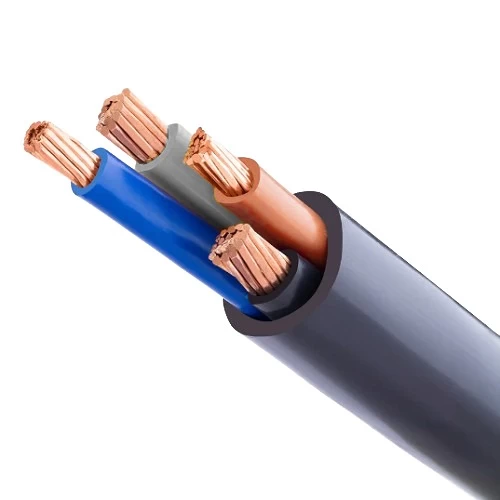
A 0.6/1 kV power cable is the standard low voltage power distribution cable defined by IEC 60502-1 — the international specification for extruded insulation power cables with rated voltages up to 30 kV. The designation U₀/U = 0.6/1 kV means:
- U₀ = 600 V: Maximum continuous phase-to-ground (earth) voltage
- U = 1 000 V: Maximum continuous phase-to-phase voltage
- Um = 1 200 V: Maximum voltage for which the equipment may be used (highest system voltage)
XLPE vs PVC Insulation — Which to Specify?
The choice of insulation material is the most consequential specification decision for a 0.6/1 kV power cable:
| Property | PVC (70°C) | XLPE (90°C) |
|---|---|---|
| Continuous conductor temperature | 70°C | 90°C |
| Short-circuit temperature | 160°C (max 5 s) | 250°C (max 5 s) |
| Current-carrying capacity at same cross-section | Reference (100%) | ~120–130% of PVC rating |
| Overload capability | 100°C short-term | 130°C short-term — more headroom for contingency loading |
| Dielectric strength | 15–20 kV/mm | 20–30 kV/mm |
| Water treeing resistance | Poor — PVC is susceptible | Good — XLPE is inherently more resistant to water treeing |
| Insulation resistance (20°C) | ≥36.8 MΩ·km | ≥1 000 MΩ·km (~27× higher) |
| Cable OD at same cross-section | Slightly larger | Slightly smaller (can use one standard lower insulation thickness) |
| Cost | 100% (reference) | 105–115% (cross-section ≤35 mm²); 100–105% (cross-section ≥50 mm²) |
XLPE is the dominant choice for new installations because the higher operating temperature provides more current-carrying capacity per square millimeter of copper — or allows a smaller conductor cross-section for the same load. The cost premium of XLPE insulation is modest (typically 0–15%) and is often recovered through conductor material savings at the next smaller standard cross-section.
PVC remains a valid choice where:
- The installed cost is the primary constraint and the ambient temperature is moderate
- The installation is indoors with no moisture exposure (PVC is susceptible to water treeing in wet conditions)
- The expected load is well within the 70°C rating with no anticipated overload
Copper vs Aluminum Conductor — Weight, Cost, and Terminations
| Parameter | Copper | Aluminum |
|---|---|---|
| Conductivity (IACS) | 100% | 61% |
| Cross-section for equivalent resistance | Reference (e.g., 50 mm²) | ~1.6× larger (e.g., 80 mm² → next standard 95 mm²) |
| Weight per km (50 mm² conductor) | ~450 kg | ~135 kg (70% lighter) |
| Cost per km (50 mm² eq.) | Higher material cost | Lower material cost — aluminum is ~3–4× cheaper per kg than copper |
| Jointing/termination | Standard compression or mechanical lugs | Bi-metallic lugs (Al-Cu) required at copper busbar connections; oxide inhibition compound required |
| Ampacity (50 mm² Cu / 95 mm² Al equiv.) | Approx. 180 A (XLPE, in air) | Approx. 180 A (XLPE, in air) — equivalent |
| Cable OD (50 mm² eq.) | Reference | Larger (due to larger conductor) — 15–20% larger OD |
| Suitable for | All applications; standard for cross-sections ≤185 mm² | Large feeders ≥185 mm²; long cable runs where weight matters; cost-sensitive projects |
Copper is standard for cross-sections up to 185 mm² in most commercial and industrial projects because the termination infrastructure (lugs, connectors, switchgear busbars) is simpler and more widely available. Aluminum becomes economically attractive at large cross-sections (≥185 mm²) and long cable runs — the weight saving (70%) reduces installation labor and support structure cost, and the material cost saving is significant.
Fixed Installation vs Flexible Cable — A Critical Distinction
A 0.6/1 kV power cable to IEC 60502-1 is designed for fixed installation — laid in a cable trench, pulled through a duct, clipped to a tray, and left stationary for its service life. It uses solid (Class 1) or stranded (Class 2) conductors. It is not suitable for:
- Drag chains or cable carriers: Class 2 stranded conductors will fatigue after thousands of flex cycles; use Class 5 or Class 6 flexible conductor cable
- Reeling drums: Fixed-installation power cable lacks a tensile core and compression-resistant construction; use a reeling-rated cable
- Frequent handling or repositioning: The armouring and sheath of a fixed-installation cable are not engineered for repeated bending; use a flexible power cable
Installation and Laying Guidelines
- Minimum bending radius: 15× cable OD for single-core, 12× for unarmoured multi-core, 15× for armoured multi-core. Exceeding the minimum bend radius during pulling can permanently deform the conductor and insulation
- Pulling tension: Maximum 50 N/mm² of total conductor cross-section for copper, 30 N/mm² for aluminum. Use a cable-pulling stocking on the outer sheath, not a pulling eye on the conductor, unless the conductor is specifically reinforced for pulling
- Installation temperature: PVC-sheathed cables should not be installed below 0°C without pre-heating — the PVC becomes brittle and can crack during bending. PE-sheathed cables can be installed down to -20°C
- Burial depth: Minimum 600 mm for direct burial in soil under pedestrian areas; 1 000 mm under roadways. Use cable tiles or warning tape 250 mm above the cable
- Cable segregation: Maintain minimum separation distances between power cables and communication/control cables per IEC 60364-5-52 to limit electromagnetic interference
Why Choose Yichi 0.6/1 kV Power Cables
- Full IEC 60502-1 compliance verified: Every production batch is tested for conductor resistance, insulation resistance, high-voltage withstand, and partial discharge (on request). Test certificates are traceable to the manufacturing batch number on every cable reel
- XLPE or PVC — your choice, not ours: We manufacture both insulation types across the full conductor range. Specify the performance you need — we do not push one material when the other would be a better fit
- Copper and aluminum in all standard and extended cross-sections: 1.5–630 mm² from a single manufacturer — consistent quality, single-source traceability
- Armouring options to match installation conditions: SWA for tensile strength and rodent protection in direct burial; STA for lighter mechanical protection in ducts and trays; unarmoured for above-ground cable management
- Custom core configurations: 3.5-core (reduced neutral), 5-core (3P+N+PE), split concentric, and specific core color coding to match your national wiring regulations — manufactured to order with fast lead times