Detailed Description
What Is a Submersible Pump Power Cable?
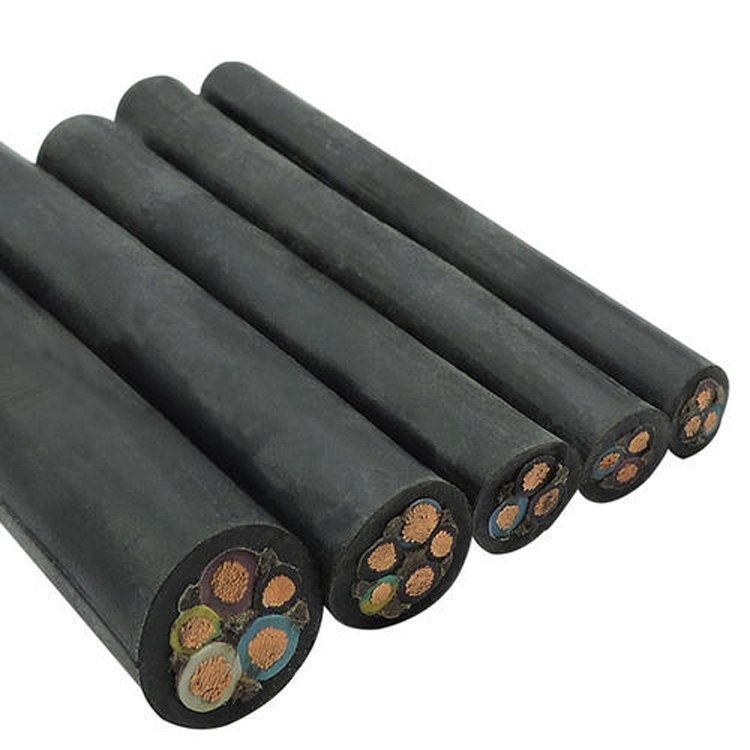
A submersible pump power cable is a heavy-duty electrical cable specifically designed to supply power to an electric motor that operates continuously submerged in water — typically at the bottom of a borehole, well, or sump tens or hundreds of metres below the surface. It is one of the most mechanically demanding cable applications: the cable hangs vertically under its own weight, is submerged in water for years, and must survive repeated installation and retrieval through a narrow well casing whose internal surface may be rough, scaled, or corroded.
The critical engineering requirements are:
- Electrical integrity under constant submersion — water must not enter the conductor, where capillary action would carry it directly to the pump motor winding and cause insulation failure. The conductor sealing at the insulation interface and the jacket integrity are fundamental
- Mechanical robustness — the cable jacket must withstand abrasion against the well casing during installation (when the pump and cable are lowered, often in a single operation) and during retrieval for maintenance or replacement, which may occur every 2–5 years
- Thermal endurance — the pump motor generates heat during operation, and the cable's insulation must not degrade at the elevated conductor temperature (90°C continuous for EPR insulation) over years of thermal cycling
- Voltage drop over long vertical runs — a 200-metre deep well with a 30 kW pump motor requires careful conductor sizing to keep the voltage drop at the motor within the permissible range (typically ≤3% for motors)
Flat vs Round Submersible Pump Cable — Choosing for the Borehole
| Cable Shape | Typical Application | Advantages | Limitations |
|---|---|---|---|
| Flat | Narrow boreholes (4–6 inch / 100–150 mm) | Smaller radial dimension in one axis — slides down the well alongside the riser pipe with minimal rubbing; self-aligning in the annular space between pipe and casing | Larger OD in the other axis — requires more careful coiling for transport; limited to smaller conductor sizes typically |
| Round | Large-diameter wells (>8 inch / 200 mm); open-water pump installations; sewage stations | Concentric construction is naturally robust; easier to coil and handle on larger drums; available in all conductor sizes up to 50 mm² | Larger minimum dimension in all directions — may not fit in narrow boreholes alongside the riser pipe |
The choice is largely determined by the well diameter. In a typical 6-inch (150 mm) water supply borehole, the submersible pump body (typically 4-inch / 100 mm diameter) occupies the centre of the casing, and the annular gap between the pump and the casing wall is only about 25 mm — half of which is taken by the riser pipe. A round cable of 15 mm OD would rub continuously during installation. A flat cable of 8 × 18 mm cross-section fits more easily in the remaining space and is the standard choice for narrow boreholes.
Conductor Sizing for Voltage Drop Over Long Vertical Runs
A submersible pump cable carries full motor current over the entire vertical distance from the surface to the pump. The voltage drop in the cable directly reduces the voltage available at the motor terminals.
| Motor Power (400 V, 3-Phase) | Full Load Current | Cable Length | Min. Conductor (3% Voltage Drop) | Min. Conductor (5% Voltage Drop) |
|---|---|---|---|---|
| 5.5 kW | ~12 A | 50 m | 2.5 mm² | 1.5 mm² |
| 5.5 kW | ~12 A | 150 m | 6 mm² | 4 mm² |
| 15 kW | ~30 A | 100 m | 10 mm² | 6 mm² |
| 30 kW | ~58 A | 100 m | 16 mm² | 10 mm² |
| 55 kW | ~105 A | 150 m | 35 mm² | 25 mm² |
| 90 kW | ~170 A | 200 m | 2× 25 mm² (parallel) | 50 mm² |
For deep-well pumps beyond 200 metres, voltage drop in the cable often becomes the dominant design constraint. The motor may be specified for 500 V or 690 V (rather than 400 V) to allow a smaller cable cross-section. Alternatively, a step-up transformer at the surface and a step-down transformer at the pump end can reduce the cable current — but this adds cost and complexity that usually favours a larger cable.
Application Analysis: Where Submersible Pump Cables Are Used
- Water supply boreholes: Municipal and agricultural water supply wells from 30 m to 500+ m depth — the pump cable is permanently submerged and must operate reliably for 5–10 years between pump replacements
- Sewage and wastewater lift stations: Submersible sewage pumps in wet wells and lift stations — the cable is exposed to aggressive water chemistry, hydrogen sulphide gas, and mechanical abuse during pump removal for blockage clearing
- Mine dewatering: Pumps in underground mine sumps and open-pit dewatering wells — the cable must resist abrasion from rock fragments and chemical attack from acidic mine water
- Groundwater remediation: Extraction wells at contaminated sites where the pump cable is exposed to solvents, hydrocarbons, and other groundwater contaminants
- Construction dewatering: Temporary submersible pumps on construction sites — the cable is handled roughly, run over by equipment, and frequently moved between locations
Why Choose Yichi for Submersible Pump Cables
- EPR insulation as standard for submersible duty: EPR (ethylene propylene rubber) at 90°C continuous rating is the proven insulation for submersible pump cables — it resists the thermal cycling, water absorption, and mechanical stress of deep-well duty better than PVC or XLPE at the same temperature class
- Water-tight conductor sealing verified on every production length: Longitudinal water tightness is tested to 1 bar water pressure (equivalent to 10 m water column) — each conductor is verified to prevent water propagation over more than 1 metre in 24 hours
- Flat cable geometry optimized for narrow boreholes: The flat submersible cable is designed with a low-profile cross-section that provides maximum clearance in the annular space between the pump/riser assembly and the well casing wall — verified by physical fit testing in standard well casing diameters
- Heavy-duty rubber jacket for installation and retrieval abuse: The PCP (neoprene) or CSP (Hypalon) jacket is formulated for abrasion resistance during repeated pump installation and retrieval — the operation that causes more cable failures than years of normal submerged service
- Factory-direct with conductor sizing support: We help calculate the voltage drop for your specific pump motor power, cable length, and starting current requirements — and manufacture the cable to the correct conductor cross-section, not a catalog approximation