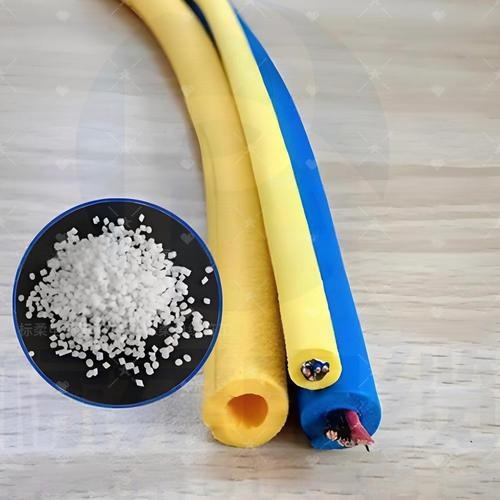
ROV Underwater Robot Tether Cable — Neutrally Buoyant High-Strength Electro-Optical Tether with Power, Signal, Fiber, and Kevlar Strength Member for Inspection and Work-Class ROVs
Underwater, Marine & ROV Cables /ROV Tethers

ROV Underwater Robot Tether Cable — Neutrally Buoyant High-Strength Electro-Optical Tether with Power, Signal, Fiber, and Kevlar Strength Member for Inspection and Work-Class ROVs

ROV tether cable: neutrally buoyant electro-optical tether with power, signal, fiber, Kevlar strength member. PUR jacket, 3000 m depth, 500-5000 kg. CE, RoHS.

Key Features

Neutrally buoyant design — foam PE/PP dielectric and carefully calculated jacket-to-core volume ratio produce a cable density matched to seawater (approximately 1.025 g/cm³); the cable neither sinks nor floats, eliminating the 'catenary drag' that wastes thruster power and reduces ROV maneuverability
Integrated electro-optical construction — power conductors (1.5–35 mm² for thruster DC bus), shielded twisted-pair signal groups (RS-485, Ethernet, CAN bus), and single-mode or multi-mode optical fibers (2–12 fibers) in a single tether cross-section
Kevlar/aramid or Vectran strength member — helically served as a torque-balanced layer under the jacket; breaking strength 500–5 000+ kg; provides the mechanical backbone for ROV recovery even under full-thrust entanglement scenarios
Water-blocked construction — longitudinal water blocking (swellable yarns and tapes under the jacket and between conductor layers) plus radial water blocking (solid conductor interstices filled with water-blocking compound); prevents water propagation along the cable if the jacket is damaged at depth
PUR TMPU outer jacket — seawater resistant, hydrolysis resistant, UV resistant; the standard jacket material for long-term marine immersion; 1.5–3.5 mm wall thickness depending on tether OD
Tinned copper conductors — corrosion resistance in the marine environment; IEC 60228 Class 5 or Class 6 stranding for flexibility on the deployment winch and through the TMS traction sheave
Deep-rated to 3 000 m water depth — tested under hydrostatic pressure per IEC 60092 for marine cables; fibre optic performance verified under pressure
CE, RoHS compliant; ISO 9001 manufactured with full electrical, optical, and mechanical test documentation per production length

Applications

Inspection-class ROV tether — main surface-to-ROV cable for electric inspection ROVs (200–1 000 m depth, 10–25 kW electrical power, HD video + sonar data on fiber)Work-class ROV tether — heavy tether for hydraulic and electric work-class ROVs (1 000–3 000 m, 50–150 kW electrical power + hydraulic supply through separate hose, multiple HD video channels)TMS (Tether Management System) flying tether — the lighter cable that pays out from the TMS cage to the free-flying ROV; typically smaller OD and lower breaking strength than the main lift umbilicalAUV (Autonomous Underwater Vehicle) recovery tether — lightweight tether for AUV launch and recovery operations; fiber for high-speed data download after mission completionUnderwater sensor and instrument deployment — tether cable for towed sonar arrays, magnetometers, sub-bottom profilers, and oceanographic instrument packagesOffshore oil & gas and renewable energy — ROV inspection and intervention on subsea wellheads, pipelines, wind turbine foundations, and tidal energy installations

Technical Specifications

Cable Type Electro-optical ROV tether with Kevlar strength member
Power Conductors Tinned copper, IEC 60228 Class 5 or Class 6; 1.5 mm² to 35 mm²; 2, 4, or 6 power conductors
Power Insulation PE or PP; foam-skin construction for buoyancy control; 90°C rated; 0.6/1 kV or 1.8/3 kV depending on ROV DC bus voltage
Signal Pairs Shielded twisted pairs (STP); 0.22–0.50 mm²; individually foil-shielded per pair; 2–12 pairs
Signal Insulation PE or PP (foam skin); low capacitance for Ethernet and serial data
Optical Fibers Single-mode (G.652D) or multi-mode (OM3/OM4); 2–12 fibers in gel-filled stainless steel loose tube(s)
Fiber Attenuation ≤0.35 dB/km at 1 310 nm (SM); ≤0.25 dB/km at 1 550 nm (SM)
Strength Member Kevlar 49 aramid or Vectran; helically served torque-balanced layer; breaking strength per customer specification
Breaking Strength 500–5 000 kg (per specification); higher on request for heavy work-class ROVs
Water Blocking Longitudinal: swellable yarns and tapes; Radial: water-blocking compound filling interstices
Inner Sheath TPE or PU; extruded over cabled core assembly
Outer Jacket PUR TMPU (polyether-based polyurethane); seawater and hydrolysis resistant; 1.5–3.5 mm wall
Jacket Color Yellow (standard, for underwater visibility); black, orange on request
Buoyancy in Seawater Neutrally buoyant — density matched to 1.025 ±0.02 g/cm³; verified by immersion test
Cable OD 8–25 mm depending on power cross-section, fiber count, and breaking strength
Weight in Air 60–500 g/m depending on construction
Depth Rating Up to 3 000 m; hydrostatic pressure tested per IEC 60092-350
Operating Temperature (Seawater) -5°C to +40°C
Storage Temperature -40°C to +60°C
Minimum Bend Radius (Dynamic) 10× cable OD (over sheave)
Minimum Bend Radius (Static) 8× cable OD (storage drum)
Minimum Sheave Diameter 20× cable OD (recommended for deployment winch and traction sheave)
Tensile Load (Operating) ≤50% of breaking strength with fibre strain <0.2% for optical continuity
Torsion Resistance Torque-balanced construction; ≤2° per metre under rated tensile load
Abrasion Resistance PUR jacket per ISO 4649; ≤80 mm³ abrasion loss
Hydrolysis Resistance PUR jacket per ISO 15702; ≥28 days at 80°C in water without significant degradation
Flame Retardant Limited (marine application); IEC 60332-1-2 on request
Certifications CE, RoHS; DNV or ABS type approval available on request for marine classification

Detailed Description

What Is an ROV Underwater Robot Tether Cable?

An ROV tether is the physical and data link between the surface control station and the remotely operated vehicle working at depth — often hundreds or thousands of metres below. It is simultaneously a power transmission line (carrying kilowatts to tens of kilowatts for thrusters, lights, and manipulators), a data highway (carrying multi-channel HD video, sonar imagery, and telemetry on optical fibre), and a mechanical lifeline (providing the tensile strength to recover a disabled vehicle from depth).

A tether is not a cable that can be specified from a catalog. Every ROV has a different combination of:

  • Electrical power demand — an inspection ROV may need 10 kW at 300 V DC; a work-class ROV may need 100 kW at 3 000 V AC. The power conductor cross-section and voltage rating are matched to the specific ROV
  • Data bandwidth — from a single composite video channel on a small inspection ROV to four simultaneous 1080p HD video feeds, multi-beam sonar data, and manipulator feedback on a work-class vehicle. Fibre count and type are determined by the data architecture
  • Mechanical duty — the winch and traction sheave impose repeated bending and tension cycles. The tether must survive deployment through a moon pool or over an A-frame in sea states that can generate snatch loads several times the steady-state tension
The Yichi ROV tether is built to the specific electrical, optical, and mechanical specification of the ROV it serves. The neutrally buoyant design is not an option — it is a fundamental requirement for effective underwater vehicle operation.

Neutrally Buoyant Design — The Engineering Challenge

In air, a cable's weight is a straightforward mechanical load. In water, the buoyancy force — equal to the weight of water displaced — counteracts some or all of the cable's weight. A cable that is neutrally buoyant in seawater displaces exactly its own weight, so it neither sinks nor rises.

Achieving neutral buoyancy in a multi-element tether — which contains dense copper conductors and Kevlar fibres alongside low-density foam PE insulation and hollow optical fibre tubes — requires careful materials selection and cross-section design:

  • Foam-skin PE or PP insulation on power conductors and signal pairs — the foam core reduces the average density of the dielectric, and the solid skin provides mechanical protection and dielectric integrity
  • Balanced cross-section — the total volume of each material (copper, PE, Kevlar, PUR, gel, hollow tube) is calculated to produce a cable with an overall density of approximately 1.025 g/cm³ — the density of standard seawater at 20°C and 3.5% salinity
  • Immersion verification — a sample of each production length is immersed in a calibrated brine tank and its buoyancy (positive, negative, or neutral) is measured and recorded
A non-neutrally-buoyant tether forms a catenary curve between the surface and the ROV — sagging if negatively buoyant, floating upward if positively buoyant. The ROV's thrusters must work against this catenary tension just to maintain position, wasting power and reducing station-keeping accuracy. In strong currents, the catenary increases the tether's drag cross-section, pulling the ROV off station. A neutrally buoyant tether eliminates both effects.

Tether Construction — Layer by Layer

Layer (from Centre)MaterialFunction
Power conductorsTinned copper, Class 5/6DC or AC power transmission to ROV thrusters, lights, and hydraulic power unit
Power insulationPE/PP foam-skinElectrical insulation (0.6/1 kV or 1.8/3 kV) + buoyancy control
Signal pairsShielded twisted pairs (STP)RS-485, CAN bus, Ethernet (via DSL extender or media converter) for ROV control and telemetry
Optical fibresSM or MM in gel-filled stainless steel loose tubeHD video, sonar data, gigabit Ethernet — the primary data path on modern ROVs
Core assembly beddingNon-hygroscopic filler yarnsFill the interstices for a round, stable core; swellable yarns for longitudinal water blocking
Water-blocking compoundPetroleum-based or synthetic compoundFills remaining voids in the core assembly for radial water blocking
Inner sheathTPE or PUBinds the core assembly and provides a bedding layer for the strength member
Strength memberKevlar 49 aramid or Vectran, helically servedProvides the tensile backbone; torque-balanced lay prevents cable rotation under load
Outer jacketPUR TMPUSeawater, hydrolysis, UV, and abrasion resistance; the primary environmental barrier

Each layer contributes to one or more of the tether's three functions — power transmission, data transmission, mechanical strength — and the neutrally buoyant density is the result of the interaction of all layers.

Optical Fibre in the Tether — Why It Matters

Until the early 2000s, most ROV tethers carried video as a composite analog signal on a coaxial element in the tether — adequate for a single standard-definition camera. Modern ROVs demand much higher bandwidth:

  • HD video — a single 1080p30 video stream over Gigabit Ethernet requires approximately 100 Mbps. Four simultaneous camera feeds push 400 Mbps, which is well within the capability of a single single-mode fibre pair but strains copper-based transmission (coaxial or twisted-pair Ethernet extenders) over kilometre-length tethers
  • Sonar data — a multi-beam imaging sonar can generate 50–100 Mbps of raw data. Transmitting this over copper requires complex data compression at the ROV end, adding latency and processing power
  • Future-proofing — optical fibre's bandwidth scales with the transceivers at each end, not the cable. A tether with 4 single-mode fibres can carry 10 Gbps, 40 Gbps, or 100 Gbps per fibre pair by upgrading the SFP modules at the surface and ROV — without pulling a new tether
The Yichi ROV tether integrates single-mode (G.652D) or multi-mode (OM3/OM4) fibres in gel-filled stainless steel loose tubes. The gel prevents water ingress at the fibre, and the stainless steel tube — typically 1.5–2.5 mm OD — provides crush resistance during handling and deployment.

Application Analysis: Where ROV Tether Cables Are Used

  • Offshore oil & gas inspection: Inspection-class ROVs deployed from platforms and support vessels to inspect subsea wellheads, flowlines, risers, and jacket structures at depths of 50–3 000 metres
  • Hydroelectric dam and penstock inspection: ROVs navigating inside dam intake structures, penstocks, and tailrace tunnels — where the tether must be neutrally buoyant in fresh water (density 1.000 g/cm³, requiring a different buoyancy specification than seawater)
  • Ship hull and port infrastructure inspection: Hull inspection ROVs operating in harbours and ports for security, anti-smuggling, and maintenance surveys — the tether must resist fouling in debris-laden water
  • Scientific oceanographic research: Deep-sea research ROVs deployed from oceanographic vessels for benthic surveys, hydrothermal vent exploration, and biological sampling at depths exceeding 3 000 metres
  • Search and recovery: ROVs deployed for underwater search, evidence recovery, and salvage operations by law enforcement, Coast Guard, and commercial salvage teams
  • Offshore renewable energy: Wind turbine foundation inspection, inter-array cable survey, and tidal turbine inspection — the fastest-growing ROV application sector

Why Choose Yichi for ROV Tether Cables

  • Built to your ROV specification, not adapted from a catalog: Power cross-section, fibre count, breaking strength, and buoyancy are specified to the electrical, optical, and mechanical requirements of your vehicle — Yichi manufactures the tether that your ROV needs
  • Neutrally buoyant as a design requirement, verified by immersion test: The cross-section is calculated for neutral buoyancy during the design phase, and each production length is verified in a calibrated brine tank — not estimated from material densities on a datasheet
  • Kevlar or Vectran strength member with torque-balanced lay: The strength member is helically served in opposing directions (two contra-helical layers) to produce a torque-balanced cable that does not rotate under tensile load — essential for ROV station-keeping where cable torque would rotate the vehicle
  • Integrated water blocking — longitudinal and radial: Swellable tapes and yarns for longitudinal blocking, water-blocking compound for radial blocking — if the jacket is damaged at depth, water propagation along the cable is limited to less than 1 metre in 24 hours per IEC 60092-350
  • Full documentation with every tether: Electrical conductor resistance and insulation resistance per core, OTDR trace and insertion loss per fibre, breaking strength test on a sample from the production length, buoyancy certificate — the full test package required for offshore and marine classification

Frequently Asked Questions

How is neutral buoyancy achieved without adding a flotation layer?

The dielectric uses foam PE or PP construction, and the jacket-to-core volume ratio is calculated so the finished cable density matches seawater at 1.025 ±0.02 g/cm³. Every production length is verified by immersion test rather than by calculation alone.

What strength member options are available, and how strong are they?

Kevlar 49 aramid or Vectran, served helically as a torque-balanced layer under the jacket, with breaking strength from 500 kg to 5 000 kg depending on specification. Higher ratings are available for heavy work-class ROVs.

How does the cable handle water ingress after repeated deployment?

It is water blocked both longitudinally, with swellable yarns and tapes under the jacket and between conductor layers, and radially, with water-blocking compound filling the interstices. The 1.5–3.5 mm PUR TMPU jacket resists seawater and hydrolysis.

What depth and minimum sheave diameter should I plan for?

The cable is rated to 3 000 m and hydrostatic pressure tested per IEC 60092-350. Dynamic bend radius is 10 × cable outer diameter over a sheave and 8 × static, with a recommended minimum sheave diameter of 20 × cable OD.

Product Inquiry

Product: ROV Underwater Robot Tether Cable — Neutrally Buoyant High-Strength Electro-Optical Tether with Power, Signal, Fiber, and Kevlar Strength Member for Inspection and Work-Class ROVs

Add technical specifications (optional)

The more detail you provide, the faster and more accurate our quotation.

No file chosen

PDF, Office, image or CAD file — up to 5 MB

Need Help?

Certifications

ISO 9001
Quality
CE
European
RoHS
Environmental
TÜV
Certification

Need a Quote for This Product?

Send us your requirements and receive a detailed quotation within 24 hours.