Detailed Description
What Is an ROV Umbilical Cable?
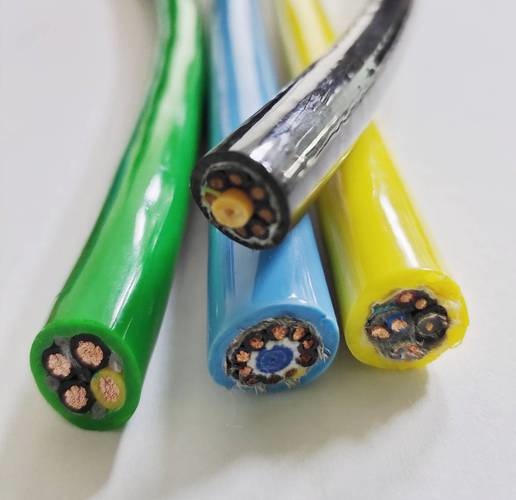
An ROV umbilical cable is a neutrally buoyant, multi-function cable that provides the power, signal, and data connection between two underwater nodes — typically the Tether Management System (TMS) cage and the free-flying ROV, or a subsea junction box and an instrument. It is the lighter, more flexible counterpart to the main ROV tether (which connects the surface to the TMS or the ROV directly).
The umbilical's design priorities differ from the main tether:
- Lower breaking strength — the flying tether between the TMS and ROV only needs to support the ROV's submerged weight (which is close to zero when neutrally buoyant) plus dynamic recovery loads, rather than the full catenary weight of the main tether in the water column
- Smaller OD and higher flexibility — the flying tether pays out and retracts continuously as the ROV moves around the work site. Flexibility and low bending stiffness reduce the force the ROV's thrusters must overcome to drag the tether
- Shorter length — a flying tether is typically 150–300 m, not the 1 000–3 000 m of the main tether. The shorter length relaxes the voltage drop constraint on the power conductors, allowing smaller cross-sections
ROV Umbilical vs ROV Tether — When to Use Each
| Parameter | ROV Tether (Surface-to-ROV) | ROV Umbilical (TMS-to-ROV) |
|---|---|---|
| Connection | Surface control station to ROV (or to TMS) | TMS cage to free-flying ROV; or subsea junction box to instrument |
| Length | 500–3 000+ m | 150–300 m (flying tether); shorter for instrument umbilicals |
| Power cross-section | 1.5–35 mm² (10–150 kW) | 0.75–6 mm² (2–8 kW) |
| Breaking strength | 500–5 000+ kg | 200–1 000 kg |
| Cable OD | 10–25 mm | 6–15 mm |
| Fibre count | 2–12 fibres standard | 0–4 fibres (optional on smaller inspection ROVs) |
| Flexibility requirement | Moderate — low-cycle deployment/retrieval | High — continuous payout/retraction during ROV operations |
| Buoyancy | Neutrally buoyant (mandatory) | Neutrally buoyant (mandatory) |
| Drag in water | Important — catenary drag on long cable | Critical — low drag directly affects ROV station-keeping and power consumption |
In single-body ROV systems (no TMS), the "tether" serves both functions — it is the only cable from surface to vehicle. In that case, the tether specification must cover both the long-length and flexibility requirements. The Yichi ROV umbilical is designed for the lighter end of that spectrum — where drag, flexibility, and compactness are the top priorities.
Flying Tether Dynamics — Why Flexibility Matters
When an ROV moves on its flying tether, the cable follows. Every metre of cable that the ROV drags through the water consumes thruster power. The drag force depends on:
- Cable OD — drag is proportional to diameter (not cross-sectional area, because the flow separates around a cylinder at typical ROV speeds)
- Cable stiffness — a stiff cable resists bending around the ROV's motion path, creating additional tension at the vehicle
- Tether shape — a neutrally buoyant tether assumes a nearly straight line between the TMS and the ROV (minimal catenary), minimizing total cable length in the water
Application Analysis: Where ROV Umbilical Cables Are Used
- TMS-to-ROV flying tethers: The neutrally buoyant cable between the TMS cage (parked at working depth) and the inspection ROV — the most demanding umbilical application in terms of flexibility, drag, and repeated bending cycles
- Subsea observatory instrument connections: A neutrally buoyant umbilical from a subsea junction box to a remotely operated instrument — seismometer, hydrophone, ADCP (Acoustic Doppler Current Profiler), or water quality monitoring package — deployed for months or years without retrieval
- ROV tooling umbilical: A dedicated power + signal cable from the ROV to a specific tool — manipulator jaw, cleaning brush, torque tool — that is separate from the main tether for operational flexibility
- Underwater camera and light deployment: A lightweight umbilical paying out from a deployment winch to a towed or lowered camera/light frame for visual inspection of pipelines, intake structures, and quay walls
- Scientific instrument moorings: An electro-mechanical umbilical integrating power conductors and data pairs on a single mooring cable — supplying instruments at multiple depths from a surface buoy
Why Choose Yichi for ROV Umbilical Cables
- Lower drag through smaller OD and neutrally buoyant design: Yichi umbilicals are sized for the actual power and data requirement of the ROV — no oversizing that increases drag and wastes thruster power. The neutrally buoyant density is calculated and verified per production length
- Torque-balanced Kevlar lay matched to your vehicle weight: The strength member is specified for the ROV's submerged weight plus recovery margin — not the 5 000 kg of the main tether. A correctly sized strength member saves OD and weight
- Seamless optical fibre integration: Even on a 6 mm OD umbilical, a single fibre in a 1.5 mm stainless steel loose tube can be integrated without compromising the cable's flexibility or buoyancy — providing HD video and gigabit Ethernet on the flying tether
- PUR jacket tested for hydrolysis and seawater immersion: The polyether-based PUR in Yichi umbilicals is formulated for long-term seawater contact — tested per ISO 15702 for hydrolysis resistance and per ISO 4649 for abrasion against the TMS sheave
- Factory-direct umbilical manufacturing with full test documentation: Conductor resistance, insulation resistance, OTDR fibre trace, breaking strength sample, and buoyancy certificate — the same test package as the main tether, scaled to the umbilical's specification