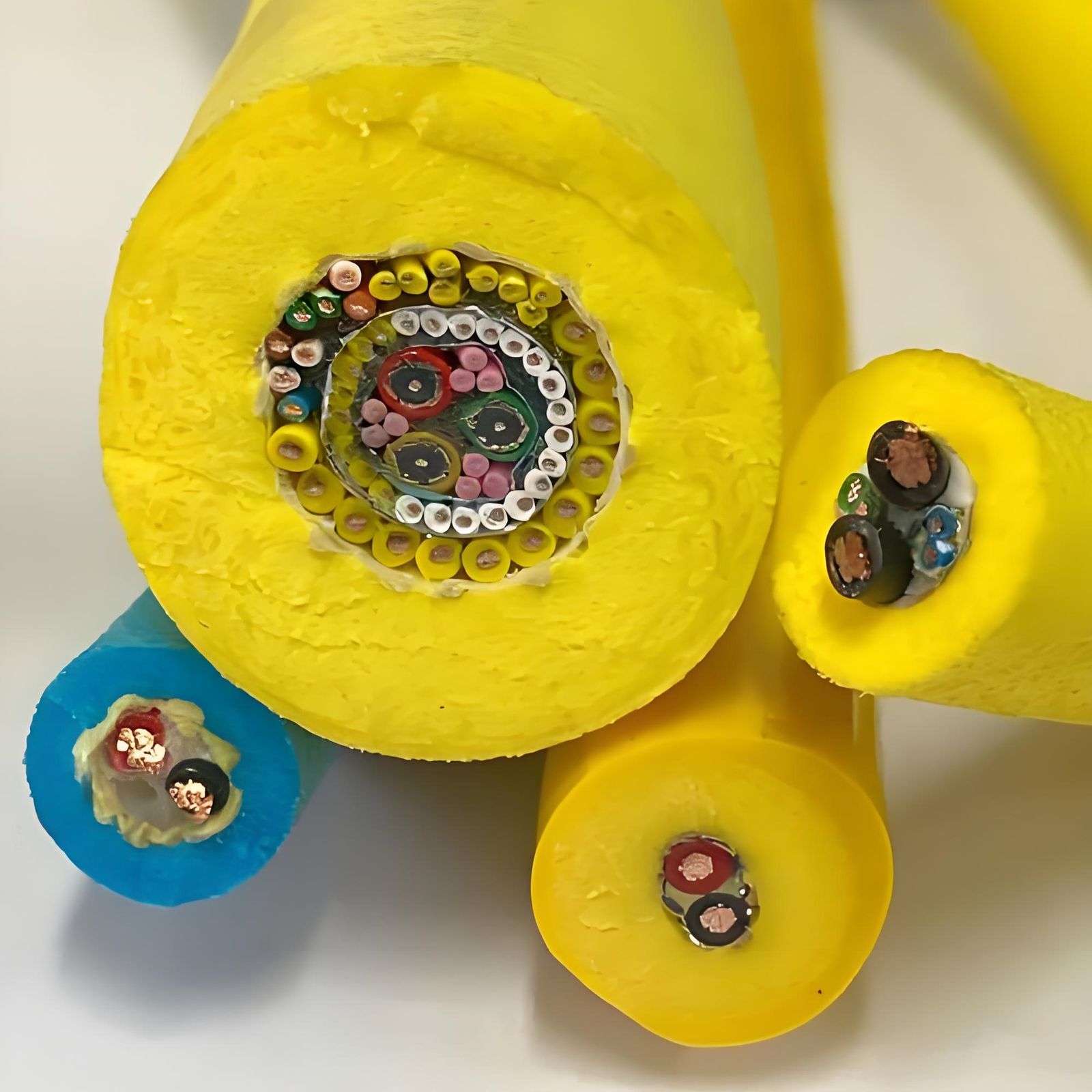
Detailed Description
What Is a Neutrally Buoyant (Zero Buoyancy) Cable?
A neutrally buoyant cable is an underwater electrical cable whose overall density is engineered to match that of the surrounding seawater — approximately 1.025 g/cm³ at standard temperature and salinity. When deployed in water, the cable displaces exactly its own weight. It neither sinks to the bottom nor floats to the surface. It stays where it is placed.
This property — which sounds simple — is the most important single characteristic of a cable that operates underwater for any length of time. A negatively buoyant cable (denser than seawater) sags, creating a catenary arc that drags on the seabed, snags on obstacles, and applies a downward force at every attachment point. A positively buoyant cable (less dense than seawater) floats upward, creating a reverse catenary that pulls instruments off their mounting points and tangles in surface equipment.
The neutral buoyancy is achieved not by adding external floats (which increase drag and cost) but by engineering the cable's internal materials and geometry:
- Foam-skin PE insulation on each conductor — the foam core reduces the insulation's average density from 0.92 g/cm³ (solid PE) to approximately 0.65–0.75 g/cm³, while the thin solid skin preserves dielectric strength and mechanical protection
- Calculated cross-section — the volume of each material in the cable (copper at 8.9 g/cm³, PE foam at 0.7 g/cm³, Kevlar at 1.44 g/cm³, PUR at 1.15 g/cm³, water-blocking compound at 0.95 g/cm³) is calculated so the total volume-weighted density equals 1.025 g/cm³
- Immersion verification — a sample from each production length is immersed in a calibrated brine tank at the target density, and the cable's buoyancy (whether it floats, sinks, or remains suspended) is measured and recorded
How Foam-Skin Insulation Achieves Neutral Buoyancy
Conventional underwater cables use solid PE insulation. PE is one of the lightest practical dielectrics (density 0.92 g/cm³), but the copper conductor it surrounds has a density of 8.9 g/cm³ — nearly nine times denser. Even with solid PE, a copper conductor assembly is much denser than seawater.
Foam-skin PE addresses this by replacing roughly 20–30% of the solid PE volume with gas-filled micro-cells:
| Insulation Type | Density | Effective Density of a 1.5 mm² Conductor + Insulation | Buoyancy of Cable Core |
|---|---|---|---|
| Solid PVC | 1.38 g/cm³ | ~3.2 g/cm³ | Significantly negatively buoyant |
| Solid PE | 0.92 g/cm³ | ~2.1 g/cm³ | Negatively buoyant |
| Foam-skin PE (30% foam) | 0.70 g/cm³ | ~1.4 g/cm³ | Slightly negatively buoyant — compensated by jacket and filler materials |
| Foam-skin PE (40% foam) | 0.60 g/cm³ | ~1.1 g/cm³ | Near neutral — fine-tuning at the full cable level |
The foam-skin construction is the key: a continuous solid skin (0.05–0.10 mm thick) on the outside of each insulated conductor maintains the electrical integrity and mechanical robustness of a solid dielectric, while the foam core provides the density reduction. Without the skin, the foam surface would be porous and mechanically weak, susceptible to moisture absorption and dielectric failure.
Buoyancy Engineering — Matching the Cable to the Application
| Application | Water Density (g/cm³) | Cable Density Target | Notes |
|---|---|---|---|
| Standard seawater (35 ppt salinity, 20°C) | 1.025 | 1.025 ±0.02 | The default specification for ocean and coastal applications |
| Brackish water (estuaries, 15 ppt) | 1.012 | 1.012 ±0.02 | Lower density than seawater — cable specified for standard seawater will be slightly negatively buoyant in brackish water |
| Fresh water (lakes, rivers, 0 ppt) | 0.998 | 0.998 ±0.02 | Significantly lower density — a seawater-buoyant cable will sink in fresh water. A separate buoyancy specification is required |
| Deep ocean (high pressure, 4°C) | 1.028 | 1.028 ±0.02 | Slightly higher density due to compression and lower temperature; cable foam cells compress slightly at depth, increasing the effective density |
For most applications in seawater, the 1.025 g/cm³ specification is correct. For fresh water — dam inspection, lake research, river monitoring — the buoyancy must be re-specified. Yichi manufactures neutrally buoyant cables for all three water density regimes, verified by immersion test in a brine tank calibrated to the target density.
Application Analysis: Where Neutrally Buoyant Cables Are Used
- Oceanographic sensor profiling: A CTD rosette carrying multiple water sampling bottles and sensors is lowered from a research vessel on a neutrally buoyant cable. The zero-buoyancy cable does not add weight to the rosette (which would require more winch tension) or create a loop that could tangle with the rosette frame
- Permanent subsea observatories: Cabled seafloor observatories — such as NEPTUNE (Canada) and DONET (Japan) — use neutrally buoyant cables to connect junction boxes to instruments spread across kilometres of seafloor. The cable lies flat on the seabed without floating loops that could be snagged by fishing gear
- Aquaculture monitoring: Fish farm pens deploy underwater cameras, dissolved oxygen sensors, and current meters on neutrally buoyant cables that stay in position without pulling on the sensor mounting brackets or floating into the fish net
- Underwater archaeology and marine biology: Divers and ROVs working on wreck sites and coral reef surveys use neutrally buoyant lighting and camera cables that do not disturb sediment or damage fragile organisms through cable drag
- Towed sensor arrays: Side-scan sonar and magnetometer towfish are deployed on neutrally buoyant cables that maintain a constant depth behind the survey vessel — a negatively buoyant cable would pull the towfish deeper, a positively buoyant one would pull it toward the surface
- Tidal and wave energy monitoring: Instruments deployed on tidal turbine foundations and wave energy converter moorings — where the cable must remain stationary in strong, reversing currents without adding drag or creating entanglement hazards
Why Choose Yichi for Neutrally Buoyant Cables
- Buoyancy engineered, not estimated: The cable cross-section is calculated for neutral buoyancy at the design stage using the actual material densities of the production batch — not generic handbook values. Each production length is verified by immersion test in a brine tank calibrated to the specified water density
- Foam-skin PE insulation manufactured in-house: The foam extrusion process that creates the density-reduced dielectric is controlled at Yichi's manufacturing line. Foam percentage (typically 20–40%) is chosen to balance buoyancy, dielectric strength, and mechanical integrity for the specific cable design
- Three water density regimes — you specify the operating environment: Standard seawater (1.025 g/cm³), brackish water (1.012–1.020 g/cm³), or fresh water (0.998 g/cm³) — Yichi manufactures to the buoyancy specification of your operating environment, not just the default seawater density
- Optional Kevlar strength member without compromising buoyancy: If your application requires tensile strength (deployment over a sheave, towing, suspended instruments), a Kevlar layer is integrated into the cable cross-section with its density contribution accounted for in the buoyancy calculation — the finished cable remains neutrally buoyant
- Full buoyancy certification with every production length: A buoyancy certificate recording the test brine density, the measured buoyancy of the cable sample (positive/negative/neutral), and the test date — documentation that your underwater installation team can rely on before deployment