Detailed Description
Why Servo Feedback Cables Need High Tensile Strength
Standard servo feedback cables are engineered for bending, not pulling. In a horizontal drag chain, the dominant mechanical stress is repeated flexing, and the cable's own weight is supported by the chain. But in several real-world installations, the cable must also carry axial tension:
- Vertical drag chains: The cable hangs vertically and supports its own weight — a 50 m vertical run of a typical 10 mm OD servo cable weighs roughly 35–45 N, plus the acceleration force during carriage motion
- Steeply inclined cable carriers: On inclined gantry or lift systems, the cable's weight component along the travel direction adds continuous axial load on every cycle
- Suspended loops: Where cables trail behind moving machines without full chain support, the signal cores are pulled by the cable's own weight
- Robotic axes: Suspended sections of robot cabling experience both bending and hanging tension
How Aramid Reinforcement Works
Para-aramid yarn — the same family of fibres used in ballistic and lifting applications — has a specific strength roughly five times that of steel wire. In a high tensile servo cable:
| Construction Feature | Standard Servo Cable | PUR High Tensile Servo Cable |
|---|---|---|
| Strength member | None (copper carries all load) | Aramid yarn bundle in core center + aramid fillers |
| Axial breaking force | Copper + jacket only (100–600 N typical) | 500–2 000 N typical (2–3× standard) |
| Weight penalty | — | +2–5% cable weight |
| OD increase | — | +0.5–1.5 mm |
| Flex life impact | — | Minimal — aramid yarn bends as well as copper |
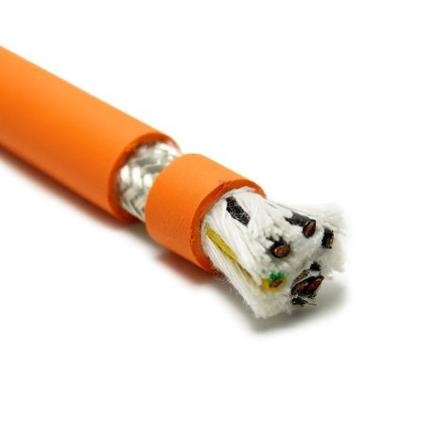
The aramid bundle is laid in the core center during stranding, so it follows the same neutral bending axis as the conductors. Filler elements between pairs are aramid-reinforced, distributing tension evenly across the cross-section. The result: the cable can be pulled, suspended, or dropped vertically without the signal conductors taking the strain.
High Tensile Servo Cable vs Standard Servo Cable — Selection Guide
| Requirement | Choose Standard Servo Cable | Choose PUR High Tensile Servo Cable |
|---|---|---|
| Horizontal drag chain | ✓ | ✓ |
| Vertical drop > 10 m | ✗ (risk of core strain) | ✓ |
| Inclined carrier > 30° | ✗ | ✓ |
| Suspended robot cabling | ✗ | ✓ |
| Maximum flex life at 10× D/d | ✓ (10M+ cycles) | ✓ (10M+ cycles) |
| Minimal cable OD | ✓ | ✗ (+0.5–1.5 mm) |
Application Analysis: Where High Tensile Servo Cables Are Specified
- Automated storage and retrieval systems (AS/RS): Stacker crane servo drives move vertically at accelerations up to 2–5 m/s². The feedback cable travels in a vertical chain and must survive both the flexing and the repeated axial loading of the carriage
- CNC gantry machining centers: Long Y-axis and Z-axis travels put servo feedback cables on steep inclines. Aramid reinforcement prevents strand fatigue in the encoder pairs over years of high-cycle operation
- Elevator and lift systems: Encoder feedback on elevator motors and door operators sees continuous tension plus flexing. Reinforced construction extends service life versus standard cable
- Robotic production cells: Suspended sections of robot cabling — where the cable hangs from the arm to a fixed junction — are the classic application for aramid-reinforced servo cable
- Large-format printing: Machines with long web travels and tensioned cable loops place sustained axial load on feedback cabling
- Wind and solar tracking systems: Servo-driven trackers with vertical cable loops in outdoor, cold environments benefit from PUR cold-flex plus tensile reinforcement
Why Choose Yichi High Tensile Servo Cables
- Tensile-tested production batches: Every production batch is sample-tested for breaking force — the tensile rating on the data sheet is a measured value, not an estimate
- Integrated aramid construction: Strength members are laid in during stranding, not wrapped on as an afterthought — uniform tension distribution and no OD-bulging
- Verified signal performance: Capacitance (≤60 pF/m core-to-core), insulation resistance, and shield coverage ≥85% are tested on every length, matching the electrical quality of our standard servo feedback cables
- Full flex endurance testing: 10+ million cycle drag chain testing in our laboratory validates both bending and combined bending-plus-tension scenarios
- Custom engineering: Specify aramid bundle size, tensile rating, jacket color, connector scheme, or drive-brand-specific pair allocation — we manufacture to your drawing