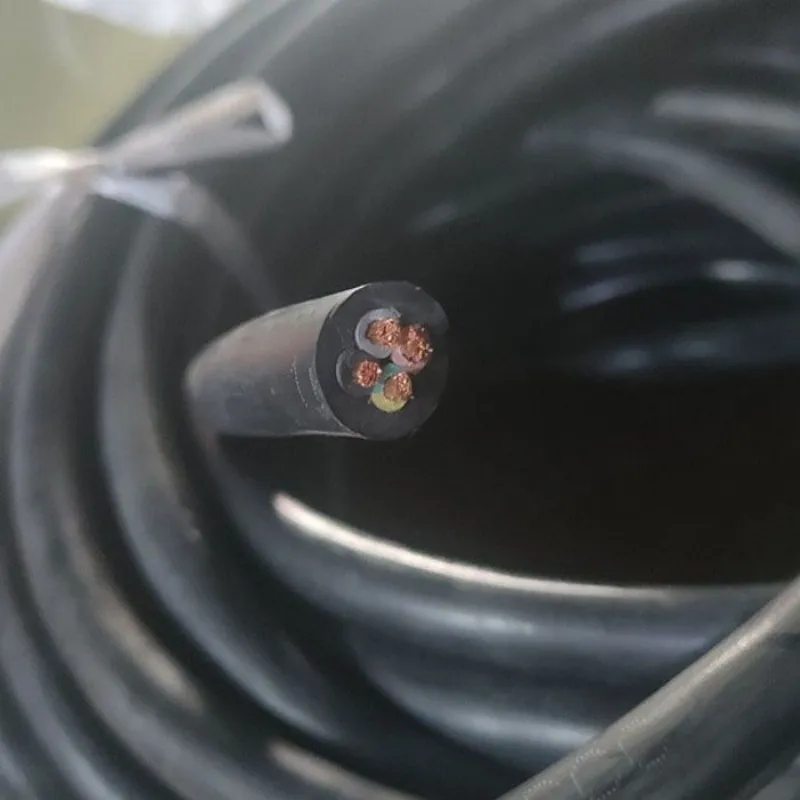
Detailed Description
What Is a JHS Waterproof Rubber Sheathed Cable?
JHS is a Chinese cable type designation for a heavy-duty flexible rubber-insulated, rubber-sheathed waterproof cable. The name encodes the cable's construction:
| Letter | Chinese | Meaning | Engineering Significance |
|---|---|---|---|
| J | 橡皮绝缘 (xiang-pi jue-yuan) | Rubber insulation | Natural rubber, SBR, or EPR insulation — flexible, mechanically tough, and water-resistant |
| H | 橡套 (xiang tao) | Rubber sheath | Heavy-duty rubber outer jacket — the mechanical protection for mining and construction environments |
| S | 防水 (fang-shui) | Waterproof | Compacted core with rubber-filled interstices and seamless sheath — water-tight for wet environment operation |
JHS is the cable of choice in underground mining, tunneling, and heavy construction where three environmental factors coincide: water (flooding, seepage, spray), mechanical abuse (dragging over rock, run over by machinery, sharp edges), and the need for flexibility (frequently moving portable equipment). No thermoplastic cable — PVC, even with a nylon over-sheath — can match the combination of flexibility, impact resistance, and water resistance that a heavy-duty rubber cable provides.
JHS vs Other Submersible and Waterproof Cables
| Cable Type | Insulation | Sheath | Voltage Class | Best Application |
|---|---|---|---|---|
| JHS (Rubber Waterproof) | Natural rubber, SBR, or EPR | PCP (neoprene) or CSP (Hypalon) | 450/750 V | Mining, tunneling, quarrying, heavy construction — wet + mechanical abuse |
| Submersible Pump Power Cable | EPR (90°C) | PCP/CSP or PUR | 0.6/1 kV | Deep-well and borehole pump power — continuous submersion, vertical hang |
| Waterproof Submersible Cable | PVC or EPR | Rubber or PUR | 450/750 V | Pool, fountain, water feature lighting and pumps — clean water, low mechanical stress |
| Marine / Shipboard Cable | EPR or XLPE | CSP or SHF2 (LSZH) | 0.6/1 kV | Vessel and offshore platform — fire performance, oil resistance, low smoke |
JHS occupies the heavy industrial end of the waterproof cable spectrum. If the cable will be dragged through a wet tunnel, run over by a loader, submerged in muddy water, and expected to keep delivering power — JHS is the cable type for that environment. If the cable will be permanently installed underwater in a swimming pool or fountain with clean water and no mechanical abuse, the waterproof submersible cable is a more cost-effective specification.
Rubber Insulation vs PVC — Why Rubber for Harsh Wet Environments
| Property | Natural Rubber / SBR (JHS) | PVC (Standard Submersible) | Why It Matters |
|---|---|---|---|
| Flexibility at -25°C | Excellent — rubber remains flexible | Poor — PVC stiffens significantly below -5°C | Mining and construction sites in winter; cable handling without sheath cracking |
| Tear resistance | High — rubber stretches rather than tearing | Low — PVC tears from notches and cuts | Cable dragged over sharp rock fragments; cable run over by equipment wheels |
| Impact resistance | High — rubber absorbs impact energy | Low — PVC transmits impact to inner layers | Falling rock in tunnel and mine environments; dropped tools on the cable |
| Water absorption (insulation) | Low — rubber is naturally hydrophobic | Moderate — PVC absorbs some water over time | Continuous submersion in water and mud |
| Abrasion resistance | Good (rubber compound with carbon black) | Moderate (PVC compound with filler) | Cable dragged along rough tunnel walls and over rocky ground |
| Cost | Higher — rubber compound and processing cost | Lower — PVC compound and extrusion cost | JHS is specified where PVC has failed or is known to be inadequate |
The cost premium for rubber is justified by the environment. In an underground mine, a cable failure is not an inconvenience — it stops production. The submersible pump that keeps the working face dry stops. The ventilation fan stops. The loader stops. A JHS cable that survives where a PVC cable would have failed pays for its premium many times over in avoided downtime.
Application Analysis: Where JHS Cables Are Used
- Underground coal and metal mining: Submersible face pumps, auxiliary ventilation fans, continuous miner trailing cables, and shuttle car power — the cable is dragged through water and mud, run over by trackless equipment, and exposed to falling rock
- Tunnel construction (TBM and drill-and-blast): Dewatering pumps, ventilation fans, shotcrete machine power, and temporary lighting in water-bearing tunnels where the cable operates in continuous spray and occasional full submersion
- Quarry dewatering: Submersible pumps in quarry sumps and settling ponds — the cable is handled roughly during pump deployment and retrieval, exposed to abrasive rock slurry, and frequently moved between sumps
- Cofferdam and bridge pier construction: Temporary dewatering pumps, welding equipment power, and construction tool power on bridge pier and dam construction sites with water, mud, and concrete spillage
- Dredging and river engineering: Portable power cables on dredgers, work pontoons, and riverbank construction equipment — continuous exposure to water, mud, and mechanical handling on the work deck
- Emergency flood response: Portable submersible pump cables deployed during flood events — the cable must work immediately after deployment in flood water, debris, and mud, and survive rough handling by emergency crews
Why Choose Yichi for JHS Waterproof Rubber Cables
- Genuine rubber compound manufactured in-house: The rubber insulation and sheath compounds are mixed and tested in Yichi's rubber compounding facility — not purchased as generic masterbatch. Compound formulation is controlled for the specific balance of flexibility, water resistance, and mechanical toughness that JHS applications demand
- EPR insulation option for higher temperature rating: For submersible pump duty in mining where the pump motor runs hot and the cable is submerged, the EPR (90°C rated) insulation option provides a higher thermal margin than natural rubber (60°C) — the same temperature rating as heavy-duty submersible pump power cable
- CSP (Hypalon) sheath for chemical resistance: In mines and tunnels with acidic water (acid mine drainage), alkaline grouting chemicals, or hydrocarbon contamination, the CSP sheath provides superior chemical resistance compared to standard PCP (neoprene)
- Flexibility that survives in cold and wet conditions: Rubber's low-temperature flexibility (−25°C and below) means the cable can be coiled, uncoiled, and moved on a freezing winter construction site without the sheath cracking — a failure mode that is common with PVC cables in cold weather
- Factory-direct with rapid response for emergency orders: Flood dewatering and emergency pump deployment do not wait for long lead times. Yichi maintains stock of common JHS sizes for urgent mining, construction, and emergency response requirements