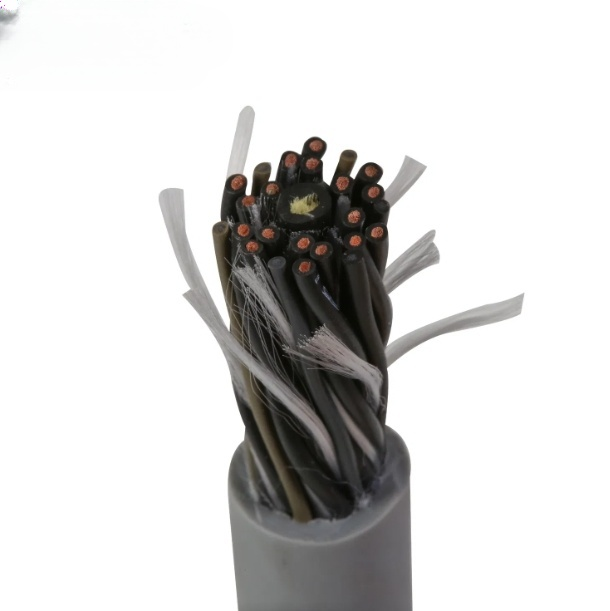
Detailed Description
Medium Flex — The Overlooked Middle Ground
The drag chain cable market tends to polarize: either the cheapest possible PVC cable, or the most expensive premium PUR high-flex cable. But a large segment of real-world applications falls squarely in the middle — needing better durability than economy PVC, but not justifying the cost of Class 6 ultra-fine stranding and halogen-free PUR jacket.
Medium Flex Drag Chain Cable fills this gap. It is neither the cheapest nor the best — it is the right cable for applications where both extremes are wrong.
How Medium Flex Differs from Standard and High-Flex
| Property | Standard (Economy PVC) | Medium Flex | High-Flex (TRVV Class 6) |
|---|---|---|---|
| Conductor class | Class 5 (basic flexible) | Class 5 (optimized lay) | Class 6 (extra-fine) |
| Lay length | Standard | Medium-optimized | Ultra-short |
| Flex life (cycles) | 1–3 million (basic design) | 1–3 million (verified) | 5–10 million |
| Jacket quality | Basic PVC | PVC or NBR-PVC | PUR or TPE |
| Oil resistance | Minimal | Moderate (NBR option) | Excellent |
| Temperature range | -5°C to +70°C | -15°C to +70°C | -30°C to +90°C |
| Bend radius | 7.5×D (10×D long travel) | 7.5×D | 5–7.5×D |
| Cost relative to Standard | Baseline | +15–25% | +50–80% |
When Medium Flex Is the Optimal Choice
The key insight: many applications have peak demands that Standard cannot meet but average demands that do not justify High-Flex.
Example 1: Machine Tool Tool Changer
A CNC tool changer operates intermittently — 20 tool changes per hour, each requiring 2 carrier strokes. That is 40 cycles per hour × 8 hours × 250 days = 80 000 cycles per year. Standard PVC (1–3M cycles) would last 12–37 years mechanically — far exceeding the machine's life. But the environment has occasional coolant splash, which degrades standard PVC over 3–5 years. Medium Flex with NBR-PVC jacket provides the oil resistance needed without the unnecessary cost of Class 6 conductor and PUR.
Example 2: Packaging Line Labeler
A labeler runs 24/7 but the carrier stroke is only 150 mm with a cable bend radius of 100 mm. The stroke is so short that the cable experiences near-zero bending stress. The limiting factor is jacket abrasion from carrier wall contact, not conductor fatigue. Medium Flex provides adequate mechanical performance with the option of NBR-PVC jacket for improved wear resistance.
Example 3: Inspection Camera Carrier
A vision inspection camera moves along a gantry at 0.5 m/s with a 2 m stroke — 10 complete cycles per minute. At 3 million cycles rated, the cable would last 5 000 hours of continuous operation. But the machine operates one 8-hour shift per day, so 5 000 hours = 625 working days ≈ 2.5 years. This matches the machine's planned upgrade cycle. High-Flex would be wasted; Standard would cut it too close.
NBR-PVC Jacket — The Pragmatic Upgrade
The NBR-PVC (nitrile butadiene rubber / PVC blend) jacket option is a key differentiator for Medium Flex. It provides:
- Better abrasion resistance than PVC: Taber ≤15 mg vs >25 mg — a 40%+ improvement
- Moderate oil resistance: Handles occasional coolant splash, hydraulic oil drips, and lubricant spray without the swelling that damages standard PVC
- Improved low-temperature flexibility: -15°C minimum vs -5°C for standard PVC — important for unheated factory bays in winter
- Lower cost than PUR: ~10% premium over standard PVC vs ~30%+ for PUR
Core Configuration Flexibility
Medium Flex uses Class 5 conductors, which are available in a wide range of standard cross-sections:
| Core Count | Typical Cross-Sections | Typical OD | Typical Use |
|---|---|---|---|
| 2–4 cores | 0.5–2.5 mm² | 5.0–9.0 mm | Simple sensor, solenoid, small motor |
| 5–8 cores | 0.5–1.5 mm² | 7.0–12.0 mm | Multi-signal control, limit switches |
| 10–18 cores | 0.25–1.0 mm² | 9.0–15.0 mm | I/O wiring, PLC connections |
| 20–36 cores | 0.14–0.5 mm² | 11.0–18.0 mm | High-density signal, data acquisition |
Filler elements (PP yarn or jute) are used to fill the interstitial spaces between cores, creating a round, stable cable profile. This prevents cores from shifting and creating localized stress concentrations during bending.
Installation — Medium Flex Guidelines
- Carrier fill ratio: ≤ 60% of cross-section for PVC jacket; ≤ 55% for NBR-PVC
- Bend radius verification: Measure the carrier's actual bend radius at installation. A carrier specified at 75 mm may measure 70 mm after installation due to mounting bracket tolerances. At 7.5×D, this reduces the allowable OD from 10 mm to 9.3 mm — verify before routing
- Ambient temperature check: If the factory floor temperature drops below -5°C (PVC) or -15°C (NBR-PVC), do not initiate machine motion until the carrier area has warmed up
- Cable labeling: Label both ends with the cable part number and date of installation. This makes replacement re-ordering trivial and provides service life data for future optimization
Why Choose Yichi Cable Medium Flex?
- Right-sized performance: We do not upsell from Standard to High-Flex when Medium Flex is the correct choice. Our application review identifies the actual limiting factor — flex life or environmental resistance — and recommends accordingly
- Verified flex life: Every Medium Flex design is tested to 1–3 million cycles in our CNAS-accredited lab before the rating is published. This is a verified performance guarantee, not a calculated estimate
- NBR-PVC option: The enhanced jacket at a modest premium fills the gap between PVC and PUR — most manufacturers skip this middle tier entirely
- Wide core range: 2–36 cores, 0.14–16 mm² from stock — configurations for virtually any light to medium automation application
- Quick delivery: Standard configurations 5–7 days; custom configurations 10–14 days