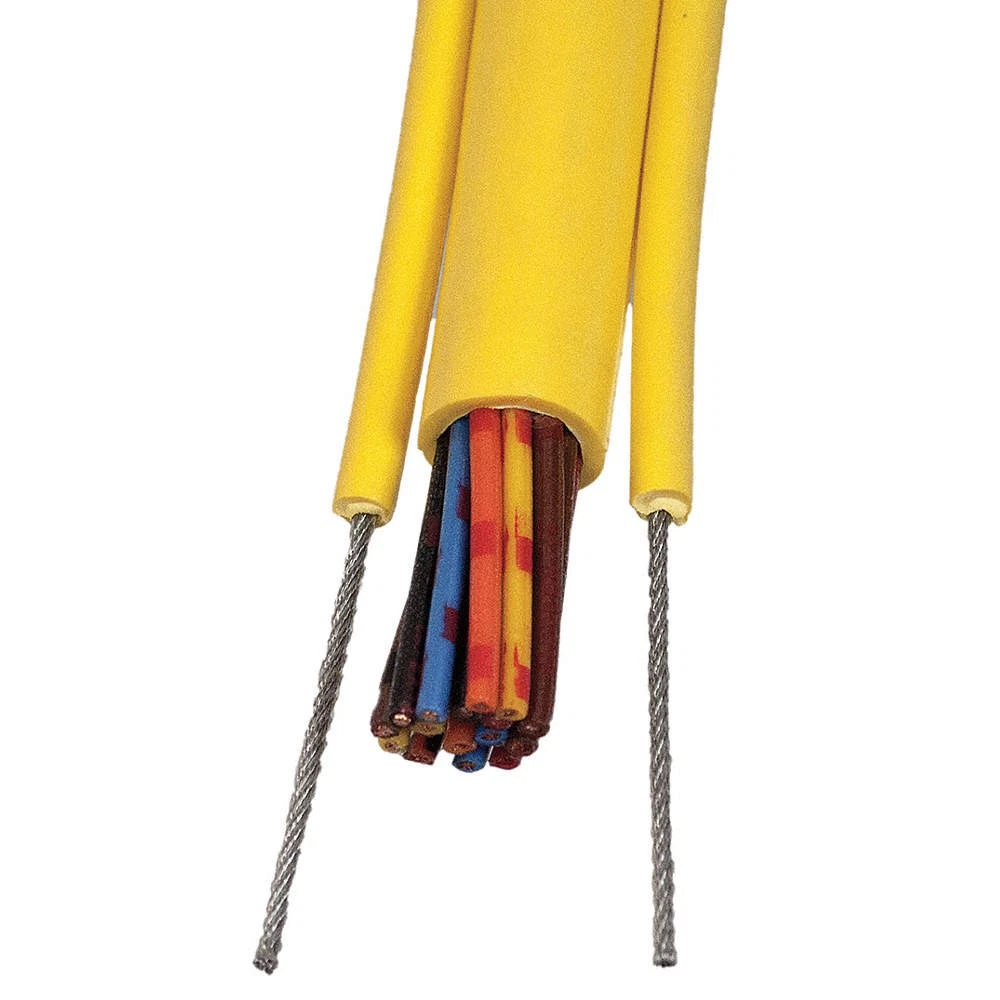
Detailed Description
What Makes a Cable a "Pendant" Cable?
The word "pendant" defines the application: the cable hangs vertically from the crane hoist or trolley, terminating at a hand-held push-button control station (the pendant). The operator holds the pendant, walks alongside or below the load, and controls the crane motions. This application imposes requirements that a general-purpose control cable does not satisfy:
1. Low Weight
A 12-core, 1.5 mm² standard control cable weighs approximately 0.30 kg/m. At a typical 8-meter pendant drop, the cable alone weighs 2.4 kg. Add a 2 kg pendant enclosure and the operator is supporting 4.4 kg continuously while walking and positioning loads. Over an 8-hour shift, this causes operator fatigue, reduced productivity, and in the worst case, the operator rests the pendant on the load or hook — a safety hazard.
Pendant control cable reduces weight by approximately 10–15% through optimized core stranding with lightweight filler materials. A 12-core, 1.5 mm² pendant cable weighs approximately 0.25 kg/m — 2.0 kg for the 8-meter drop — saving 0.4 kg. Over a shift, this difference is significant.
2. Low Bending Force
Standard control cable uses relatively long lay lengths (10–12× cable OD) for core stranding, which optimizes for electrical properties and reduces copper usage. But long lay length means higher bending stiffness — the cable resists bending and wants to maintain a straight or coiled shape. The operator must fight this stiffness every time they move the pendant.
Pendant control cable uses shorter lay lengths (7–8× cable OD) that reduce bending stiffness. The cable drapes naturally rather than springing back. This is a subjective quality — it feels better in the operator's hand — but it has a real effect on operator comfort and precision when positioning loads.
3. Jacket Surface Quality
The pendant cable jacket slides through the operator's hand and over clothing continuously during operation. A rough or high-friction jacket surface causes discomfort and catches on gloves and clothing. Pendant-grade PVC and PUR jacket compounds are formulated for a smoother surface finish and lower coefficient of friction on fabric — tested per ISO 8295.
PVC vs PUR for Pendant Cables
| Factor | PVC Pendant Cable | PUR Pendant Cable |
|---|---|---|
| Surface smoothness | Good | Excellent — lower friction, better dirt resistance |
| Weight | Slightly lighter | Slightly heavier (+5–8%) |
| Cold flexibility (–20°C) | Stiff; jacket may crack | Fully flexible |
| Oil / chemical resistance | Limited | Excellent |
| UV resistance | Poor — indoor only | Excellent — outdoor rated |
| Abrasion resistance | Moderate | Excellent (2–3× PVC) |
| Cost | Lower | Higher (15–25% premium) |
| Best for | Indoor factory cranes; moderate use | Outdoor cranes; heavy use; cold climate; food/pharma clean areas |
For indoor factory EOT cranes with moderate usage (20–50 lifts per shift, clean environment), PVC is the standard specification. For outdoor, cold-climate, heavy-use, or hygiene-critical applications, the PUR upgrade is justified by longer service life and better operator experience.
Yichi Pendant Cable Quality
- Weight measured per production batch: Target weight per meter is verified on every production run. Overweight cable is rejected — it means excessive filler or jacket thickness
- Bending force tested: A 1-meter sample is subjected to a 3-point bend test — the force required to bend the cable to a 7.5× OD radius is measured and compared to the specification. This is not a standard IEC test; it is a Yichi internal quality metric developed specifically for pendant cables
- Jacket surface inspected: Surface roughness is visually inspected and tactile-tested on every production length. Bumps, drag marks, or die lines in the jacket surface are cause for rejection — they create high-friction points that irritate the operator's hand
- Orange jacket option: High-visibility orange PVC jacket available — improves cable visibility in dimly lit crane bays and factory environments, reducing trip hazards and accidental cable damage from forklifts