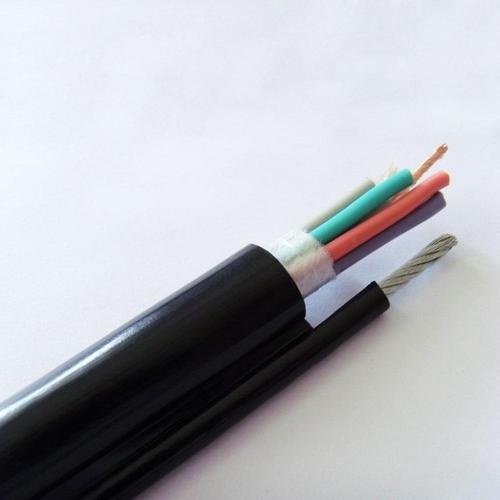
Detailed Description
Why a Dedicated Hoist Cable?
An electric hoist is a self-contained lifting unit — motor, gearbox, brake, drum or chain sprocket, limit switches, and electrical enclosure — all packaged into a compact housing. The cable that connects this unit to the power supply and control system faces constraints that a general-purpose flexible cable does not:
Space Constraints
The cable entry gland on a typical 2-tonne electric chain hoist accepts a cable with an outer diameter of 10–16 mm. A separate 4-core power cable (4 mm², ~12 mm OD) plus a separate 4-core control cable (1.5 mm², ~9 mm OD) requires two glands or an oversized gland — space that the hoist housing does not have. The electric hoist cable combines power + control into a single compact cable, typically 12–18 mm OD, that enters through one standard-sized gland.
Chain Guide Proximity
Electric chain hoists use a chain bucket or chain bag to collect the unloaded chain as it exits the hoist. The cable routes near this chain — within 50–100 mm in many hoist designs. A cable that is too stiff will interfere with the chain; a cable that is too large in diameter will rub against the chain or chain bucket. The electric hoist cable's compact OD and high flexibility prevent physical interference with the chain mechanism.
Control Circuit Integration
The hoist's limit switches (upper hook limit, lower hook limit), brake solenoid, and motor thermal sensor all require electrical connections back to the control panel. Running a separate control cable doubles the installation time, doubles the number of cable glands and terminal block connections, and creates two potential failure points instead of one. The electric hoist cable eliminates this by carrying control cores within the same cable as the power cores.
Core Configuration Table
| Hoist Type | SWL (Typical) | Motor Power | Power Cores | Control Cores | Total Cores | Approx. OD |
|---|---|---|---|---|---|---|
| Electric chain hoist | 250 kg – 2 t | 0.5–2.0 kW | 4 × 1.5 mm² | 4 × 0.75 mm² | 8 | 13 mm |
| Electric chain hoist | 2 t – 5 t | 2.0–5.0 kW | 4 × 2.5 mm² | 4 × 1.0 mm² | 8 | 15 mm |
| Wire rope hoist | 1 t – 5 t | 3.0–7.5 kW | 4 × 4.0 mm² | 4 × 1.5 mm² | 8 | 17 mm |
| Wire rope hoist | 5 t – 10 t | 7.5–15 kW | 4 × 6.0 mm² | 6 × 1.5 mm² | 10 | 20 mm |
| Wire rope hoist | 10 t – 20 t | 15–25 kW | 4 × 10 mm² | 6 × 1.5 mm² | 10 | 23 mm |
Yichi Electric Hoist Cable Manufacturing
- Compact OD design: Our core stranding process uses mathematically optimized lay lengths and filler cross-sections to achieve the smallest possible OD for a given copper cross-section and core count. Target OD is ≤105% of the theoretical minimum — verified on every production length
- Power and control core separation: Power cores and control cores are clearly distinguishable — power cores use thicker insulation (color: black with printed numbers) and the PE core is green/yellow. Control cores use thinner insulation and are numbered per VDE 0293. No ambiguity at the terminal block
- Flex life verification: Samples from each production batch are subjected to a 3-pulley flex test at D/d 7.5:1 — 10 000 cycles minimum without conductor breakage or insulation failure. This simulates the cumulative flexing over years of hoist festoon travel
- Gland compatibility: Our cable OD tolerances are held to ±0.3 mm — within the compression range of standard metric cable glands. A cable that is 0.5 mm oversize will not seal properly; a cable that is 0.5 mm undersize will not be gripped securely