Detailed Description
What Is an Overhead Crane Control Cable?
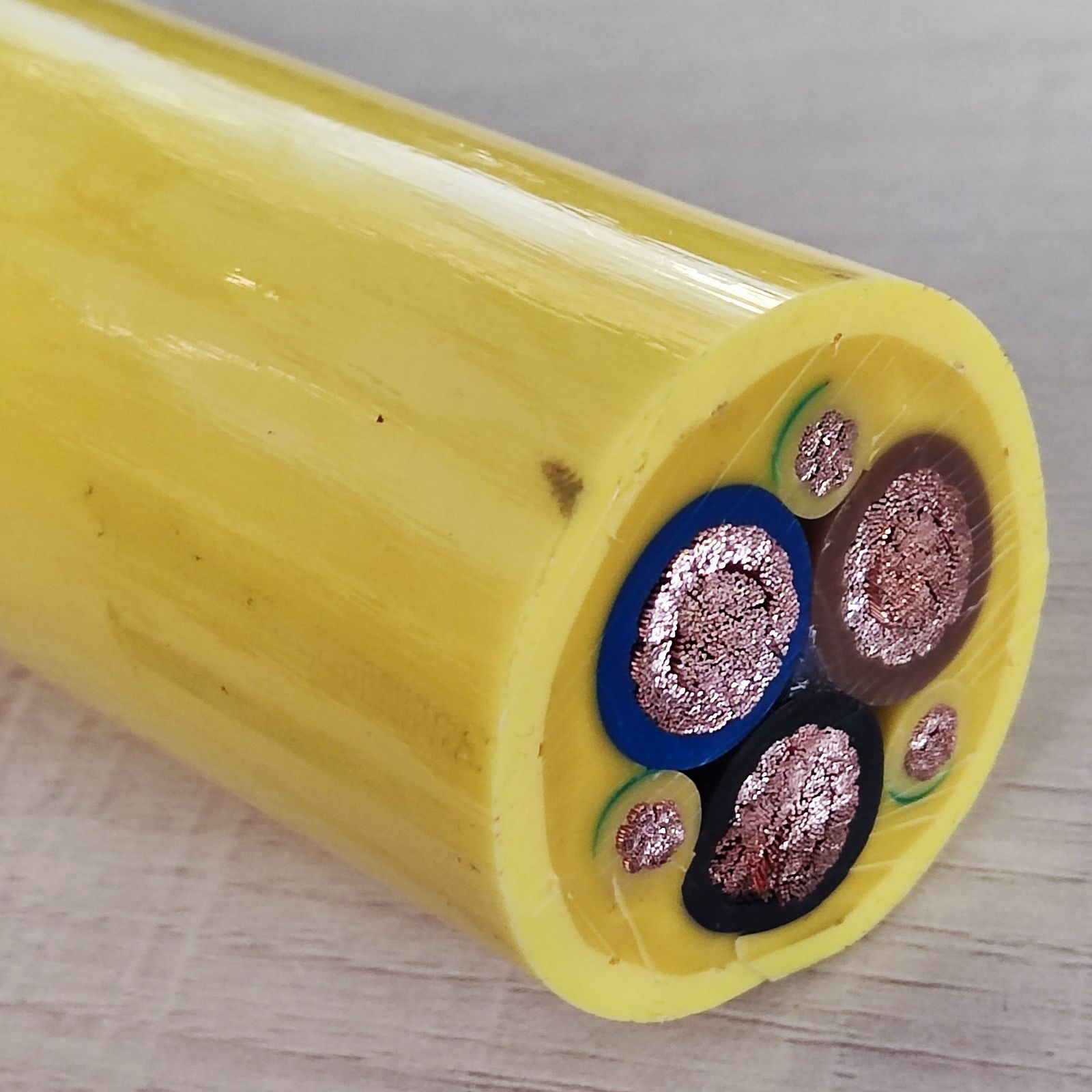
An overhead crane control cable is a multi-core flexible cable that connects the operator's pendant push-button station — or a radio remote control receiver box — to the crane's main control panel and electrical enclosure. It carries all hoist and travel command signals, limit switch feedback, emergency stop circuits, and low-voltage control power (typically 24 V DC or 48 V AC) between the moving hoist/trolley assembly and the fixed control cabinet on the crane bridge.
In an EOT (Electric Overhead Traveling) crane, the control cable hangs vertically from the hoist or trolley, moving with it as the operator walks alongside. The cable must withstand repeated bending, the tensile load of its own suspended weight (plus the pendant station), and in some cases exposure to oil, cutting fluids, or outdoor weather — all while maintaining reliable electrical continuity for safety-critical stop and limit switch circuits.
Core Count Selection Guide
The number of cores depends on the crane control scheme and how many functions the pendant station controls. The table below provides a practical selection reference for common EOT crane configurations.
| Crane Type | Typical Functions | Recommended Core Count | Notes |
|---|---|---|---|
| Single-girder, 1-speed | Hoist up/down, trolley L/R, bridge F/R, E-stop | 8–10 cores | Plus 2 spare cores recommended |
| Single-girder, 2-speed | As above + 2-speed control (4 extra cores) | 12–16 cores | 2-speed on all motions doubles the signal count |
| Double-girder, 1-speed | Two hoists, trolley, bridge, E-stop | 14–18 cores | Each hoist adds ~4 cores |
| Double-girder, 2-speed + aux | Two hoists 2-speed, trolley, bridge, E-stop, horn, light | 20–24 cores | Auxiliary functions add 2–4 cores each |
| Automated / VFD crane | Hoist, trolley, bridge, E-stop, VFD enable, speed reference (0–10 V), encoder signals | 16–24 cores | Shielded pairs may be needed for analog/VFD signals; consider combined cable for this case |
For crane systems that also require encoder feedback, load cell weighing signals, or VFD speed reference (0–10 V or 4–20 mA), a combined overhead crane cable (power + control + shielded signal pairs in one jacket) is recommended over a standard control-only cable. See the related products section.
Steel Wire Reinforcement — When and Why
The Problem
A vertically suspended pendant control cable supports two loads:
- Its own weight per meter
- The weight of the pendant push-button station (typically 1.5–5 kg)
The Solution
Integrating one or more galvanized steel wire strands into the core assembly transfers the tensile load from the copper conductors to the steel wire. The steel wire:
- Carries the pendant weight — copper conductors are no longer in tension
- Has a breaking strength of 1 770 N/mm² — a single 1.5 mm² steel wire supports approximately 250 kg
- Is anchored at both cable terminations via dedicated strain relief clamps
- Does not affect the electrical performance — it is electrically isolated or used as an equipment ground conductor
Jacket Material Selection
| Jacket | Environment | Advantages | Limitations |
|---|---|---|---|
| PVC (ST2) | Indoor, clean factory | Lowest cost; good electrical properties; widely available | –15°C minimum; limited oil resistance; not UV-stable |
| CR (Neoprene) | Indoor industrial; machine shops | Oil-resistant per IEC 60811; good flame retardancy; wider temperature range | Higher cost than PVC; heavier |
| PUR (TMPU) | Outdoor; marine; harsh chemical | –40°C low-temp rated; UV-stable >720 h; halogen-free; best abrasion resistance; seawater resistant | Highest cost; requires specialized extrusion |
For outdoor gantry, portal, and shipyard cranes exposed to sun, rain, and salt spray, PUR is the recommended jacket material. For indoor factory EOT cranes in a clean environment, PVC is the cost-effective standard. For machine shop and foundry cranes with oil mist and elevated ambient temperatures, CR offers the best balance of performance and cost.
Yichi Quality — What You Get
- IEC 60228 Class 5 conductors as standard: Every core is finely stranded — we do not use Class 2 or rigid conductors that crack under repeated flexing
- Numbered cores: Every core is printed with a permanent number per VDE 0293 — no guessing, no ringing-out during installation
- Layered concentric stranding with fillers: The core assembly is laid up in concentric layers with non-hygroscopic filler elements for a round, compact cable cross-section — preventing core migration under flexing
- Steel wire integrated in-house: Where specified, the steel wire is cabled into the core assembly in our own production — tested for tensile strength before jacket extrusion
- Jacket concentricity monitored: Wall thickness is controlled to ±0.1 mm tolerance — thin spots lead to premature jacket failure in flexing applications
- Every drum tested: Each production length is spark-tested at 2 500 V AC and insulation resistance is measured before dispatch