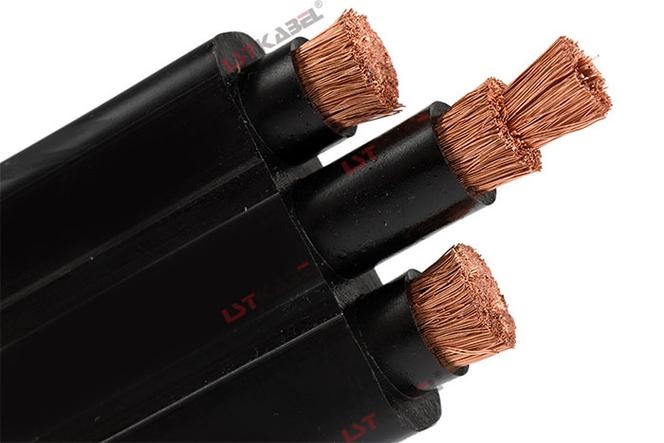
Detailed Description
RVV-NBR — The Oil-Resistant Budget Option
The cable jacket market for reeling applications has a gap:
- PVC jackets: $ — economical, but swell and degrade in oil within months
- PUR jackets: $$$ — excellent oil resistance, but 30–40% more expensive
- CR (neoprene) jackets: $$$ — good oil resistance, but heavy and contains chlorine
- TPU jackets: $$$$ — best performance, highest cost
RVV-NBR Naming — What the Designation Means
| Letter | Meaning | Material |
|---|---|---|
| R | Flexible conductor (软) | IEC 60228 Class 5 — fine stranded for flexibility |
| V | PVC insulation | First V — core-to-core electrical isolation |
| V | PVC inner sheath | Second V — extruded layer over core assembly |
| NBR | Nitrile rubber jacket | Outer jacket — oil-resistant rubber compound |
In a standard RVV cable, the second "V" is the outer jacket — PVC. In RVV-NBR, the outer jacket is replaced with NBR (nitrile butadiene rubber / NBR-PVC blend). This change adds approximately 10–15% to the cable cost while providing significantly improved oil resistance.
NBR Oil Resistance — How It Compares
| Oil Exposure | PVC Jacket | NBR Jacket | PUR Jacket |
|---|---|---|---|
| Occasional oil splash | Degrades within months | Survives years | Survives indefinitely |
| Oil mist / vapor | Swells, softens | Moderate swelling — still functional | No effect |
| Oil drip onto cable | Rapid jacket failure | Gradual softening — replace at 2–3 years | No effect |
| Continuous oil immersion | Fails within weeks | Fails within 1–2 years | No effect |
| Cutting fluid (emulsion) | Degrades, cracks | Good resistance — comparable to PUR | Excellent |
| Hydraulic oil (mineral) | Heavy swelling | Moderate swelling — acceptable | Negligible swelling |
| Diesel / fuel oil | Rapid failure | Good resistance — better than PUR for some fuels | Good (may swell with certain fuels) |
The key insight: NBR is a significant upgrade over PVC for oil resistance, but it is not a replacement for PUR in oil-immersed applications. NBR is the right choice when oil exposure is moderate and PUR's cost premium cannot be justified.
Why NBR, Not Just "Better PVC"
NBR is a copolymer of acrylonitrile and butadiene. The acrylonitrile content (typically 25–35% for cable jackets) provides oil resistance — the higher the acrylonitrile, the better the oil resistance (but the stiffer the material at low temperatures).
NBR's rubber-like properties provide handling advantages over PVC:
- Softer and more flexible: Shore 70–80 A vs PVC 85–90 A — easier to handle, coil, and spool
- Better cold flexibility: -15°C minimum vs -5°C for PVC — functional in unheated workshops
- Less "memory": NBR does not retain coil shape as stubbornly as PVC — cables lay flat on the drum with less spring-back
- Better grip: The rubber-like surface provides traction on polished steel drums — less slippage during spooling
When to Choose RVV-NBR
| Application | PVC Sufficient? | NBR Right Choice? | PUR Required? |
|---|---|---|---|
| Clean, dry indoor reels | ✅ | ❌ Over-specified | ❌ Over-specified |
| Occasional oil splash in workshop | ❌ Fails in months | ✅ Optimal | ❌ Over-specified |
| Moderate oil mist (engine bay, factory) | ❌ Degrades in <1 year | ✅ Optimal | ⚠️ Longer life but more cost |
| Cutting fluid / coolant exposure | ❌ Cracks, degrades | ✅ Good choice | ✅ Better but more cost |
| Oil-immersed carrier | ❌ Fails in weeks | ⚠️ Accepts limited life | ✅ Required |
| Outdoor, UV-exposed reeling | ❌ Degrades in months | ⚠️ Limited UV — cover needed | ✅ Required |
Why Choose Yichi Cable RVV-NBR?
- Right-sizing the solution: We recommend NBR when it is the appropriate material — not a PUR upsell when a 15% premium would solve the problem
- NBR-PVC blend optimization: Our NBR jacket uses an optimized NBR-PVC blend ratio that balances oil resistance, flexibility, and cost — not a generic commodity NBR compound
- Oil resistance verified: Every production batch is tested for volume swell in IRM 902/903 reference oils — we know the actual oil resistance, not a catalog estimate
- Reasonable expectations: We tell you what NBR can and cannot do — it is an oil-resistant jacket, not an oil-proof jacket. Setting correct expectations prevents misapplication