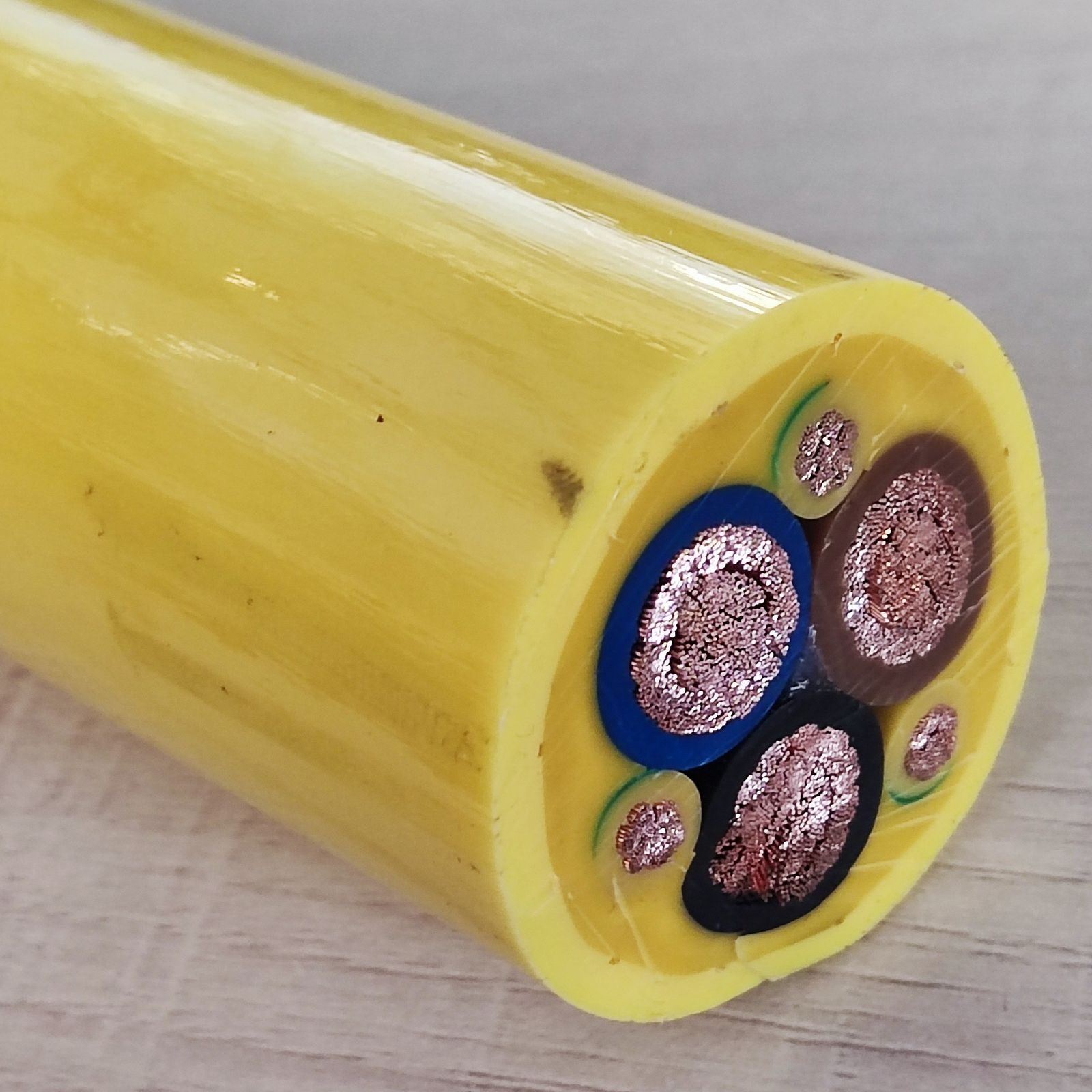
Reeling Control Cable — Multi-Core Flexible Drum-Wound Signal Cable for Limit Switches, Sensors, Brake Controls, and Crane Auxiliary Functions
Reeling & Drum Cables /Control Reeling Series

Reeling Control Cable — Multi-Core Flexible Drum-Wound Signal Cable for Limit Switches, Sensors, Brake Controls, and Crane Auxiliary Functions

Reeling control cable for auxiliary signal and control functions on motorized and spring-driven reels: IEC 60228 Class 5/6 copper, 2–36 cores, 0.5–2.5 mm². PUR or CR jacket, 300/500 V rated. PET fleece anti-abrasion wrap, anti-twist short-lay stranding for consistent retraction. Optional integrated Kevlar tensile element. D/d 10:1, >50 000 reeling cycles. For crane limit switches, hoist brake control, conveyor sensors, and any reeling system where power is handled by a separate cable.

Key Features

Multi-core signal cable for reeling: 2–36 cores, 0.5–2.5 mm² — carries control signals, not motor power
PET fleece inner wrap — prevents core-to-core and core-to-jacket abrasion during repeated reeling
Short-lay anti-twist stranding — prevents coiling memory on spring reels, enables smooth retraction
PUR or CR jacket: oil, abrasion, UV, and weather resistant for indoor/outdoor reel applications
Kevlar tensile element (optional): for longer reel lengths where cable weight affects spring retraction
Color coded (DIN 47100) or numbered (VDE 0293) — unambiguous core identification
300/500 V; D/d 10:1 minimum; lightweight for spring reel compatibility

Applications

Crane limit switches — upper/lower hook limits, trolley end stops, boom angle sensorsHoist brake control — electromagnetic brake release signal on motorized reel systemsConveyor emergency stop — pull-cord and belt misalignment sensor reelsStage and theater — DMX control and auxiliary signal reels on moving lighting barsMobile equipment — control pendant and remote operator station reels

Technical Specifications

Conductor Bare copper, IEC 60228 Class 5 or Class 6
Core Cross-Sections 0.5 mm², 0.75 mm², 1.0 mm², 1.5 mm², 2.5 mm²
Core Count 2–36 cores
Core Insulation PVC or PP — thin-wall for compact OD
Core Identification Color coded (DIN 47100) or black with white numbers (VDE 0293)
Core Stranding Short-lay anti-twist concentric layers
Inner Wrap PET fleece
Tensile Element (Optional) Kevlar fiber — central, for spring reel tension relief
Outer Jacket — PUR PUR TMPU, halogen-free; Taber ≤5 mg; -40°C to +80°C
Outer Jacket — CR CR neoprene; -25°C to +70°C
Jacket Color Black, Gray, Orange
Rated Voltage 300/500 V
Test Voltage 2 000 V AC / 5 min
Drum D/d 10:1 minimum; 12:1 recommended
Retraction Cycles (Spring Reel) >30 000
Reeling Cycles (Motorized) >100 000
Typical OD (12 × 1.0 mm²) ~11 mm
Flame Retardant IEC 60332-1-2
Certifications CE, RoHS

Detailed Description

Control vs Power — Two Cables, One Reel System

Most reeling systems use two cables: a power cable for the motor, and a control cable for auxiliary signals. Separating them makes engineering sense — power and signal have different requirements:

Reeling Power CableReeling Control Cable
Core cross-section1.5–400 mm²0.5–2.5 mm²
Core count3–52–36
WeightHeavy (2–40 kg/m)Light (0.1–1.0 kg/m)
Reel typeMotorized drumSpring reel or light motorized
Tensile reinforcementSteel wire (required)Kevlar (optional, lightweight)
Primary stressCable weight + winding tensionSpring retraction + repeated coiling

The control cable does not carry significant power — it carries 24 V DC PLC signals, 230 V AC relay coils, and milliamp sensor loops. The engineering focus is on signal integrity, core identification, and spring reel compatibility — not on tensile strength or current capacity.

Anti-Twist — The Spring Reel Requirement

A spring-driven control cable reel retracts under constant spring tension. If the cable develops coiling memory (a permanent spiral shape from being wound on the drum), the retraction becomes uneven — the cable bunches, tangles, or fails to retract fully.

Short-lay anti-twist stranding prevents this: the cores are twisted with a deliberately short lay length in alternating directions per layer. This cancels the internal torsional stress that causes coiling memory. The cable lies flat on the drum and retracts smoothly — every time.

Kevlar Tensile Element — When to Add It

Standard reeling control cable relies on the copper conductors for tensile strength during retraction. For short reels (< 15 m) with lightweight cable, this is adequate. For longer reels or heavier cable:

  • Kevlar center core: A non-conductive aramid fiber strand in the cable center carries tensile load during retraction — the copper conductors carry zero tension
  • Weight penalty: Negligible — Kevlar is 80% lighter than steel wire of equivalent strength
  • Electrical advantage: Kevlar is non-conductive — no risk of the tensile element shorting to a conductor if insulation is damaged
Add Kevlar when the reel length exceeds 15 m OR when the cable weight per meter exceeds 0.5 kg/m.

Why Choose Yichi Cable Reeling Control?

  • Spring reel optimized: Short-lay anti-twist stranding + lightweight construction — designed for spring retraction, not just adapted from fixed control cable
  • Kevlar option: Add tensile support without the weight or conductivity penalty of steel
  • Full color/number choice: DIN 47100 color coding or VDE 0293 numbering — your standard, your choice
  • Compact OD: Thin-wall PP insulation + compact stranding = smaller OD → more cable on the same reel

Product Inquiry

Product: Reeling Control Cable — Multi-Core Flexible Drum-Wound Signal Cable for Limit Switches, Sensors, Brake Controls, and Crane Auxiliary Functions

Add technical specifications (optional)

The more detail you provide, the faster and more accurate our quotation.

No file chosen

PDF, Office, image or CAD file — up to 5 MB

Need Help?

Certifications

ISO 9001
Quality
CE
European
RoHS
Environmental
TÜV
Certification

Need a Quote for This Product?

Send us your requirements and receive a detailed quotation within 24 hours.