Detailed Description
The Engineering Conflict — Flex vs Shield
High-flex cable design and shielded cable design pull in opposite directions:
High-flex demands: Fine conductors, short lay lengths, soft jacket, minimal internal friction, cores that slide freely past each other. Everything is optimized for movement. Shielding demands: A rigid cylindrical metal tube around the cores, mechanically coupled to a jacket that compresses it. Everything is optimized for electromagnetic performance — and that means rigidity.This is why most "shielded flexible cable" compromises one for the other. Standard shielded cable uses Class 5 conductors (acceptable flex) with a braid that fatigues after 2–3 million cycles. High-flex cable uses Class 6 conductors (excellent flex) but is typically unshielded because adding a braid would negate the flex advantage.
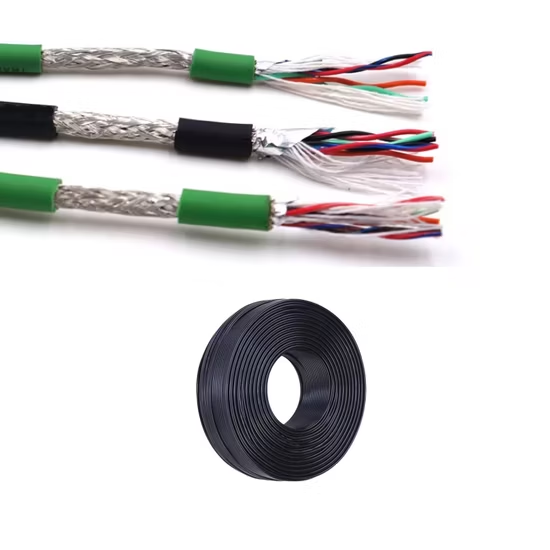
Shielded High-Flex Cable resolves the conflict through three engineering choices:- Braid-to-inner-jacket bonding: The braid is not a loose tube — it is adhesively bonded to an extruded inner jacket with a flexible adhesive. The braid moves with the core assembly as one unit, not sliding relative to it. Telescoping — the longitudinal migration of the braid under acceleration — is eliminated.
- Spiral shield option: For torsion applications (robot wrists), the braid is replaced by a parallel-wrapped spiral copper shield. Spiral-wrapped wires slide past each other during twisting without opening gaps — the braid's crossed-wire construction locks and opens under torsion.
- PP core insulation: Polypropylene's naturally low coefficient of friction reduces the internal core-to-core movement that would otherwise be transferred to the shield as mechanical noise. Less internal movement = less shield fatigue.
Braid vs Spiral — Choosing the Right Shield for Motion
| Shield Type | Flex Mode | EMI Performance | Flex Life | Cost | Best Application |
|---|---|---|---|---|---|
| Braid (bonded) | Bending only | Good (80 dB) | 5–10M cycles | Moderate | Drag chain, linear motion |
| Spiral wrap | Bending + torsion | Moderate (70 dB) | 10–15M cycles | Moderate | Robot arm joints, twisting |
| Foil + braid | Bending only | Excellent (85+ dB) | 3–5M cycles | Higher | Static EMI-critical, not flex-rated |
| No shield | All modes | None | 10–20M cycles | Lowest | No EMI, flex-primary |
- If the motion is planar bending (drag chain, linear axis, gantry) → braid shield, optionally bonded
- If the motion includes torsion (robot wrist, rotary joint, 3D arm) → spiral shield
- If the motion is exclusively torsion (robot axis 6, full-time twisting) → spiral shield with TPE insulation — the most flexible combination
Shield Bonding — The Adhesive That Prevents Shield Migration
When a cable accelerates in a carrier, Newton's first law applies to every component. The core assembly — being heavier (copper) — resists acceleration more than the lighter braid. If the two are mechanically independent, the core slides longitudinally inside the braid. Over millions of cycles, this "telescoping" accumulates until the braid bunches up at the carrier clamp, exposing the cores behind it.
Bonded shield construction solves this:- A thin layer of flexible polyurethane adhesive is applied between the inner jacket and the braid
- The adhesive is formulated to remain flexible at -40°C and not degrade at +90°C
- Bond strength: 2–3 N/cm peel strength — strong enough to prevent telescoping, weak enough that the bond does not restrict cable flexibility
- The bond is "sacrificial but sufficient": after 5–10 million cycles, microscopic delamination may begin — but by then the cable has exceeded its rated flex life and should be replaced
Spiral Shield — The Torsion Solution
Braid is cross-woven: each wire passes alternately over and under other wires. When the cable twists, these crossing points lock against each other, forcing the braid to kink and eventually break.
Spiral shield is parallel-wrapped: all wires run in the same helical direction, parallel to each other. When the cable twists, the wires slide past each other — the helix angle changes, but the coverage remains continuous. No locking, no kinking, no broken shield strands.
The trade-off: spiral shield has approximately 5–8 dB lower shielding effectiveness than braid at frequencies below 10 MHz (where wavelengths are long enough to penetrate between the parallel wires). For torsion applications, this is an acceptable compromise — some EMI protection is vastly better than a broken braid providing none.
Why Choose Yichi Cable Shielded High-Flex?
- Bonded braid option: We offer adhesive-bonded shield for high-acceleration applications — most manufacturers skip this step because it adds production complexity
- Spiral shield expertise: If your application involves torsion, we specify spiral shield, not braid — and explain why. Most catalogs list only "shielded" with no torsion guidance
- Flex + shield tested together: Every Shielded High-Flex design is tested for both flex life AND shield continuity in our CNAS-accredited lab. A cable that survives 10 million flex cycles but loses shield continuity at 3 million is not acceptable
- Application review: Send us your motion profile (bend, torsion, acceleration) and EMI environment (VFD frequency, nearby noise sources) — we recommend braid vs spiral, bonded vs unbonded, and jacket material