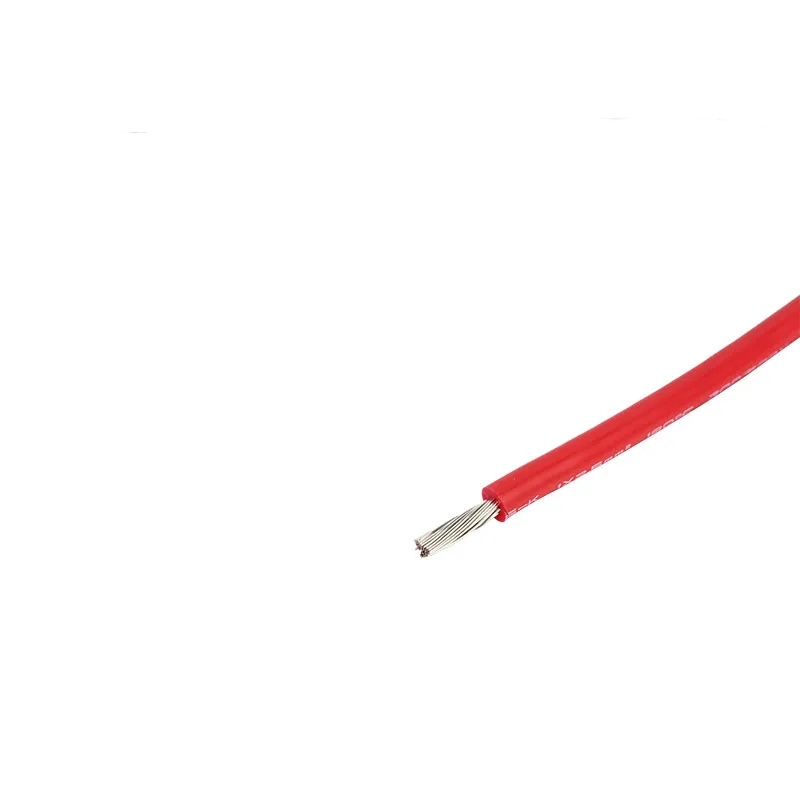
Silicone High Temperature Wire — UL 3122 / 3257 Single-Core Silicone Rubber Insulated Flexible Hookup Wire Rated 200°C to 250°C with Nickel-Plated Copper Conductor and Optional Fibreglass Outer Braid for Appliance Internal Wiring, Lighting Fixture Leads, Heating Element Connections, and High-Temperature Equipment Electrical Interconnection
Fire Resistant, High Temperature & LSZH Cables /Silicone Wire

Silicone High Temperature Wire — UL 3122 / 3257 Single-Core Silicone Rubber Insulated Flexible Hookup Wire Rated 200°C to 250°C with Nickel-Plated Copper Conductor and Optional Fibreglass Outer Braid for Appliance Internal Wiring, Lighting Fixture Leads, Heating Element Connections, and High-Temperature Equipment Electrical Interconnection

Silicone high temperature wire: UL 3122 (200°C) / UL 3257 (250°C) single-core silicone rubber insulated hookup wire. Nickel-plated copper Class 5, 0.22–50 mm², AWG 24–1/0. For oven, heater, lamp, appliance internal wiring. Optional fibreglass braid. Flame retardant VW-1, halogen-free. CE, UL, RoHS.

Key Features

Single-core silicone rubber insulated hookup wire — the workhorse of high-temperature equipment internal wiring; silicone's unique combination of 200–250°C thermal rating, excellent flexibility at all temperatures, halogen-free combustion, and good dielectric properties make it the preferred wire for appliance and industrial equipment internal connections in hot zones
UL 3122 (200°C, 600 V) and UL 3257 (250°C, 600 V) recognized component wire — the two standard UL silicone wire temperature classes for equipment internal wiring; UL 3122 covers the majority of commercial and industrial high-temperature wiring applications; UL 3257 adds the fibreglass outer braid for the 250°C temperature class and mechanical protection
Nickel-plated copper conductor, IEC 60228 Class 5 flexible stranded — the nickel plating (2–5 μm) prevents copper oxidation at the wire's rated continuous temperature, maintaining stable conductor resistance and low terminal contact resistance for the equipment's service life; bare copper would develop a thick, high-resistance black oxide (CuO) scale at these temperatures within days to weeks
Peroxide-cured silicone rubber insulation — the silicone insulation is soft (Shore A 60–80), flexible, and easily stripped for termination; it does not melt (decomposes to silica at >300°C), does not harden or crack with thermal cycling, and retains its dielectric strength at the rated continuous temperature
Halogen-free — silicone contains zero chlorine, bromine, or fluorine; in an equipment fire, the wire emits no corrosive HCl gas (which would damage sensitive electronics in the same enclosure) and no toxic halogenated gases; the combustion product is non-conductive silica ash (SiO₂)
VW-1 flame retardant per UL 1581 — the wire self-extinguishes when the flame source is removed; silicone burns with difficulty, produces a low flame when the ignition source is present, and forms a silica ash residue that provides some continued electrical insulation during and after the fire
Available in solid, striped, and high-temperature printed identification — standard colors: white, black, red, blue, yellow, green, brown, grey, orange, natural/translucent; longitudinal striping for two-color identification; the colour is integral to the silicone compound — it does not fade, bleed, or rub off at 200°C
Cross-section range 0.22–50 mm² (AWG 24–1/0) — from thin sensor and thermocouple extension wire (AWG 24, 0.22 mm²) to heavy heating element power leads (AWG 1/0, 50 mm²); the full equipment wiring cross-section spectrum in a single wire family

Applications

Domestic cooking appliance internal wiring — silicone insulated wire connecting the thermostat, selector switch, heating element, indicator lamp, and terminal block inside ovens, grills, hobs, and toasters; the wire operates at 120–200°C in the oven cavity or in direct contact with heating element terminalsCommercial kitchen equipment — UL 3122 silicone wire for deep fat fryers, griddles, chargrills, bain-maries, and conveyor ovens in restaurants and institutional kitchens where the wire is routed inside the appliance housing at sustained elevated temperaturesIndustrial heating equipment — silicone wire for band heaters, cartridge heaters, and immersion heaters in plastic processing, packaging, and industrial process heating; the wire connects the power supply to the heating element terminals at temperatures up to 250°CLighting fixture internal wiring — silicone wire for luminaire internal connections between the ballast/transformer, lampholder, and terminal block; specified for enclosed fixtures where the internal ambient temperature exceeds the 90°C rating of standard PVC or XLPE appliance wireSauna and steam room equipment — silicone insulated wire for sauna heater connections and steam generator internal wiring; the silicone insulation resists the combined thermal + high-humidity environment where PVC would absorb moisture and lose insulation resistanceElectric motor and transformer lead wire — silicone wire for Class H (180°C) motor winding connections and dry-type transformer internal wiring where the hot-spot temperature exceeds the rating of standard PVC or XLPE lead wireMedical and laboratory sterilizable equipment — silicone wire for autoclave, sterilizer, and laboratory oven internal wiring; silicone withstands repeated autoclave cycles (121–134°C steam) without degradation and does not outgas or contaminate the sterile environment

Technical Specifications

Standard — UL UL 3122 (AWM Style 3122: silicone rubber, 200°C, 600 V, single-core); UL 3257 (AWM Style 3257: silicone rubber + fibreglass braid, 250°C, 600 V); UL recognized component (AWM — Appliance Wiring Material), simplifying UL end-product listing
Standard — IEC / VDE IEC 60227-3 (applicable test methods for silicone single-core wire); VDE 0250-502 (silicone insulated single-core wires, Germany); harmonized types: H05SJ-K (300/500 V, 180°C) and H07SJ-K (450/750 V, 180°C)
Rated Voltage — UL 3122/3257 600 V AC (UL AWM); also available at 300 V for thin-wall silicone wire where lower voltage rating allows a thinner insulation wall
Rated Voltage — IEC Harmonized 300/500 V (H05SJ-K, ≤1.0 mm²); 450/750 V (H07SJ-K, ≥1.5 mm²)
Conductor Material — Standard Nickel-plated copper; IEC 60228 Class 5 flexible stranded; nickel plating thickness 2–5 μm per ASTM B355; the nickel plating is continuous and verified by sodium polysulfide porosity testing on every production batch
Conductor Material — Optional Silver-plated copper (for solderable terminations — nickel-plated copper requires activated flux); bare copper (for ≤150°C applications only); pure nickel conductor (for >250°C — higher resistivity, larger cross-section required for equivalent current rating)
Conductor Cross-Sections — Metric 0.22, 0.34, 0.50, 0.75, 1.0, 1.5, 2.5, 4, 6, 10, 16, 25, 35, 50 mm²
Conductor Sizes — AWG AWG 24 (0.22 mm²), AWG 22 (0.34 mm²), AWG 20 (0.52 mm²), AWG 18 (0.82 mm²), AWG 16 (1.31 mm²), AWG 14 (2.08 mm²), AWG 12 (3.31 mm²), AWG 10 (5.26 mm²), AWG 8 (8.37 mm²), AWG 6 (13.3 mm²), AWG 4 (21.2 mm²), AWG 2 (33.6 mm²), AWG 1 (42.4 mm²), AWG 1/0 (53.5 mm²)
Insulation — Silicone Rubber Peroxide-cured VMQ (methyl-vinyl silicone rubber); Shore A 60–80; rated 200°C continuous (UL 3122); the silicone compound is formulated with thermal stabilizer (typically iron oxide or cerium oxide) to extend the thermal endurance at the rated temperature
Insulation Thickness — UL 3122 (600 V) Per UL 62 / UL 1581; 0.4–0.8 mm (AWG 24–16); 0.8–1.2 mm (AWG 14–10); 1.2–1.6 mm (AWG 8–4); the wall thickness increases with wire size to maintain the 600 V dielectric withstand rating
Insulation Colors — Standard White, black, red, blue, yellow, green, brown, grey, orange, violet, natural (translucent amber); solid colors and two-color longitudinal stripe combinations; the color is integral to the silicone compound
Fibreglass Braid — UL 3257 (250°C) Fibreglass yarn braid applied over the silicone insulation; saturated with high-temperature silicone varnish or inorganic binder; the braid provides mechanical abrasion protection, prevents the silicone surface from sticking to hot surfaces, and enables the 250°C temperature rating by providing additional thermal and mechanical stability
Maximum DC Conductor Resistance at 20°C — Nickel-Plated Copper Per IEC 60228 Class 5 for the conductor cross-section; 89.2 Ω/km (AWG 24, 0.22 mm²) to 0.386 Ω/km (AWG 1/0, 50 mm²); nickel-plated copper has the same DC resistance as bare copper of the same cross-section (the plating thickness is negligible relative to the conductor diameter)
Insulation Resistance at 20°C — Silicone ≥200 MΩ·km (minimum at 500 V DC, 1 min)
Test Voltage (AC — Spark Test, In-Line) 100% spark test during manufacturing per UL 1581; 6 kV AC (300 V rated), 10 kV AC (600 V rated); any pinhole or thin spot in the silicone insulation is detected and the wire is cut out
Dielectric Withstand (AC — Finished Wire) 2 500 V AC / 1 min (600 V rated wire) per UL 1581
Temperature — Continuous (UL 3122) 200°C conductor temperature
Temperature — Continuous (UL 3257) 250°C conductor temperature (the fibreglass braid provides the additional thermal and mechanical stability for the 50°C higher temperature class)
Temperature — Short-Term Excursion 250°C (UL 3122) / 280°C (UL 3257) for limited periods (hours); above 250°C, silicone decomposition accelerates significantly
Temperature — Low-Temperature Flexibility -60°C; silicone remains flexible at cryogenic temperatures
Minimum Bend Radius — Silicone Wire 3× wire OD (fixed routing); 5× wire OD (handling and installation)
Stripability — Silicone Good; silicone strips cleanly from nickel-plated copper conductor using standard mechanical or thermal wire strippers; the strip force is moderate — higher than PVC but manageable with standard production tooling; thermal (hot-blade) stripping is preferred for production volumes because it eliminates any risk of nicking the nickel plating on the conductor strands
Solderability — Nickel-Plated Copper Requires activated (RA or RMA) flux and higher soldering temperatures (370–400°C vs 300–350°C for bare copper); for applications where solderability is critical, specify silver-plated copper conductor instead
Solderability — Silver-Plated Copper (Optional) Excellent — solders with standard Sn-Pb or Sn-Ag-Cu solder at standard temperatures; the preferred conductor finish for high-temperature wire that will be soldered
Flame Retardant UL VW-1 (UL 1581 vertical flame test); silicone ignites with difficulty, burns with a low flame, self-extinguishes, and forms non-conductive silica ash
Halogen-Free Silicone contains zero chlorine, bromine, or fluorine (IEC 60754-1: HCl <0.5% by chemistry, not by formulation); combustion products: SiO₂, CO₂, H₂O — non-corrosive, non-toxic
Weather / UV / Ozone Resistance Excellent; silicone is inherently UV-stable and ozone-resistant; the wire can be used in outdoor equipment and in ozone-generating environments (near high-voltage equipment, UV lamps)
Chemical Resistance — Silicone Moderate; silicone is swollen by non-polar solvents (gasoline, mineral oil, toluene, chlorinated solvents); resistant to water, dilute acids and alkalis, alcohol, and polar solvents; for applications with aggressive chemical exposure, specify FEP or PTFE insulated wire instead
Certifications UL recognized component (AWM, UL 3122/3257); CSA on request; CE; RoHS; VDE on request; ISO 9001 manufactured

Detailed Description

What Is Silicone High Temperature Wire?

Silicone high temperature wire is a single-core, nickel-plated copper conductor insulated with silicone rubber, rated for continuous service at 200°C (UL 3122) or 250°C (UL 3257 with fibreglass braid). It is the wire that equipment manufacturers use to connect the heating element in an oven, the lamp holder in a high-temperature luminaire, or the thermostat in a commercial deep fryer — any application where the wire operates in an environment too hot for PVC (70°C), XLPE (90°C), or even standard silicone (150°C UL 3074).

Silicone wire differs from the multi-core silicone cable (previous product) in scale and purpose: the wire is a single conductor for point-to-point internal equipment wiring, while the cable is a multi-conductor assembly for power and control circuits. The wire is sold on spools for the equipment manufacturer's production line; the cable is specified for the equipment installer. Both share the same silicone insulation technology, the same thermal rating philosophy, and the same halogen-free safety characteristics.

Nickel-Plated Copper — Why the Plating Matters at 200°C

At 200°C, bare copper oxidizes rapidly in air. The oxide layer is not the thin, protective cuprous oxide (Cu₂O, red-brown) that forms at room temperature — it is a thick, poorly-adherent cupric oxide (CuO, black) scale that:

  • Increases conductor resistance by reducing the effective conductor cross-section (the CuO scale is non-conductive)
  • Creates high-resistance terminal connections (the oxide layer at the crimp or screw terminal interface acts as an insulator)
  • Causes localized heating at the terminal — the high-resistance connection generates I²R heat, which accelerates further oxidation, creating a thermal runaway cycle that ends with the terminal melting or igniting
Nickel plating prevents this entirely. The nickel layer (2–5 μm) is a physical barrier between the copper and the atmosphere. Nickel itself oxidizes at 200°C, but nickel oxide (NiO) is thin, adherent, and — critically — remains semiconductive at the terminal contact pressure, allowing a low-resistance electrical connection to be maintained. This is the fundamental reason that silicone high-temperature wire uses nickel-plated copper as standard, not bare copper.

Why Choose Yichi Silicone High Temperature Wire

  • UL 3122 and UL 3257 recognized component — 200°C and 250°C temperature classes: The wire is UL recognized component (AWM), simplifying equipment UL listing. The UL file data, test reports, and construction details are available for certification submission
  • Nickel-plated copper conductor — verified plating integrity: The nickel plating is continuous, uniform, and porosity-tested (sodium polysulfide test per ASTM B809) on every production batch. Pinholes in the nickel plating allow localized copper oxidation that creates a weak point in the wire's oxidation resistance — the porosity test ensures the plating is a continuous barrier
  • 100% in-line spark testing at 10 kV AC: Every meter of wire is spark-tested during production. A pinhole or thin spot in the silicone insulation — which could cause an insulation failure at the equipment's operating temperature — is detected and cut out before the wire reaches the packaging spool
  • Standard colours and striping for harness identification: The 10 standard solid colours plus two-colour striping options cover the colour coding requirements of complex equipment wiring harnesses. The colour is integral to the silicone compound — it does not fade or bleed at 200°C
  • Silver-plated copper option for soldered terminations: For equipment manufacturers using soldered connections (common in lighting fixture and small appliance production), silver-plated copper wire solders with standard solder at standard temperatures. Nickel-plated copper is specified for crimped and screw-terminal connections where soldering is not required

Product Inquiry

Product: Silicone High Temperature Wire — UL 3122 / 3257 Single-Core Silicone Rubber Insulated Flexible Hookup Wire Rated 200°C to 250°C with Nickel-Plated Copper Conductor and Optional Fibreglass Outer Braid for Appliance Internal Wiring, Lighting Fixture Leads, Heating Element Connections, and High-Temperature Equipment Electrical Interconnection

Add technical specifications (optional)

The more detail you provide, the faster and more accurate our quotation.

No file chosen

PDF, Office, image or CAD file — up to 5 MB

Need Help?

Certifications

ISO 9001
Quality
CE
European
RoHS
Environmental
TÜV
Certification

Need a Quote for This Product?

Send us your requirements and receive a detailed quotation within 24 hours.