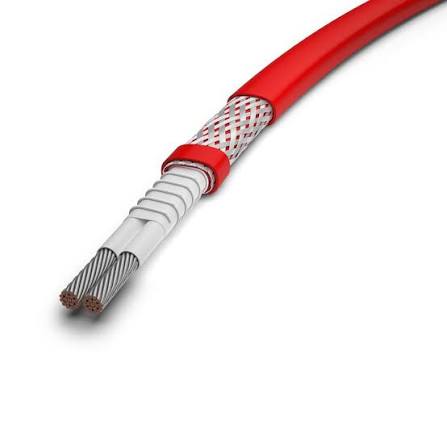
Heating Cable (Trace Heating) — IEC 60800 / IEEE 515 Self-Regulating and Constant Wattage Electric Trace Heating Cable with Tinned Copper Bus Wire, Semiconductive Heating Matrix, and Fluoropolymer/TPE Outer Jacket for Pipe Freeze Protection, Roof and Gutter De-Icing, Floor Heating, and Industrial Process Temperature Maintenance
EV Charging & Renewable Energy Cables /Trace Heating

Heating Cable (Trace Heating) — IEC 60800 / IEEE 515 Self-Regulating and Constant Wattage Electric Trace Heating Cable with Tinned Copper Bus Wire, Semiconductive Heating Matrix, and Fluoropolymer/TPE Outer Jacket for Pipe Freeze Protection, Roof and Gutter De-Icing, Floor Heating, and Industrial Process Temperature Maintenance

Heating cable trace heating: IEC 60800 / IEEE 515 self-regulating or constant wattage, tinned copper bus wire, semiconductive heating matrix. Fluoropolymer or TPE jacket. 10–60 W/m at 10°C. For pipe freeze protection, roof de-icing, floor heating, process temperature maintenance. -40°C cold start. CE, RoHS.

Key Features

IEC 60800 and IEEE 515 compliant — the international standards for electric trace heating cables covering self-regulating (PTC — positive temperature coefficient) and constant wattage (series resistance and zone/parallel resistance) heating cable technologies
Self-regulating (PTC) heating matrix — a carbon-black-loaded cross-linked polymer matrix extruded between two parallel tinned copper bus wires; the matrix's electrical resistance increases with temperature, automatically reducing the heat output as the pipe or surface warms up and increasing it as the temperature drops; this self-regulation eliminates the risk of overheating and burnout if the cable is overlapped or covered with thermal insulation
Tinned copper bus wires (1.2–1.5 mm²) — the two parallel conductors that run the full length of the heating cable and supply power to the semiconductive heating matrix; the tinning protects against corrosion in the damp, condensing environments where trace heating cables are installed (pipe chases, roof valleys, underground conduit)
Fluoropolymer (FEP/PFA) or TPE outer jacket — fluoropolymer for high-temperature industrial trace heating applications to 200°C (steam-traced pipe replacement, process vessel heating) with excellent chemical resistance; TPE for commercial and residential applications to 65°C (pipe freeze protection, roof de-icing) with halogen-free construction and good UV resistance for outdoor exposed installations
Power outputs from 10 to 60 W/m at 10°C pipe temperature — 10 W/m for domestic water pipe freeze protection in insulated attics and crawl spaces; 26 W/m for commercial hot water temperature maintenance; 40–60 W/m for industrial process pipe temperature maintenance and roof/gutter de-icing
Tinned copper braid earth screen (≥80% coverage) over the heating element — provides the electrical safety earth path; the braid is in continuous contact with the heating cable jacket and, when connected to an RCD/GFCI protected circuit, provides the earth leakage path that trips the protection if the cable is damaged and the heating element contacts the braid
Optional fluoropolymer or TPE outer jacket over the braid — provides additional mechanical and chemical protection; the outer jacket is essential for chemical plant and industrial installations where the trace heating cable may be exposed to solvents, acids, or caustic cleaning solutions
Cold lead (power connection) cable — a 2–3 m non-heating flexible cable factory-jointed to the heating cable for connection to the power supply junction box; the cold lead to heating cable transition is sealed and insulated for the rated operating temperature and environmental exposure of the installation

Applications

Pipe freeze protection — self-regulating heating cable spiralled or traced straight along domestic and commercial water pipes in unheated spaces (attics, crawl spaces, external walls) to prevent water freezing and pipe bursting at ambient temperatures down to -30°CCommercial hot water temperature maintenance — heating cable installed along the hot water recirculation loop in hotels, hospitals, and apartment buildings to maintain the hot water temperature at the point of use without a dedicated hot water return pipe and recirculation pumpRoof and gutter de-icing — self-regulating heating cable in a zigzag pattern on the roof edge and through gutters and downspouts to prevent ice dam formation; the cable melts channels through snow and ice, allowing meltwater to drain rather than backing up under the roof coveringIndustrial process pipe temperature maintenance — constant wattage or self-regulating heating cable for maintaining process fluids (oils, chemicals, food products) at the required temperature to prevent solidification, viscosity increase, or phase separation in processing plants and refineriesTank and vessel heating — heating cable wrapped around storage tanks and process vessels to maintain the contents at the required storage or processing temperature; the cable is installed under the tank thermal insulation and sized for the tank surface area, insulation thermal resistance, and the temperature difference between the tank contents and the minimum ambientFloor heating — constant wattage heating cable embedded in the screed or self-levelling compound under tile, stone, and engineered wood floor finishes for comfort heating in bathrooms, kitchens, and living spaces; the cable is controlled by a floor-sensing thermostat to maintain the set floor surface temperatureRamp and stair heating — heating cable embedded in concrete or asphalt for snow and ice melting on outdoor pedestrian ramps, stairs, walkways, and loading docks; the higher power output (200–350 W/m²) provides the heat flux required to melt falling snow at the design snowfall rate

Technical Specifications

Standard — Heating Cable IEC 60800: Heating cables with a rated voltage of 300/500 V for comfort heating and prevention of ice formation; IEEE 515: Standard for the Testing, Design, Installation, and Maintenance of Electrical Resistance Trace Heating for Industrial Applications
Standard — Electrical Installation IEC 60364-7-753: Electrical installations — heating cables and embedded heating systems; the installation standard covering RCD protection, circuit sizing, and control requirements
Heating Cable Type — Self-Regulating (PTC) Two parallel tinned copper bus wires (1.2–1.5 mm²) embedded in a semiconductive cross-linked polymer (polyolefin or fluoropolymer) heating matrix; the matrix is a carbon-black-loaded polymer whose electrical resistance increases with temperature per the PTC effect; the resistance increase is smooth and repeatable over the full operating temperature range
Heating Cable Type — Constant Wattage (Zone) Two parallel bus wires with a nichrome resistance heating wire spiralled around the insulated bus wires and connected to alternate bus wires at regular intervals (typically every 1 m — the zone length); each zone is a fixed-resistance heating element; the total heat output is constant regardless of temperature (no self-regulation); used where constant heat output is required and the installation conditions guarantee that the cable will not overheat
Heating Cable Type — Constant Wattage (Series Resistance) A single continuous nichrome or copper-nickel alloy resistance wire; the total circuit resistance determines the heat output (P = V²/R); cut to a precise length at the factory — cannot be shortened on site; used for long pipeline trace heating where a single continuous heating circuit of hundreds of meters is practical
Rated Voltage 230 V AC (standard for European and Asian installations); 110–120 V AC (North America); the heating cable is connected to a single-phase supply through a thermostat or controller
Power Output at 10°C (Self-Regulating) 10 W/m (light duty — domestic water pipe freeze protection); 17 W/m (medium duty — commercial pipe freeze protection); 26 W/m (heavy duty — hot water temperature maintenance); 33 W/m (industrial — process pipe temperature maintenance); 40–60 W/m (de-icing — roof, gutter, ramp)
Power Output (Constant Wattage) Fixed per the cable's design; typically 10, 20, 30, 40 W/m; the output is independent of temperature; the cable must be controlled by a thermostat to prevent overheating
Bus Wire Material Tinned copper; 1.2 mm² (standard for heating cables up to 150 m circuit length); 1.5 mm² (for long circuit lengths and high-startup-current self-regulating cables in cold-start conditions)
Heating Matrix — Polyolefin (Self-Regulating) Carbon-black-loaded cross-linked polyolefin; rated 65°C continuous (energized); 85°C intermittent (de-energized exposure, e.g., steam cleaning of the pipe); the polyolefin matrix is the standard for commercial and residential trace heating applications
Heating Matrix — Fluoropolymer (Self-Regulating, High-Temp) Carbon-black-loaded cross-linked fluoropolymer; rated 120°C continuous (energized); 200°C intermittent (de-energized exposure); for industrial process pipe trace heating at elevated temperatures where polyolefin would thermally degrade
Inner Jacket — Polyolefin or Fluoropolymer Extruded over the heating matrix for electrical insulation between the heating element and the earth braid
Earth Braid Tinned copper braid; ≥80% coverage; in continuous contact with the inner jacket; the braid provides the earth fault path and must be connected to the circuit protective earth at the power supply end
Outer Jacket — TPE Thermoplastic elastomer; rated 65°C; halogen-free; UV-stabilized; for commercial and residential applications where the cable is exposed to weather (roof de-icing, outdoor pipe freeze protection)
Outer Jacket — Fluoropolymer (FEP/PFA) Rated 200°C (FEP) or 260°C (PFA); chemically resistant to most industrial solvents, acids, and bases; for chemical plant, refinery, and industrial process trace heating where the cable jacket may be exposed to aggressive chemicals
Cold Lead — Power Connection Cable 3-core flexible PVC or silicone-insulated cable, 2.0–3.0 m length, factory-jointed to the heating cable; the transition joint is sealed and over-moulded or heatshrink-sleeved for the rated exposure temperature and IP rating (typically IP67 for wet locations)
Circuit Length — Maximum (Self-Regulating, 10 W/m) Up to 150 m per circuit at 230 V with a C16 MCB; the circuit length is limited by the startup current (2–3× the steady-state current at cold start) and the voltage drop along the bus wires; longer circuits can be achieved with 1.5 mm² bus wire and a C20 MCB
Startup Current — Self-Regulating at Minimum Temperature Typically 2–3× the steady-state current; a 100 m circuit rated 26 W/m (2 600 W steady state) draws approximately 11.3 A steady state at 230 V; at a -20°C cold start the startup current may peak at 25–35 A for the first few minutes until the heating matrix warms and its resistance increases — the circuit breaker must be sized for the startup current, not the steady-state current
Earth Leakage Protection RCD / GFCI protection at 30 mA trip current is mandatory per IEC 60364-7-753 for all trace heating circuits in accessible locations; the earth braid provides the leakage path if the heating cable is mechanically damaged; the RCD trips before a person can contact a live heating element
Temperature Control Thermostat with a pipe-surface or ambient-air temperature sensor; the thermostat set point is typically 5°C for freeze protection (cable energizes when the pipe temperature drops below 5°C, de-energizes above 10–15°C); for process temperature maintenance, the set point is the required process temperature ±5°C hysteresis
Minimum Installation Temperature -30°C (self-regulating cable with polyolefin matrix — the cable can be installed in cold conditions but must be handled carefully; the polymer jacket is less flexible at low temperatures but will not crack under installation bending at the specified minimum bend radius)
Minimum Bend Radius 25 mm (small cables); 6× cable OD (larger cables); the bend radius is specified to prevent kinking the bus wires — a kinked bus wire creates a high-resistance point that can overheat and fail the cable
Certifications CE; RoHS; IEC 60800 type testing; VDE on request; ISO 9001 manufactured

Detailed Description

What Is Trace Heating Cable?

An electric trace heating cable (also called heat tracing, heat tape, or heating tape) is a flexible cable that converts electrical energy into heat along its entire length to compensate for heat losses from pipes, tanks, roofs, and other surfaces to the surrounding environment. Unlike a conventional power cable — which is designed to deliver electrical energy from A to B with minimum loss — a heating cable is designed to dissipate electrical energy as heat (I²R loss in a resistive heating element) at a controlled power per unit length, distributed uniformly along the cable.

Trace heating replaces or supplements conventional thermal insulation. A pipe with 50 mm of mineral wool insulation loses approximately 8–12 W/m of heat at a 40°C temperature difference between the pipe contents and the ambient air. Without trace heating, water in an unheated attic pipe at -10°C ambient will freeze within hours regardless of the insulation thickness — because insulation only slows heat loss; it does not add heat. A 10 W/m trace heating cable installed on the pipe surface under the insulation adds exactly the heat that is lost, maintaining the pipe at a safe temperature above freezing.

Self-Regulating vs Constant Wattage — How They Work

ParameterSelf-Regulating (PTC)Constant Wattage
Heating elementCarbon-black-loaded polymer matrix between two bus wiresNichrome resistance wire (zone type: spiralled around bus wires; series type: continuous single wire)
Temperature responsePower output decreases as temperature rises — the polymer matrix resistance increases per the PTC effectPower output is fixed regardless of temperature
Self-regulationYes — the cable adjusts its heat output to match the local heat loss; if a section is covered by snow (insulated), that section's temperature rises and its power output drops, preventing overheatingNo — the cable delivers constant power; it must be controlled by a thermostat to match the heat demand and prevent overheating
Overlap toleranceCan be overlapped — if the cable crosses itself, the overlapped section warms up, its resistance rises, and its power output drops, preventing hotspot formationCannot be overlapped — overlapping a constant wattage cable creates a hotspot because both cable sections deliver full power at the overlap point, doubling the heat flux and potentially overheating the cable
Cut-to-length on siteYes — the heating matrix between the bus wires acts as a continuous resistive strip; cutting the cable anywhere between bus wires creates a functional heating sectionZone type: cut at marked zone intervals only (typically 1 m); series type: factory-cut only — the total resistance determines the heat output and cannot be changed on site
Circuit length flexibilityYes — the cable can be shortened or extended (within the maximum circuit length limit) to match the pipe lengthZone type: limited to integer multiples of the zone length; series type: fixed factory length
Typical applicationsPipe freeze protection, roof de-icing, commercial hot water maintenanceLong pipeline industrial trace heating, tank heating, process temperature maintenance where constant heat output is required and the thermostat provides control
Cost per meterHigher — more complex manufacturing (extruding the heating matrix)Lower — simpler construction
Thermostat requiredRecommended (energy saving) but not mandatory — the self-regulation provides inherent overheat protection at moderate ambient temperaturesMandatory — the thermostat is the only overheat protection

Self-regulating cable dominates the commercial and residential trace heating market because of its safety advantage: it cannot overheat itself if overlapped, covered, or buried in insulation. For industrial applications where the process temperature must be maintained precisely and the installation conditions are controlled (no overlap risk, thermostat installed), constant wattage cable is a cost-effective alternative.

Why Choose Yichi Trace Heating Cables

  • IEC 60800 / IEEE 515 compliant — tested for trace heating safety: The cable is type-tested for the full trace heating duty cycle including cold-start current surge, thermal ageing at rated temperature, mechanical crush and impact resistance, and earth braid continuity. Trace heating cable is a safety-critical product — a failed cable in an attic can cause a frozen pipe burst costing thousands in water damage; a failed cable in a chemical plant can cause a process fluid to solidify, shutting down production
  • Self-regulating and constant wattage technologies — select the right cable for the application: Yichi manufactures both technologies. For most commercial and residential trace heating, self-regulating cable with its inherent safety and cut-to-length convenience is recommended. For industrial long-pipeline and process applications, constant wattage cable with its predictable heat output and lower cost per meter is available
  • Fluoropolymer high-temperature option to 200°C: For industrial process pipe trace heating where the pipe temperature exceeds 65°C (steam-traced replacement, high-temperature process maintenance), the fluoropolymer-jacketed self-regulating cable provides reliable heat tracing at temperatures that would degrade a polyolefin or TPE jacket within months
  • Tinned copper bus wire and earth braid: Both are tinned — because trace heating cables are installed in environments where condensation and moisture are present (pipe chases, attics, roof edges). Bare copper in these environments corrodes, increasing the bus wire resistance and reducing the heating cable's power output over time. Tinned copper maintains stable electrical characteristics for the rated service life
  • Cold lead factory-jointed and sealed: The transition from the non-heating cold lead to the heating cable is the most critical joint in the installation — if water enters this joint (from condensation, rain, or pipe leaks), it can cause earth leakage, circuit breaker tripping, and heating failure. The Yichi cold lead connection is over-moulded and rated IP67 for wet locations
  • Application sizing support: Provide the pipe diameter, insulation type and thickness, minimum ambient temperature, required maintain temperature, and the pipe material (metal or plastic) — we calculate the heat loss per meter per IEC 62395 (industrial trace heating design) or IEEE 515 and recommend the cable power output, circuit length, and thermostat set point

Product Inquiry

Product: Heating Cable (Trace Heating) — IEC 60800 / IEEE 515 Self-Regulating and Constant Wattage Electric Trace Heating Cable with Tinned Copper Bus Wire, Semiconductive Heating Matrix, and Fluoropolymer/TPE Outer Jacket for Pipe Freeze Protection, Roof and Gutter De-Icing, Floor Heating, and Industrial Process Temperature Maintenance

Add technical specifications (optional)

The more detail you provide, the faster and more accurate our quotation.

No file chosen

PDF, Office, image or CAD file — up to 5 MB

Need Help?

Certifications

ISO 9001
Quality
CE
European
RoHS
Environmental
TÜV
Certification

Need a Quote for This Product?

Send us your requirements and receive a detailed quotation within 24 hours.