Detailed Description
TRVV Control Cable vs Standard Control Cable
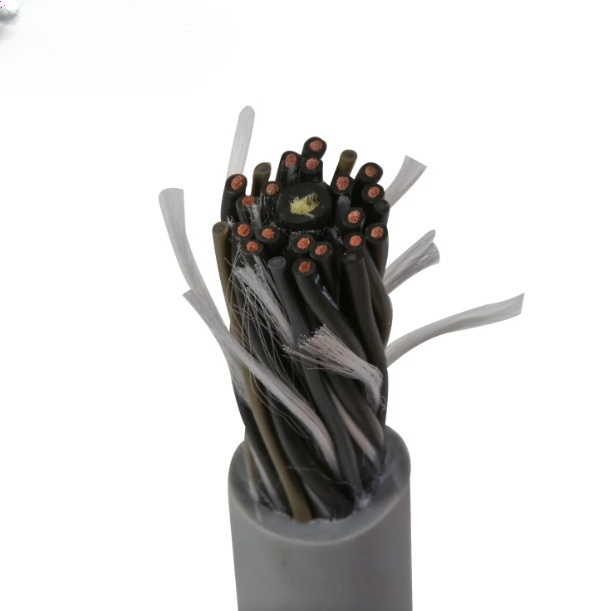
The difference between these two cables is not visible to the eye. Both use PVC insulation and jacket, both have numbered or color-coded cores, both are 300/500 V rated. The difference is in the internal construction — and in the flex life:
| Design Element | Standard Control Cable | TRVV Control Cable |
|---|---|---|
| Conductor class | Class 5 (basic flexible) | Class 5 (optimized lay) or Class 6 |
| Lay length | Standard (cost-optimized) | Short (flex-optimized) |
| Filler stranding | Optional, minimal | Standard — maintains roundness during flex |
| Inner wrap | Plastic tape (thin) | PET fleece — wear-resistant |
| Flex life rating | Not rated — design for fixed installation | 3–5 million cycles at 7.5×D |
| Bend radius | 7.5×D (conservative, untested) | 7.5×D (verified by test) |
| Cost premium | Baseline | 10–20% |
The TRVV designation means the cable has been designed and tested for repeated flexing. Standard control cable uses the same basic materials but with a construction optimized for cost and ease of manufacturing — not for millions of bend cycles.
Where Standard Control Cable Fails — Real-World Failure Modes
Control cables on moving machine parts fail in patterns that TRVV construction specifically addresses:
Failure Mode 1: Core Migration
In standard control cable, the cores are simply twisted together with minimal filler. After thousands of bending cycles, the cores shift — some migrate toward the outside of the bend (tension), others bunch up at the inside (compression). The outer cores stretch and thin, eventually breaking. TRVV's filler elements lock the cores in position, preventing migration.
Failure Mode 2: Core-to-Jacket Abrasion
Standard control cable has a thin plastic tape between the core assembly and the jacket. During bending, the cores press against this tape, which eventually wears through. Once the tape is gone, the cores rub directly against the inside of the jacket — wearing through the core insulation. TRVV's PET fleece inner wrap is thicker and more wear-resistant, absorbing this friction throughout the cable's service life.
Failure Mode 3: Conductor Fatigue at Termination
Standard control cable's longer lay length means the individual copper strands experience more bending strain per cycle. At the termination point, where the cable is rigidly clamped, this strain concentrates. TRVV's shorter lay length distributes the strain more evenly, reducing stress at the clamp point.
When TRVV Control Cable Is the Right Choice
| Application | Standard Control Cable OK? | TRVV Control Cable Needed? |
|---|---|---|
| Fixed cabinet-to-cabinet wiring (no motion) | ✅ | ❌ Over-specified |
| Cable tray with occasional maintenance movement | ✅ | ❌ Not needed |
| Hinged control panel door (< 10 cycles/day) | ✅ | ❌ Not needed |
| Robot dress pack (external cable routing) | ❌ Insufficient | ✅ Required |
| Moving gantry XY axis | ❌ Rapid fatigue failure | ✅ Required |
| Elevator traveling cable | ❌ Core migration | ✅ Required |
| Automated test head (> 1 000 cycles/day) | ❌ Insufficient flex life | ✅ Required |
| Cable carrier / drag chain | ❌ Not rated | ✅ Minimum requirement |
TRVV Construction — What Each Letter Mean for Control Applications
| TRVV Letter | Meaning | Engineering Implication |
|---|---|---|
| T | Drag chain (拖链) | Designed for repeated flexing — not just one-time installation bend |
| R | Flexible conductor (软) | IEC 60228 Class 5 or 6 stranded — each strand individually flexible |
| V | PVC insulation | First V — core-to-core and core-to-ground electrical isolation |
| V | PVC jacket | Second V — mechanical and environmental protection |
The "T" is the key differentiator from standard control cable. It signifies that this cable has been engineered for the same repeated-flex duty as drag chain cables — even if the application is not a formal cable carrier.
Why Choose Yichi Cable TRVV Control?
- Genuine TRVV construction: Our TRVV control cable uses the same stranding, filler, and inner wrap construction as our drag chain cables — not a standard control cable re-labeled as TRVV
- Class 6 option available: Need more flex life? Upgrade to Class 6 conductors — same TRVV construction, finer stranding, 5 million cycles rated
- PET fleece as standard: The critical inner wear layer is included on every TRVV control cable — not an option, not an extra
- Flex-tested, not calculated: Our 3–5 million cycle rating is based on actual laboratory testing at 7.5×D — not a theoretical calculation from conductor strand count
- Application review included: Not sure whether standard control or TRVV is right? Our application engineers review your motion profile and recommend the appropriate cable — no upselling, just engineering