Detailed Description
- q: "What is the operating temperature limit for this cable?"
- q: "How is the cable packed and can it be cut to length?"
a: "Standard packing is 100 m/roll, with selected sizes available in 100 m or 305 m rolls. Cut-to-length supply is available. Because printing may vary between production lots, note any strict printing requirements on the order."
What Is a UL20276 Shielded Twisted Pair Drag Chain Cable?
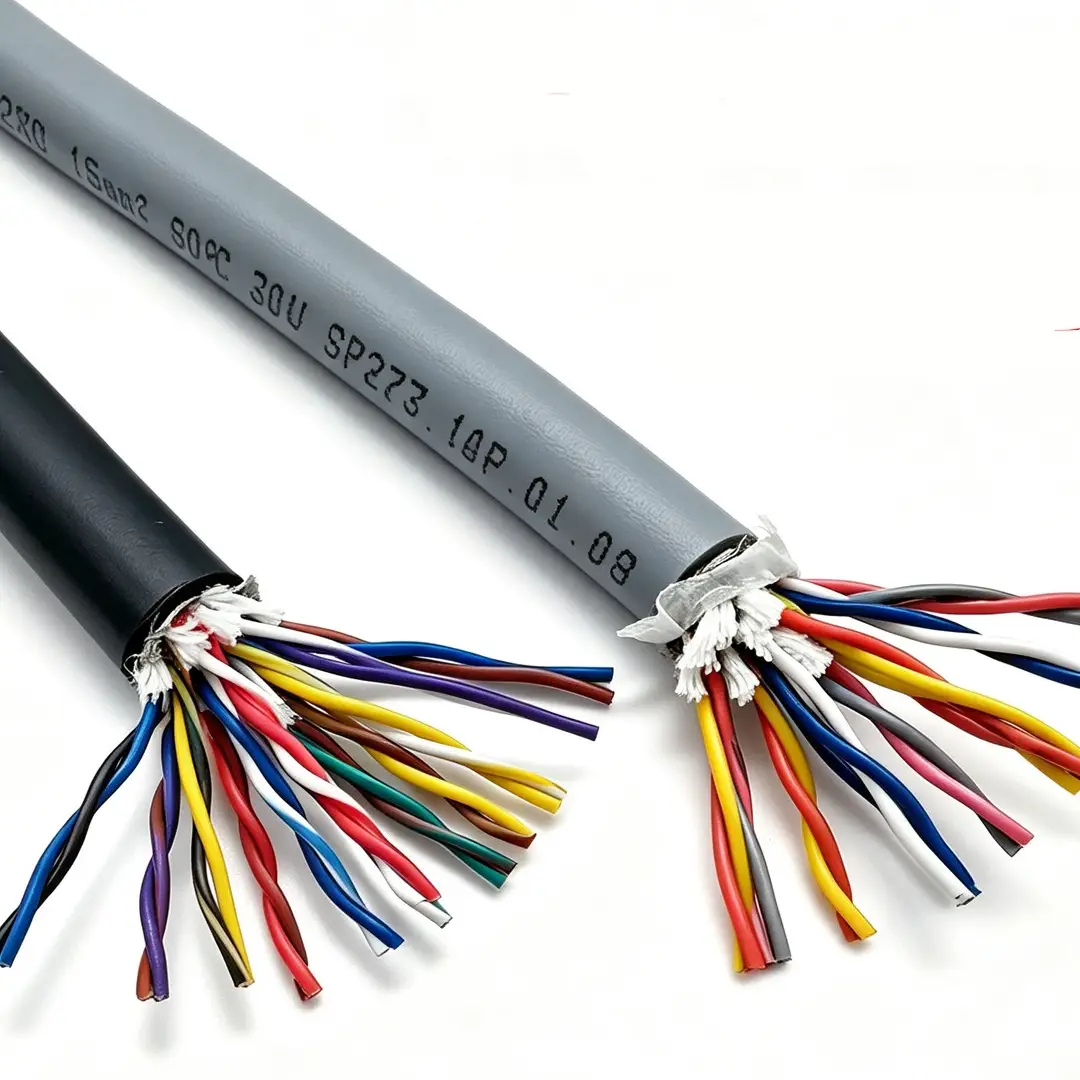
A UL20276 shielded twisted pair drag chain cable is a multi-core control and signal cable built for low-voltage equipment wiring where electromagnetic interference, repeated flexing, and oily environments are present. It uses finely stranded tinned copper conductors, HDPE insulation, a double shield of 100% aluminium foil plus tinned copper braid, and a special PVC jacket. The rated temperature is 80 °C, the rated voltage is 30 V, and the available core range is 3 to 64 cores. Typical uses include servo motor and encoder connections, industrial robot and robot arm harnesses, cable carrier wiring, CNC machines, engraving machines, PLC IO, and printing, packaging, or textile automation lines.
Construction: Conductor, Insulation, Shield, and Jacket
Conductor and Insulation
Conductors are finely stranded tinned copper. The documented builds are 28 AWG 7/0.127, 26 AWG 30/0.08TS, 24 AWG 42/0.08TS, and 22 AWG 70/0.08TS. Tinned copper helps limit oxidation at terminals and supports repeat bending. The insulation is HDPE, with a nominal wall of 0.16 mm and an insulation outer diameter of 0.70 ± 0.05 mm on the 28 AWG technical data. HDPE keeps the pair geometry stable, which matters for consistent signal behaviour in encoder and IO circuits.
Shield, Filler, and Jacket
The shield is a double construction: 100% aluminium foil plus a tinned copper braid. The braid coverage is stated conservatively as ≥85%. Cotton yarn, cotton paper, tensile cotton rope, and non-woven wrap are used as filler and separator materials to keep the core lay compact and add mechanical toughness. The jacket is a special PVC compound formulated for oil resistance and repeated flexing, and it is normally grey with black available. Cores are colour coded, and twisted pairs are marked with a × symbol, for example orange × yellow.
Electrical and Environmental Ratings
| Item | Value |
|---|---|
| Rated temperature | 80 °C |
| Rated voltage | 30 V |
| Dielectric withstand test | 1500 V AC / min |
| Insulation resistance | 10 MΩ/km @ 20 °C |
| Conductor resistance | 94.2 Ω/km @ 20 °C (24 AWG) |
| Operating temperature range | −15 °C to +80 °C |
| Fixed installation bending radius | 4 × cable O.D. |
| Drag chain test | 15,000,000 bending cycles at 7.5 × cable O.D. bending radius, 1 m travel, 88 m/min, 10 m/s² |
Flexing Performance in Cable Carriers
The cable is rated for continuous flexing in cable carriers under the tested conditions stated above. The documented drag chain test uses 15,000,000 bending cycles, a 7.5 × cable O.D. bending radius, a 1 m travel path, 88 m/min running speed, and 10 m/s² acceleration. For fixed installation, the recommended bending radius is 4 × cable O.D. Continuous flexing life depends on the actual travel length, bending radius, running speed, and acceleration in the machine. Confirm the layout before selection if the application operates near these conditions.
Core Counts, Outer Diameters, and Reference Weights
The UL20276 range covers shielded twisted pair, shielded non-twisted, and unshielded non-twisted constructions. The tables below reproduce the documented outer diameters and reference weights by construction. Values are listed as supplied for each source table; do not use one table to recalculate another.
Shielded Twisted Pair (Printed Pair) Outer Diameters
| Specification | Outer diameter mm |
|---|---|
| 5×2×28AWG (10 cores) | 5.0 |
| 10×2×28AWG (20 cores) | 6.6 |
| 13×2×28AWG (26 cores) | 7.2 |
| 17×2×28AWG (34 cores) | 8.0 |
| 20×2×28AWG (40 cores) | 8.4 |
| 25×2×28AWG (50 cores) | 9.2 |
Shielded Non-Twisted Outer Diameters
| Specification | Outer diameter mm |
|---|---|
| 10×28AWG | 4.8 |
| 20×28AWG | 6.0 |
| 26×28AWG | 6.5 |
| 34×28AWG | 7.2 |
| 40×28AWG | 7.5 |
| 50×28AWG | 8.4 |
Unshielded Non-Twisted Outer Diameters
| Specification | Outer diameter mm |
|---|---|
| 10×28AWG | 4.6 |
| 20×28AWG | 5.7 |
| 34×28AWG | 6.7 |
| 40×28AWG | 7.0 |
| 50×28AWG | 8.0 |
I/O Control Cable Outer Diameters
| Specification | Shielded outer diameter | Unshielded outer diameter |
|---|---|---|
| 100.08 | 4.8 mm | 4.6 mm |
| 150.08 | 5.8 mm | 5.5 mm |
| 200.08 | 6.0 mm | 6.0 mm |
| 260.08 | 6.5 mm | — |
| 340.08 | 7.5 mm | 6.8 mm |
| 360.08 | 7.5 mm | 7.0 mm |
| 400.08 | 7.6 mm | 7.0 mm |
| 440.08 | 8.0 mm | 7.8 mm |
| 50*0.08 | 8.4 mm | 8.0 mm |
24 AWG Outer Diameter and Reference Weight by Core Count
| Specification | Outer diameter mm | Reference weight (kg / 100 m) |
|---|---|---|
| 20276-24/3C | 5.0 | 3.9 |
| 20276-24/4C | 6.0 | 5.5 |
| 20276-24/6C | 6.7 | 7.1 |
| 20276-24/8C | 7.2 | 8.4 |
| 20276-24/10C | 7.8 | 9.9 |
| 20276-24/12C | 8.3 | 11.4 |
| 20276-24/14C | 8.9 | 13.1 |
| 20276-24/16C | 9.6 | 15.2 |
| 20276-24/18C | 9.8 | 16.1 |
| 20276-24/20C | 10.2 | 17.5 |
| 20276-24/22C | 10.9 | 19.8 |
| 20276-24/24C | 11.3 | 23.4 |
| 20276-24/26C | 11.6 | 22.6 |
| 20276-24/28C | 12.1 | 24.6 |
| 20276-24/30C | 12.6 | 26.6 |
| 20276-24/32C | 13.0 | 28.3 |
| 20276-24/34C | 13.4 | 30.1 |
| 20276-24/36C | 13.7 | 31.5 |
| 20276-24/38C | 14.4 | 34.5 |
| 20276-24/40C | 14.7 | 36.0 |
Specification Approval and 28 AWG Technical Data
| Item | Parameter |
|---|---|
| Specification model | Shielded 273-20276 24AWG series |
| Rated temperature | 80 °C |
| Rated voltage | 30 V |
| Environmental standard | RoHS |
| Conductor material | Tinned stranded copper |
| Separator material | Cotton yarn and cotton paper |
| Insulation material | HDPE |
| Jacket material | PVC (RoHS) |
| Conductor resistance | 94.2 Ω/km @ 20 °C |
| Insulation resistance | 10 MΩ/km @ 20 °C |
| Dielectric withstand test | 1500 V AC / min |
| Drag chain test | 15,000,000 bending cycles; bending radius 7.5 × cable O.D.; travel path 1 m; running speed 88 m/min; acceleration 10 m/s² |
| Item | Parameter |
|---|---|
| Conductor specification | 7/0.127 tinned copper (28 AWG) |
| Conductor outer diameter | 0.38 mm |
| Insulation | HDPE, nominal insulation thickness 0.16 mm, insulation outer diameter 0.70 ± 0.05 mm |
| Cable core counts | 50 / 40 / 34 / 26 / 20 / 10 cores (also 20 / 26 / 34 / 36 / 40 / 44 / 50 cores, 10P / 15P / 20P / 25P / 32P) |
| Temperature range | −15 °C to +80 °C |
| Bending radius | Fixed installation 4 × cable O.D. |
| Nominal voltage | 30 V |
| Core identification | Colour-coded cores |
| Jacket material | Special PVC jacket |
| Insulation material | HDPE |
| Shield structure | 100% aluminium foil + ≥85% tinned copper braid |
Selection, Installation, and Equipment Fit
Choose the conductor size and core count from the actual signal count, current requirement, available space, and the bending radius allowed by the machine. Shielded twisted pair constructions are the first choice for servo motor and encoder circuits where pair geometry and double shielding matter. Shielded non-twisted layouts suit circuits that need shielding but do not require twisted pairs. Unshielded non-twisted layouts are for lower-interference runs where a smaller outer diameter is preferred.
During installation, use stripping tools sized for the conductor and shield, and avoid nicking the tinned copper strands. Keep twisted pairs twisted as close as possible to the termination point. Ground the shield according to the equipment EMC plan. For fixed installation, respect the 4 × cable O.D. bending radius. For cable carrier use, the documented test condition is a 7.5 × cable O.D. bending radius, so confirm the actual travel, speed, and acceleration before ordering.
This cable fits equipment designs that call for a UL20276 reference, HDPE insulation, 30 V low-voltage control and signal wiring, 80 °C rated temperature, and a core range from 3 to 64. It also provides the documented pair colour coding, separate outer diameter tables for shielded twisted pair, shielded non-twisted, and unshielded non-twisted constructions, and a drag chain test result with full conditions. If your review package needs those specific data points, this construction gives you the values to check against the machine layout.
How to Request a Quote
Use the form on this page to send your core count, AWG, shielding type, jacket colour, length, and operating conditions. Include travel length, bending radius, speed, and acceleration if the cable will run in a carrier.