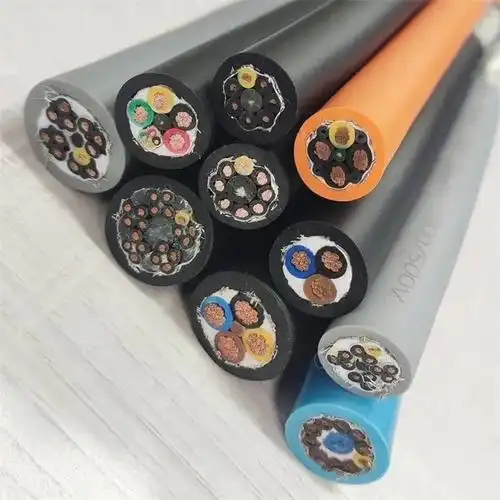
Detailed Description
Ultraflex — When High-Flex Is Not Flexible Enough
High-flex cable (Class 6 conductor, PUR jacket, 5–7.5×D bend radius, 10+ million cycles) is the standard for demanding drag chain and robot applications. It handles 95% of industrial motion requirements.
Ultraflex cable handles the remaining 5% — applications where:
- A 5×D bend radius is too large — the available space demands 3×D or less
- 10 million cycles is insufficient — the application demands 20–30 million
- Standard cable weight creates unacceptable inertia — a lighter cable enables faster acceleration
- PVC/PUR jacket stiffness causes measurable hysteresis — the cable's mechanical resistance distorts precision motion
- Cleanroom Class 1 (ISO 3) is required — standard cable jackets emit too many particles
Why Ultraflex Works — Physics at the Micron Scale
Standard Class 6 conductor uses single wires of 0.08–0.12 mm. The bending strain on each wire is proportional to the wire diameter: thinner wires experience less strain for the same bend radius.
By reducing the single wire to 0.04–0.06 mm, the bending strain per wire drops by approximately 50%. This enables two critical improvements:
- Tighter bend radius without fatigue: At 3×D bend radius, 0.05 mm wire experiences the same bending strain as 0.10 mm wire at 6×D — the ultraflex cable can bend twice as tightly without exceeding the copper's fatigue limit
- Longer life at the same radius: At 5×D, 0.05 mm wire experiences half the strain of 0.10 mm wire — doubling the potential flex life from ~15 million to ~30 million cycles
TPE/TPEE Jacket — Softness That Enables Ultraflex
Standard PUR jacket has a Shore hardness of 85–90 A — comparable to a car tire. It protects the cable well but resists bending.
Ultraflex TPE/TPEE jacket has a Shore hardness of 65–80 A — comparable to a pencil eraser. It yields easily to bending forces, minimizing the mechanical energy required to flex the cable.
| Property | Standard PUR | Ultraflex TPE/TPEE |
|---|---|---|
| Shore hardness | 85–90 A | 65–80 A |
| Flexural modulus | 50–100 MPa | 10–30 MPa |
| Elongation at break | 300–500% | 400–700% |
| Compression set | 20–30% | 10–15% |
| Density | 1.15–1.25 g/cm³ | 0.95–1.10 g/cm³ |
| Bend force (relative) | 100% | 25–40% |
The lower flexural modulus means the jacket requires 60–75% less bending force than PUR. In precision motion applications, this reduces cable-induced positioning error (hysteresis) — the cable does not "fight" the motion system.
Trade-offs — Ultraflex Is Not Universal
Ultraflex cable is the right choice for extreme flexibility requirements. It is NOT the right choice for:
- Abrasive environments: The soft jacket (65–75 A Shore) wears faster than PUR (85–90 A). For abrasive carrier environments, use Wear-Resistant PUR
- Chemical/oil immersion: TPE has lower chemical resistance than PUR. For oil coolant or hydraulic fluid immersion, use PUR. TPEE provides enhanced chemical resistance — specify TPEE for moderate chemical exposure
- Cost-sensitive standard applications: Ultraflex costs 50–80% more than standard high-flex cable. If 7.5×D bend radius and 10 million cycles are sufficient, standard high-flex is the better economic choice
- Outdoor UV exposure without protection: TPE has good but not excellent UV stability. For permanent outdoor installation, PUR or TPEE with carbon black is recommended
Why Choose Yichi Cable Ultraflex?
- Genuine ultrafine stranding: 0.04–0.06 mm single wire diameter — verified by cross-section microscopy, not a catalog claim. Many "ultraflex" cables in the market use standard Class 6 (0.10 mm) conductor
- Cleanroom documentation: ISO Class 3 (Class 1) particle emission test data, siloxane-free certification, and outgassing analysis available — essential for semiconductor and medical device qualification
- TPE biocompatibility: USP Class VI and ISO 10993 test data for skin-contact and implant-adjacent medical applications
- Application-matched jacket: TPE for standard ultraflex, TPEE for enhanced chemical and temperature resistance — we help you select based on your environment, not a catalog default
- Lightweight advantage quantified: We provide actual weight per meter for your configuration — verify the inertia reduction for your specific motion profile