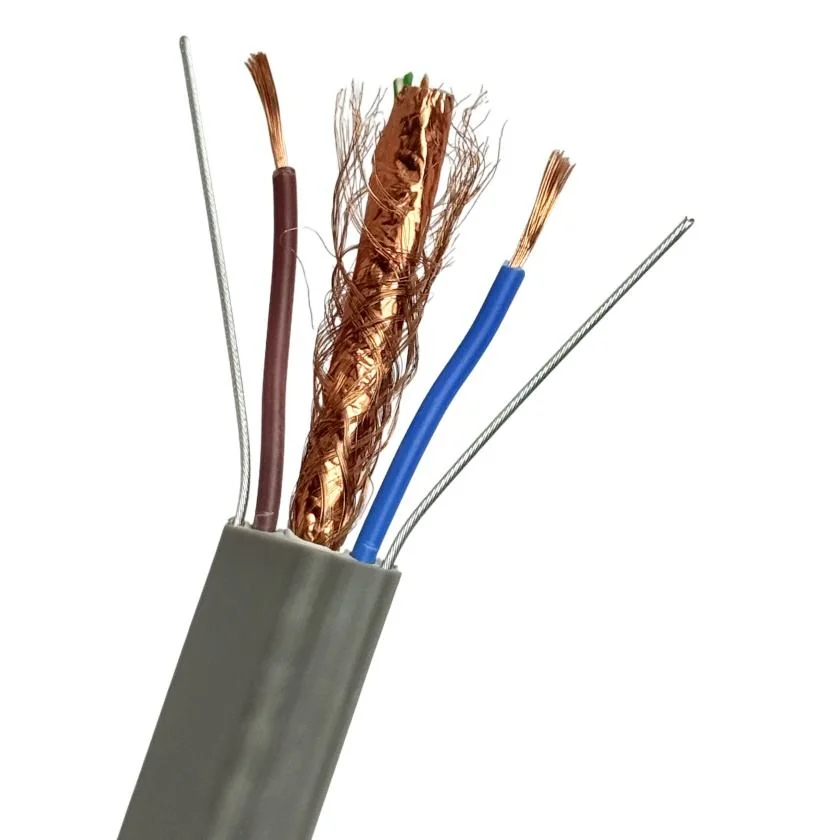
Elevator Coaxial Traveling Cable — Flat Travelling Cable with SYV75-5 Video Core, Optional 2×0.75 mm² Power Cores, Dual 1.0 mm Steel Strain Relief, and Foil Plus 128-Wire Braid Shield
สายเคเบิลลิฟต์และลิฟต์ขนของ /Coaxial Traveling Cable

Elevator Coaxial Traveling Cable — Flat Travelling Cable with SYV75-5 Video Core, Optional 2×0.75 mm² Power Cores, Dual 1.0 mm Steel Strain Relief, and Foil Plus 128-Wire Braid Shield

Flat elevator coaxial traveling cable with SYV75-5 video core, optional RVV 2×0.75 mm² power cores, dual 1.0 mm steel wires and foil plus 128-wire braid shield.

คุณสมบัติหลัก

Flat profile instead of a round bundle — the two configurations measure 6.4 mm × 14 mm and 6.8 mm × 17.9 mm, so the cable bends in one plane and stacks flat in the hoistway instead of twisting into a round bundle
Two 1.0 mm steel wires carry the tensile load — the stranded steel members sit alongside the cores and take the hanging weight of the travelling length, so the copper cores are not the load path
Dual shield: aluminium foil plus a 128-wire braid — the foil blocks electrostatic coupling and the braid handles the lower-frequency magnetic field from the hoist motor and the variable frequency drive
SYV75-5 coaxial video core — a solid polyethylene dielectric with an oxygen-free copper centre conductor, the construction used for analogue CCTV and composite video in lift cars
Optional power pair in the same jacket — the second configuration adds an RVV 2×0.75 mm² pair, so the camera and its supply run in one flat cable instead of two separate drops
Flexible PVC jacket and insulation — the compound is chosen for repeated bending as the car travels, and recovers its shape after the bend rather than taking a set
99.999% oxygen-free copper conductor — lower resistance and a stable signal path over the length of the hoistway run
Metre marking on the jacket — the length is printed along the cable, so the installed length can be read off during commissioning and future maintenance

การใช้งาน

Lift car CCTV — camera in the car ceiling or on the car frame, with the flat cable running from the car to the controllerHoistway video runs — the travelling length between the car and the machine room or the controller cabinetCar and counterweight wiring — video plus supply in a single flat drop where two separate cables would not fit the available spaceVideo and signal control — analogue video transmission and the associated control signal in the same travelling assemblyRetrofit of analogue CCTV in existing lifts — where the existing round bundle has no spare capacity for a separate camera cableMachine-room-less lifts — flat travelling cables that follow the car in a restricted hoistway envelope

ข้อมูลจำเพาะทางเทคนิค

Cable Type Flat elevator coaxial traveling cable, video core with optional power pair and dual steel strain relief
Configuration 1 Video + 2 steel wires
Configuration 2 Video + power + 2 steel wires
Video Core SYV75-5 coaxial
Video Core Dielectric Solid polyethylene
Power Core (Configuration 2) RVV 2 × 0.75 mm²
Power Core Insulation Flame retardant polyvinyl chloride
Conductor Material 99.999% oxygen-free copper
Shield Aluminium foil plus 128-wire braid, dual layer
Strain Relief 2 × 1.0 mm steel wire
Overall Height (Configuration 1) 6.4 mm
Overall Width (Configuration 1) 14 mm
Overall Height (Configuration 2) 6.8 mm
Overall Width (Configuration 2) 17.9 mm
Jacket Material Flexible polyvinyl chloride compound
Jacket Colour Grey
Marking Product name and specification printed on the jacket, with metre marking
Certifications CCC, RoHS, ISO 9001; national standard (GB) construction
Packing 100 m or 200 m per coil with certificate; lengths below 100 m supplied as measured cut lengths
Application Elevator video surveillance, video transmission, and signal control

คำอธิบายโดยละเอียด

Why an Elevator Video Cable Is Not an Ordinary CCTV Cable

A lift camera does not sit still. It travels with the car, several hundred times a day, through a hoistway that has a fixed amount of space for the cable to fold into. That changes two things about the cable: it has to bend repeatedly in a controlled plane, and it has to hang from something other than its own conductors.

This is why the elevator coaxial traveling cable is built flat. The two configurations measure 6.4 mm × 14 mm and 6.8 mm × 17.9 mm, and two 1.0 mm steel wires run alongside the cores for the full length. The steel wires take the hanging weight; the coaxial core and the optional power pair carry only signal and current.

The video core itself is SYV75-5 — a coaxial construction with a solid polyethylene dielectric and an oxygen-free copper centre conductor, the format used for analogue CCTV and composite video.

Construction: Coaxial Core, Power Cores, and the Two Steel Wires

The assembly is built from four element groups, and each has a job that the others cannot do:

  • Video core — SYV75-5 coaxial, with a solid polyethylene dielectric. The solid dielectric holds a constant geometry along the length, which is what keeps the signal stable over a long hoistway run.
  • Power pair (optional) — RVV 2 × 0.75 mm², insulated in flame retardant PVC. It supplies the camera in the same flat jacket, so the installation is one drop rather than two.
  • Shield — aluminium foil plus a 128-wire braid. The foil layer blocks electrostatic coupling; the braid handles the lower-frequency magnetic field generated by the hoist motor and its drive.
  • Strain relief — 2 × 1.0 mm steel wire. These are the tensile members, anchored at the fixed points so the copper cores never carry the cable's own weight.
  • Jacket — a flexible PVC compound in grey, selected for repeated bending as the car travels. It recovers its shape after the bend instead of taking a permanent set, which is what keeps the flat profile folding correctly in the hoistway.

Flat Dimensions and Configuration Options

ItemVideo + 2 steel wiresVideo + power + 2 steel wires
Video coreSYV75-5SYV75-5
Power core—RVV 2 × 0.75 mm²
ShieldFoil + 128-wire braidFoil + 128-wire braid
Strain relief2 × 1.0 mm steel2 × 1.0 mm steel
Height6.4 mm6.8 mm
Width14 mm17.9 mm
JacketFlexible PVC, greyFlexible PVC, grey

The two configurations differ only by the power pair. The width grows from 14 mm to 17.9 mm and the height from 6.4 mm to 6.8 mm, which is the space the second pair occupies in the same flat jacket.

Routing in the Hoistway

The flat profile is the reason this cable works in the space available. It bends in one plane, so the travelling loop folds predictably rather than twisting. A round bundle of the same core count tends to rotate as it hangs, and that rotation loads the conductors instead of the steel wires.

Two points decide the installation:

  • Fix the steel wires, not the cores. The tensile members are what the cable hangs from. The anchoring at the car end and at the fixed end is made on the steel wires, so the copper and the shield are never the load path.
  • Keep the bend in the flat plane. The profile is designed to bend across its width. Bending it the other way, out of the flat plane, works against the steel wires and shortens the service life of the jacket.
The jacket carries metre marking along with the product name and specification, so the installed length can be read off the cable during commissioning rather than measured again.

Certification and Ordering

The cable is built to national standard (GB) construction and carries CCC, RoHS, and ISO 9001. CCC is the relevant mark for the Chinese domestic lift market; for export projects, confirm which certification the destination market requires before the order is placed, since the mark on the jacket follows the market rather than the construction.

Standard supply is a 100 m or 200 m coil with a certificate. Lengths below 100 m are supplied as measured cut lengths, and because the jacket is printed with metre marking, a cut length can be verified on site.

To specify the cable, the two decisions are the configuration and the total travelling length: video only, or video plus the 2 × 0.75 mm² power pair. Send the hoistway length, the camera supply requirement, and the fixing arrangement through the enquiry form on this page, and the assembly is quoted against those three inputs.

คำถามที่พบบ่อย

Why use a flat cable in a lift instead of a round coaxial cable?

A flat cable bends in one plane and stacks flat along the car wall, which matters in a hoistway where the travelling length has to fold into a confined space. A round bundle tends to twist as it hangs, and the twist loads the cores rather than the strain relief. The flat profile also keeps the two steel wires in line with the bend.

What do the two steel wires actually do?

They carry the hanging weight of the travelling length. The cable hangs from the car and moves with it, so without a tensile member the copper cores and the shield would take that load and eventually fail at the termination. The 1.0 mm steel wires sit alongside the cores and are anchored at the fixed points.

Can I get video and camera power in one cable?

Yes. The second configuration adds an RVV 2 × 0.75 mm² pair to the SYV75-5 video core inside the same flat jacket, which brings the overall size to 6.8 mm × 17.9 mm instead of 6.4 mm × 14 mm. One drop then carries both the video signal and the camera supply.

How is the shield arranged against hoist motor interference?

There are two layers: aluminium foil, which blocks electrostatic coupling, and a 128-wire braid, which handles the lower-frequency magnetic field from the hoist motor and its variable frequency drive. The foil alone would not deal with the magnetic component, and the braid alone would leave the foil-covered gap.

What lengths are supplied, and is the length marked on the cable?

Standard coils are 100 m and 200 m with a certificate. Lengths below 100 m are supplied as measured cut lengths, and the jacket carries metre marking plus the product name and specification, so the installed length can be read directly from the cable.

สอบถามสินค้านี้

สินค้า: Elevator Coaxial Traveling Cable — Flat Travelling Cable with SYV75-5 Video Core, Optional 2×0.75 mm² Power Cores, Dual 1.0 mm Steel Strain Relief, and Foil Plus 128-Wire Braid Shield

เพิ่มข้อมูลจำเพาะทางเทคนิค (ไม่บังคับ)

ยิ่งให้รายละเอียดมาก เราจะเสนอราคาได้เร็วและแม่นยำยิ่งขึ้น

ยังไม่ได้เลือกไฟล์

ไฟล์ PDF, Office, รูปภาพ หรือ CAD — ไม่เกิน 5 MB

ต้องการความช่วยเหลือ?

การรับรอง

ISO 9001
คุณภาพ
CE
ยุโรป
RoHS
สิ่งแวดล้อม
TÜV
การรับรอง

ต้องการใบเสนอราคาสำหรับผลิตภัณฑ์นี้หรือไม่?

ส่งความต้องการของคุณและรับใบเสนอราคาโดยละเอียดภายใน 24 ชั่วโมง