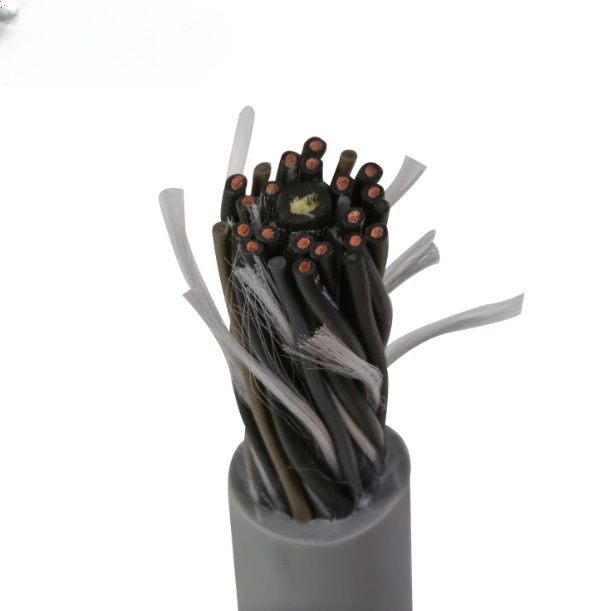
Detailed Description
What Makes a Cable "Flexible" — Beyond the Conductor Class
IEC 60228 defines conductor flexibility classes: Class 1 (solid), Class 2 (stranded, rigid), Class 5 (flexible), Class 6 (extra-flexible). These classes specify minimum wire count and maximum single-wire diameter. A cable with Class 5 conductor is technically "flexible" by standard definition.
But conductor class alone does not determine real-world drag chain performance. A cable is a system, and flexibility is determined by the interaction of four elements:
1. Conductor Stranding — How, Not Just How Many
Two Class 5 conductors with identical wire counts can perform very differently in a drag chain. The difference is in the bunch stranding process:
- Standard bunch: Wires are simply twisted together with a fixed lay length. Bend stress concentrates at the points where individual wires cross.
- Optimized bunch: Wires are arranged in concentric layers, each layer with a progressively adjusted lay length. Stress distributes evenly across the conductor cross-section during bending.
2. Core Stranding — Equalizing Tension Across Layers
Multi-core cables are stranded in layers around a central filler. In standard cables, inner-layer cores travel a shorter path than outer-layer cores during bending, creating unequal tension. The optimized lay lengths in Flexible Drag Chain Cable equalize this: inner layers have shorter lay lengths to compensate for their smaller bend radius.
3. PET Fleece Inter-Layer — The 5% Solution
A thin PET non-woven tape between the core assembly and the jacket adds less than 5% to the cable cost but addresses a major wear mechanism: cores rubbing against the inner jacket surface during bending. The fleece absorbs this friction, protecting both the core insulation and the jacket from internal abrasion.
4. Jacket Surface — Friction Matters
A smooth, matte jacket surface with low friction coefficient reduces the energy required to pull the cable through the carrier. This is not a flex life issue — it is a carrier motor sizing issue, especially in long-travel systems where cable friction can account for 10–15% of the total carrier drive load.
Flexible vs Standard — The Real Difference
| Property | Standard Drag Chain (Basic TRVV) | Flexible Drag Chain |
|---|---|---|
| Conductor bunch stranding | Basic bunch | Concentric optimized-lay bunch |
| Core stranding | Fixed lay | Layer-equalized lay |
| Inter-layer protection | None | PET fleece wrapping |
| Flex life at 7.5×D | 1–3M (unverified) | 3–8M (tested and verified) |
| Jacket friction | Standard surface | Controlled matte finish |
| manufacturing process control | Commodity | Engineered — each batch flex-tested |
The cost premium over standard is modest (~10–15%) because the improvements are in the stranding process and the addition of a fleece layer — not in fundamentally more expensive materials.
Three Jacket Options — Match Environment to Budget
| Jacket | Cost vs PVC | Oil | Temp Range (Move) | UV | Halogen-Free | Best For |
|---|---|---|---|---|---|---|
| PVC | Baseline | Limited | -5°C to +70°C | No | No | Indoor, clean, budget-primary |
| NBR-PVC | +10% | Moderate | -15°C to +70°C | No | No | Indoor, occasional oil, unheated factories |
| PUR | +30% | Excellent | -30°C to +80°C | Yes | Yes | Outdoor, oil-immersed, cleanroom |
Why "Class 5+" Instead of Class 6
Class 6 conductor (the finest stranding class, 0.08–0.12 mm single wire) is the standard for High-Flex cables. Flexible Drag Chain Cable uses Class 5+ — the "plus" indicating optimized stranding within the Class 5 specification.
The reason is economic: Class 6 requires extra stranding steps that add 15–20% to the conductor cost. For applications that do not need 10+ million flex cycles, this cost delivers no value. Class 5+ provides 80% of the flex performance improvement at 30% of the cost differential.
Installation — Getting the Flex Life You Paid For
- Carrier alignment: Even a 2° misalignment between the fixed and moving carrier ends forces the cable to bend in an unintended plane, reducing flex life. Verify alignment with a laser or straightedge after carrier installation
- Cable twist check: After routing, visually inspect for any twist along the cable length. A twisted cable concentrates bend stress on one side. If twist is present, disconnect one end and allow the cable to relax before re-clamping
- First-cycle witness mark: Draw a longitudinal line (paint marker) along the top of the cable at installation. After 1 000 cycles, inspect — if the line has rotated, the cable is twisting inside the carrier and strain relief needs adjustment
- Bend radius verification: The rated flex life assumes 7.5×D minimum. At 6×D, flex life drops to approximately 40% of rated. At 5×D, expect early failure. Use the carrier's datasheet bend radius, not an eyeball estimate
Why Choose Yichi Cable Flexible Drag Chain?
- Optimized stranding as standard: We do not sell "Class 5" as a commodity — the bunch stranding is engineered for uniform bend stress distribution, verified in production
- PET fleece included: The internal wear protection layer is standard on Flexible Drag Chain Cable — not a hidden extra-cost option
- Verified, not calculated: Flex life ratings are based on actual bending tests in our CNAS-accredited laboratory, not mathematical models
- Three jacket tiers: We do not force a PUR upsell when PVC or NBR-PVC is adequate. You choose the jacket that matches your environment