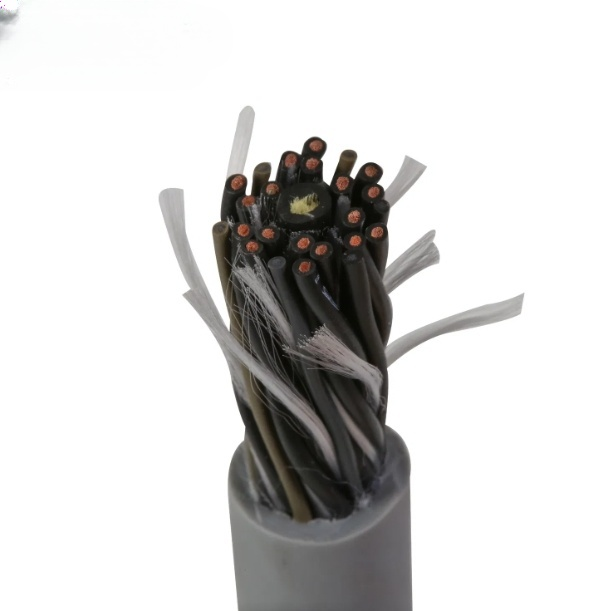
Detailed Description
Why Standard Jackets Wear Out — and Why It Matters
In a drag chain, the cable's outer jacket slides against the carrier floor with every cycle. At first, this contact is benign — the jacket's surface is smooth, and the friction force is low. But over millions of cycles, three mechanisms progressively destroy the jacket:
1. Adhesive Wear (Micro-Transfer)
At a microscopic level, the jacket and carrier surfaces are not perfectly smooth. Asperities (surface peaks) from each surface momentarily weld together under pressure, then tear apart — transferring tiny fragments of jacket material to the carrier floor. This is the same mechanism that wears out car tires on asphalt — just at a micron scale.
2. Abrasive Wear (Third-Body Particles)
Dust, metal particles, fiber debris, and coolant residue enter the carrier and become trapped between the jacket and the carrier floor. These particles act as miniature cutting tools, scoring the jacket surface. In woodworking and stone-processing environments, this mechanism dominates — the abrasive particles are the process itself.
3. Fatigue Wear (Surface Cracking)
Repeated compressive loading at carrier bend points creates subsurface fatigue cracks in the jacket material. These cracks propagate to the surface, where small flakes of material detach. This mechanism accelerates when the jacket has hardened from chemical exposure (oil absorption in PVC) or UV degradation (surface oxidation).
A wear-resistant jacket must resist all three mechanisms — not just one. Standard PUR is good (≤5 mg/1 000 cycles Taber). High-hardness PUR is better (≤3 mg/1 000 cycles).
Material Science — High-Hardness PUR vs Standard PUR vs PVC
| Jacket Material | Shore Hardness | Taber Wear | Coefficient of Friction | Cut Resistance | Chemical Resistance |
|---|---|---|---|---|---|
| Standard PVC | 85–90 A | >25 mg | 0.35–0.45 | Poor | Poor (swells in oil) |
| Standard PUR | 85–90 A | ≤5 mg | 0.25–0.30 | Good | Excellent |
| Wear-Resistant PUR | 92–95 A | ≤3 mg | 0.20–0.25 | Excellent | Excellent |
| NBR-PVC Blend | 80–85 A | >15 mg | 0.30–0.40 | Moderate | Moderate |
| TPE | 75–85 A | >10 mg | 0.25–0.35 | Moderate | Good |
The wear-resistant PUR achieves its superior abrasion performance through:
- Higher Shore hardness (92–95 A): Increased surface hardness directly reduces adhesive wear — fewer asperities deform enough to create micro-welds
- Optimized polymer chain length: Longer polyurethane chains create higher molecular weight networks that resist fracture under repeated compressive loading (fatigue wear mechanism)
- Low-friction surface finish: A controlled matte surface texture reduces the real contact area with the carrier floor — less contact = less wear
- Solid lubricant additives: Micro-scale solid lubricant particles embedded in the PUR matrix reduce friction without the migration problems of liquid plasticizers
Wear Life Comparison — Quantified
Data from our CNAS-accredited abrasion test laboratory (Taber CS-17 wheel, 1 000 g load, 25°C):
| Jacket Type | Time to 0.5 mm Wear Depth | Cycles in Carrier* | Estimated Service Life |
|---|---|---|---|
| Standard PVC | 150 cycles | ~1.5 million | 12–18 months (typical indoor) |
| Standard PUR | 750 cycles | ~7.5 million | 3–5 years |
| Wear-Resistant PUR | 1 250 cycles | ~12.5 million | 5–8 years |
*Estimated cycles to jacket failure at 20 m stroke, 60% carrier fill, 25°C ambient.
The 2.5× increase in Taber wear resistance translates to a proportionally longer service life — but only if the jacket is the life-limiting component. In many applications, conductor fatigue or shield failure occurs first. This cable is designed for environments where jacket wear IS the dominant failure mode.
When to Specify Wear-Resistant Jacket
Select this cable over standard PUR when any two of these conditions apply:
- [ ] Carrier travel distance exceeds 20 meters
- [ ] Operating environment contains abrasive particles (dust, metal chips, fiber, sand, concrete)
- [ ] Machine operates more than 16 hours per day, 6–7 days per week
- [ ] Carrier has metal dividers or ribs that increase cable-to-wall contact pressure
- [ ] Previous cable failures showed visible jacket wear (grooves, thinning, cracks) before conductor failure
- [ ] Outdoor installation with wind-induced carrier vibration
Orange Jacket Option — Why Visibility Matters
Wear-resistant cables are often specified with an orange jacket (RAL 2003) rather than the standard black. The reason is practical, not cosmetic:
- Wear inspection: A black jacket makes it nearly impossible to visually detect early-stage abrasion. On an orange jacket, surface wear appears as darker patches — visible during routine inspection without removing the cable from the carrier
- Contamination visibility: In dusty environments, dark cable jackets blend with accumulated debris — making it difficult to assess carrier cleanliness. Orange is high-contrast against dust, oil, and metal surfaces
- Safety identification: In multi-cable carriers, the orange jacket signals to maintenance technicians that this is a wear-critical cable requiring priority inspection
Maintenance and Inspection
- Visual inspection: Every 500 000 cycles (approximately every 3 months of 24/7 operation), inspect the jacket surface at carrier bend points for signs of initial wear
- Jacket thickness measurement: Use an ultrasonic thickness gauge at the same reference points — record baseline thickness at installation and track reduction over time
- Replace at 30% thickness loss: Do not wait for conductor exposure. When jacket thickness has decreased by 30% from the original value, schedule replacement during the next planned maintenance window
- Carrier cleanliness: Remove accumulated debris from the carrier floor at every inspection. The debris grinding against the cable jacket accelerates wear
Why Choose Yichi Cable Wear-Resistant?
- Quantified wear performance: Every cable batch is tested for Taber abrasion — we publish the test result, not a marketing claim
- Orange jacket availability: Standard stock in both black and orange — no minimum order for orange
- Long-travel engineering support: For carriers exceeding 30 m stroke, we review your carrier layout, cable weight, and vibration profile to confirm the jacket is appropriate
- Wear monitoring program: We provide a free ultrasonic thickness gauge loan program for customers operating 10+ machines with our wear-resistant cables — track actual wear rates in your specific environment