Detailed Description
What Is High Voltage Wire?
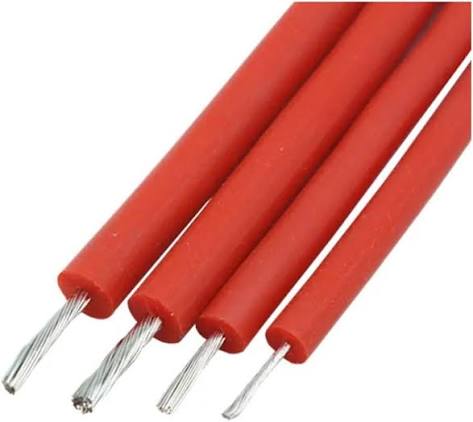
High voltage wire is a single-core flexible conductor with a thick insulation wall designed to withstand DC voltages from 3 kV to 100 kV and beyond — not as a power transmission cable, but as hookup wire for the internal electrical connections of high voltage equipment. It is the wire that connects the HV power supply to the X-ray tube, the wire from the capacitor bank to the flash lamp, the wire from the flyback transformer to the CRT anode.
Unlike power cables, which are designed for fixed installation in cable trays, ducts, and trenches with defined bending radii and pulling tensions, HV wire is designed to be handled — routed by an equipment assembler through a chassis, dressed around standoffs, terminated at solder lugs or screw terminals. The insulation must survive this handling without damage, then withstand the rated voltage continuously for the equipment's operating life without corona-induced degradation.
The most common insulation material is silicone rubber. Silicone is the preferred choice for HV wire for three reasons:
- Corona resistance: When the electric field at the conductor surface exceeds the dielectric strength of the surrounding air (approximately 3 kV/mm for sharp points, lower at high altitude), a corona discharge forms — a localized ionization of the air around the conductor. This corona attacks the insulation surface, eroding it molecule by molecule. Silicone rubber erodes to a non-conductive silica (SiO₂) powder that remains on the surface and acts as a partial barrier. Organic polymers (PE, PVC, XLPE) erode to conductive carbon, which accelerates the erosion rate
- Thermal stability: HV equipment often generates significant heat — transformer windings, power supply semiconductors, X-ray tubes. Silicone's 180–200°C continuous rating provides margin above what a PVC (105°C) or XLPE (125°C) insulation can handle
- Flexibility and handling: Silicone is the most flexible insulation material at all temperatures. A 50 kV silicone wire can be bent to 3× its diameter without insulation damage. This flexibility is essential for equipment wiring where space is constrained and the assembler must route the wire through tight chassis paths
Insulation Material Selection by Application
| Insulation Material | Max Voltage (DC, Typical) | Temp Rating | Dielectric Strength | Corona Resistance | Best For |
|---|---|---|---|---|---|
| Silicone Rubber | 100 kV | 180–200°C | 20 kV/mm | Excellent | X-ray, laser, test equipment — the standard for HV wire |
| XLPE | 50 kV | 125°C | 35 kV/mm | Good | Space-constrained equipment; thinner wall for same voltage |
| Modified PE (Irradiated) | 50 kV | 105–125°C | 40 kV/mm | Moderate | Miniaturized HV assemblies; highest dielectric strength |
| FEP | 30 kV | 200°C | 22 kV/mm | Good | Chemical environment; transparent insulation for visual inspection |
| PTFE | 30 kV | 260°C | 20 kV/mm | Good | Aerospace, military; extreme temperature |
Corona — The HV Wire Design Constraint
Corona is the single most important design consideration for HV wire used in air. At the surface of a small-diameter conductor at high voltage, the electric field can exceed the dielectric strength of air (approximately 3 kV/mm at standard atmospheric pressure), causing localized ionization. Once corona ignites, it:
- Produces ozone (O₃), which chemically attacks the insulation surface
- Creates ultraviolet radiation, which degrades organic polymer chains
- Generates nitric acid in the presence of moisture, accelerating surface erosion
- Produces electromagnetic interference (EMI), which can disrupt sensitive measurement circuits
This means:
- A 1 mm diameter conductor (AWG 18, 0.82 mm²) will begin to show corona at approximately 3 kV
- A 3 mm diameter conductor (16 mm²) will begin to show corona at approximately 9 kV
- A 10 mm diameter conductor (70 mm²) will begin to show corona at approximately 30 kV
Practical Design Guidelines for HV Wire Selection
- Conductor diameter determines corona performance, not just ampacity: For HV wire, select the conductor diameter for corona control first, then verify that the cross-section meets the current-carrying requirement. In most equipment internal wiring, the current is milliamps to a few amps — the conductor is oversized for its current rating because corona control demands a larger diameter
- Semiconductive layer for ≥15 kV DC: Specifying a semiconductive layer between the conductor and the primary insulation is recommended for voltage ratings ≥15 kV. The incremental cost is modest, and the PD elimination significantly extends service life
- Air clearance and creepage distance: The wire insulation is not the only voltage withstand element. The terminal ends (stripped insulation, bare conductor) and any uninsulated connections must meet the air clearance and creepage distance requirements of IEC 60664-1 (or UL 840) for the equipment's overvoltage category and pollution degree
- High-frequency derating: When the HV wire carries significant high-frequency content (switching converters at 20–300 kHz, pulsed power at nanosecond rise times), the insulation is stressed both dielectrically and thermally (dielectric losses increase with frequency × tan δ × V²). Silicone rubber has a tan δ of 0.001–0.01 at power frequency, increasing at higher frequencies. For high-frequency HV applications, PTFE (tan δ <0.0002) or PE (tan δ <0.0005) may be preferred despite their poorer corona resistance
- Ozone and environmental exposure: In enclosed equipment where ozone from corona accumulates, the insulation must resist ozone cracking. Silicone (inorganic backbone) and FEP/PTFE (fully fluorinated) are excellent; XLPE and PVC are poor and should not be used in ozone-generating environments without ventilation
Why Choose Yichi High Voltage Wire
- Silicone rubber as standard — the correct material for HV wire: Silicone's corona resistance, thermal stability, and handling flexibility make it the first-choice insulation for high voltage hookup wire. We manufacture silicone HV wire across the full 3–100 kV DC range — if silicone is not the right material for your application, we offer XLPE, modified PE, FEP, and PTFE alternatives
- Corona-tested wire for ≥15 kV ratings: Every HV wire with a rated voltage ≥15 kV DC receives a corona extinction voltage test per ASTM D1868. The CEV must be ≥1.2× the rated DC voltage — ensuring that any corona that might initiate at a transient overvoltage will extinguish when the voltage returns to normal
- Semiconductive layer option — eliminating PD at the conductor surface: For voltage ratings ≥15 kV, the semiconductive layer option eliminates the air-gap partial discharge that occurs between individual conductor strands and the insulation. This is the difference between a wire that operates silently at rated voltage and one that emits partial discharge from day one
- UL recognized component — simplifying equipment certification: UL 3239, UL 3289, and UL 3398 recognized component listings mean your equipment uses recognized internal wiring, simplifying the UL end-product listing process. UL file numbers and test data are available for certification submission
- Custom striping, color coding, and marking: Standard solid colors or your specific color code; sequential meter marking on request for cut-to-length manufacturing; special jacket striping for polarity identification in high-voltage assemblies
- Application support for HV wire selection: Send us your operating voltage, waveform (DC, AC, pulsed, HF), maximum current, ambient temperature, and any space constraints — our engineering team recommends the insulation material, conductor size, and whether a semiconductive layer is required for corona-free operation