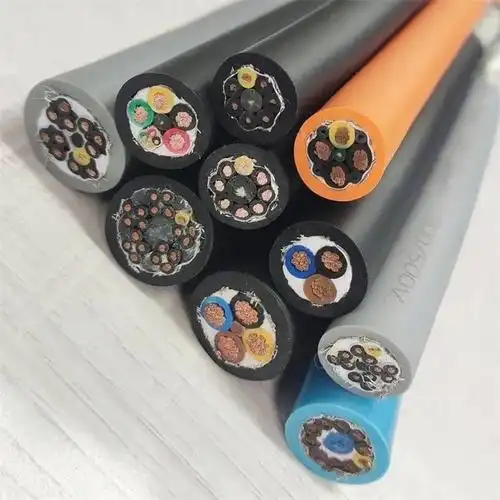
Detailed Description
What Is a Magnetic and Proximity Switch Sensor Cable?
A magnetic and proximity switch sensor cable is the wiring between a switching sensor — a magnetic (reed) switch, an inductive or capacitive proximity switch, a photoelectric switch — and the PLC input card or I/O block that reads it. It carries an on/off signal at 24 V DC, drawing only a few milliamps, but those milliamps have to cross a machine tool, a conveyor line or an assembly station where coolant, chips, oil and continuous movement are all present.
The dominant failure mode in this class of cable is not electrical — it is mechanical: a jacket that cracks, a conductor that work-hardens and breaks, a colour code that causes a miswire at commissioning. The cable specified on this page addresses those failure modes directly, through a flame-retardant flexible PVC jacket and core counts and colour sequences that match the sensor interfaces actually in use.
Construction of the Cable
Conductor
The conductor is multi-strand oxygen-free copper at 99.99% purity. Stranding lets the cable bend without work-hardening individual wires, and the high copper purity keeps conductor resistance low at signal current. Low resistance means less heat generated in the cable, and a strand surface that stays solderable and crimpable over the service life of the machine.
Insulation
Each core is insulated with PVC. The compound is made from virgin material rather than regrind, so it holds its mechanical and electrical properties against ageing.
Jacket
The outer jacket is flame-retardant flexible PVC, self-extinguishing when the flame source is removed. It is abrasion-resistant, cold-resistant and resistant to repeated folding. In a sensor cable the jacket does double duty: it keeps coolant and chips away from the cores, and it acts as the mechanical buffer inside the sensor backshell where vibration would otherwise chafe through core insulation.
Both insulation and jacket are extruded with low eccentricity, so the wall thickness is uniform around the core. Thin spots are where breakdown begins — either electrical breakdown or the point where coolant ingress starts.
Outer Diameter Specifications — 2, 3, 4 and 5 Cores
All dimensions below are in millimetres.
2-core
| Model | Outer Diameter |
|---|---|
| 2 × 0.14 mm² | 3.0 mm |
| 2 × 0.2 mm² | 3.8 mm |
| 2 × 0.3 mm² | 4.8 mm |
| 2 × 0.5 mm² | 5.6 mm |
| 2 × 0.75 mm² | 6.0 mm |
3-core
| Model | Outer Diameter |
|---|---|
| 3 × 0.14 mm² | 3.0 mm |
| 3 × 0.2 mm² | 3.8 mm |
| 3 × 0.3 mm² | 4.8 mm |
| 3 × 0.5 mm² | 6.0 mm |
| 3 × 0.75 mm² | 6.5 mm |
4-core
| Model | Outer Diameter |
|---|---|
| 4 × 0.14 mm² | 3.0 mm |
| 4 × 0.2 mm² | 3.8 mm |
| 4 × 0.3 mm² | 4.8 mm |
| 4 × 0.5 mm² | 6.5 mm |
| 4 × 0.75 mm² | 7.2 mm |
5-core
| Model | Outer Diameter |
|---|---|
| 5 × 0.2 mm² | 4.8 mm |
| 5 × 0.3 mm² | 4.8 mm |
Core outer diameter also matters where the cable has to enter a sensor backshell or a cable gland seal: 3 × 0.5 mm² has a core OD of 2.0 mm, and both 3 × 0.75 mm² and 4 × 0.75 mm² measure 2.2 mm.
Core Counts and Colour Code
| Cores | Colours | Typical Use |
|---|---|---|
| 2 | Brown / Blue | Supply and return for magnetic and reed switches |
| 3 | Brown / Blue / Black | Three-wire DC proximity and photoelectric switches with a switching output |
| 4 | Brown / Blue / Black / White | Sensors with a second output, or two sensors on one cable |
| 5 | Brown / Blue / Black / White / Grey | Multi-output sensors and multi-channel wiring |
The brown/blue/black sequence follows the convention most PLC and sensor manufacturers use on DC three-wire sensors. Keeping it consistent at the factory reduces miswiring at commissioning and during fault-finding.
Selection and Installation Notes
- Match the core count to the sensor interface, not to whatever is on the shelf. 2-core covers magnetic switches, 3-core covers the large majority of proximity and photoelectric switches, and 4 or 5 cores handle dual-output or multiplexed sensors.
- Choose the cross-section against loop length and current. 0.14 mm² and 0.2 mm² are adequate for short pigtails. Where the run is long, or the same cable carries several sensors, 0.5 mm² and 0.75 mm² give more margin.
- Confirm the outside diameter before buying connectors. Sensor backshells and gland seals are sized by OD range; a 7.2 mm 4 × 0.75 mm² cable will not fit a seal designed for a 4.5 mm cable.
- Keep the cable ends away from wire strippers and sharp edges. A low-eccentricity jacket is more uniform than a general-purpose cable, but it is still flexible PVC, not armour.
- If VFD carrier frequencies or large contactors are present on site, say so at the enquiry stage. The construction documented here is unshielded, and if interference is a concern it should be raised as such.
Where Magnetic, Proximity and Photoelectric Switches Use This Cable
- Magnetic (reed) switches on cylinders and linear actuators — 2-core cable carrying the open/closed state to a PLC input.
- Inductive and capacitive proximity switches on machine tools, conveyors and assembly stations — 3-core cable across M8, M12, M18 and M30 body sizes.
- Photoelectric switches for part detection, level sensing and sortation — through-beam, retro-reflective and diffuse types, wired with three or four cores depending on output.
- Sensor junction boxes and multiplexers — a single multi-core jacket carrying several sensor channels.
- Control cabinet to field runs between machine sections, where flexibility and flame retardance drive the selection.
- Retrofit and repair — replace a damaged pigtail by the metre rather than buying a full reel.
Why This Cable Fits Your Equipment
- The OD tables let you check sensor backshell, gland seal and cable duct fit before you buy, not after the cable arrives.
- 2, 3, 4 and 5 cores across 0.14 to 0.75 mm² cover the large majority of switch sensor interfaces found on a machine.
- Oxygen-free copper conductors and uniform PVC wall thickness keep loop resistance low and insulation stable across the mechanical life of the equipment.
- The flame-retardant, self-extinguishing jacket adds no fire load next to welding spatter, chips or heated surfaces.
- Standard 10 m supply, cut to order by the metre — no need to buy and scrap excess cable for a short pigtail run.