Detailed Description
What Is Flexible Welding Cable?
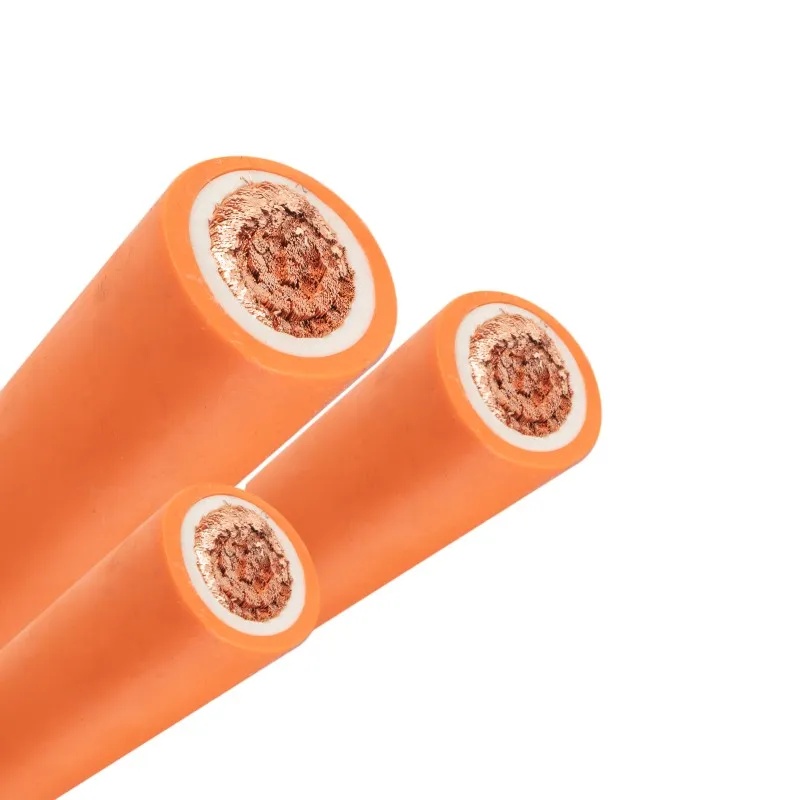
Flexible welding cable is a single-core, Class 6 (ultra-fine stranded) copper conductor insulated with a thick layer of EPR or CR rubber, designed for the secondary (low-voltage, high-current) side of arc welding equipment — the cable that connects the welding machine to the electrode holder (the "hot" lead) and the workpiece or welding table back to the machine (the "work return" or "earth" lead). The cable is defined by its flexibility: the welder holds the electrode holder and manipulates it continuously around the workpiece; a stiff cable makes the welder fight the cable as much as the weld puddle, causing fatigue and reducing weld quality.
The flexibility of a welding cable is a function of the conductor stranding. A standard power cable with Class 2 (stranded) or Class 5 (flexible) conductor has 7–50 strands per conductor. A Class 6 welding cable has hundreds to thousands of individual strands — a 50 mm² welding cable contains approximately 1 400–1 800 strands, each 0.08–0.10 mm in diameter. The individual strands can slide relative to each other during bending, allowing the cable to be as flexible as a rope. This is the defining characteristic of a welding cable — if the cable resists bending and fights the welder's hand, it is not a welding cable, regardless of what the insulation says.
EPR vs CR Jacket — Which for Your Welding Environment?
| Environmental Condition | EPR Jacket | CR (Neoprene) Jacket |
|---|---|---|
| Indoor workshop (clean, dry) | Suitable — most economical | Suitable |
| Heavy weld spatter (MMA, FCAW) | Moderate — spatter can adhere to and burn the jacket surface | Excellent — spatter does not adhere; CR is the standard for heavy welding |
| Oil and grease exposure | Good — EPR is oil-resistant but prolonged contact with petroleum-based oils can cause swelling | Excellent — CR is inherently oil-resistant and does not swell in contact with mineral oils and hydraulic fluids |
| Outdoor and weather exposure | Good — EPR is weather-resistant but degrades under UV over time | Excellent — CR is UV-stabilized and ozone-resistant |
| Shipyard and marine environment | Not recommended | Recommended — CR resists salt water, oil, and weather |
| Construction site | Suitable for short-term projects | Recommended for long-term and heavy construction |
| Cost | Reference | 15–25% higher |
For most indoor workshop and light fabrication welding, EPR jacket is adequate and cost-effective. For outdoor welding, heavy industrial fabrication, shipyard work, and any environment with significant weld spatter or oil exposure, CR jacket is the correct specification. The cost difference is recovered through extended cable service life in the demanding environment.
Why Choose Yichi Welding Cables
- IEC 60228 Class 6 ultra-fine stranded copper — verified strand count: The strand count for each cross-section is controlled and verified — a 50 mm² welding cable does not contain 50 strands (Class 2) or 200 strands (Class 5) — it contains the 1 400+ strands that Class 6 requires for true welding cable flexibility. If the cable does not feel like a rope in the hand, it is not Class 6
- Single-layer rubber insulation — thick wall for mechanical protection: The welding cable does not have a separate outer jacket — the insulation is the jacket. The wall thickness is designed for the mechanical abuse that welding cable experiences — dragged across the workshop floor, stepped on, run over by forklifts, and struck by falling metal pieces. A thin-walled insulation would be punctured or cut through within weeks
- Orange, black, and red/black jacket colours — high visibility and polarity identification: Orange is the standard for welding cable — it stands out on the workshop floor, reducing trip hazard and making the cable easier to locate and manage. Red/black dual-colour cables enable immediate visual identification of electrode vs work return polarity — one less thing for the welder to check before striking an arc
- Weld spatter resistant CR jacket — proven in heavy welding service: The CR jacket compound is formulated for spatter resistance — molten steel droplets do not adhere, burn through, or create a conductive path through the jacket. This is laboratory-verified by a spatter resistance test (a controlled arc generating spatter directed at the cable surface), not claimed from the compound data sheet
- Full 16–120 mm² range — from light fabrication to heavy structural welding: One cable type for the complete workshop welding cable inventory. The cross-section is selected for the welding current, duty cycle, and cable length — provide these and we confirm the recommended cross-section per IEC 60245-6