Detailed Description
Flat Cable on Stacker Reclaimers — Where and Why
| Machine Section | Cable Type | Why Flat? |
|---|---|---|
| Boom conveyor festoon | Flat festoon cable | Boom luffs (raises/lowers) — loops expand/contract; flat stays organized |
| Tripper car cable reel | Flat reeling cable | Compact drum space; flat profile maximizes capacity |
| Slewing platform | Flat festoon cable | 360° slewing → flat cable handles loop dynamics better than round |
| Emergency/auxiliary | Flat reeling cable | Lightweight spring reel; flat packs efficiently |
The boom conveyor is the most demanding flat cable application. As the boom luffs from horizontal to 30°+ incline, the festoon loops extending along the 50–90 m boom must expand and contract while the conveyor continues operating at full capacity. Dust, vibration, and weather compound the mechanical demands.
Boom Festoon — Maintaining Loop Integrity Under Dust Load
Coal and ore dust accumulate on everything in a stockyard — including the festoon cable loops. This dust adds weight (up to 2–3 kg/m on horizontal sections) and acts as an abrasive paste between cable and support trolleys.
Flat cable handles this better than round:
- Dust slides off the flat surface — the smooth ribbon profile sheds dust more effectively than a round surface where dust collects in the "valleys" between turns
- Visual inspection is straightforward — a flat surface shows wear, cracks, and dust accumulation immediately; round cables hide early damage
- Loop shape remains consistent — the flat geometry prevents the twisting that causes round cable loops to invert and tangle
Tripper Car Reel — Space Efficiency Matters
The tripper car is a mobile discharge unit that travels along the boom. It has limited space for a cable reel — typically a compact motorized drum mounted on the car structure.
Flat cable's packing density (30–50% more cable on the same drum vs round) means the tripper car reel can be smaller and lighter — reducing the structural load on the boom and simplifying the reel drive motor sizing.
Stacker Reclaimer Flat Cable Construction Notes
- Bulk handling environment expertise: We understand stockyard dust, boom dynamics, and tripper car space constraints
- Integrated steel messengers: Self-supporting festoon — no separate messenger cable to install and maintain
- MSHA certified CR jacket: North American and Australian mining compliance
- Boom festoon engineering: We review your boom length, luffing angle, and loop configuration to verify cable compatibility
Steel Wire Messengers and Self-Supporting Spans
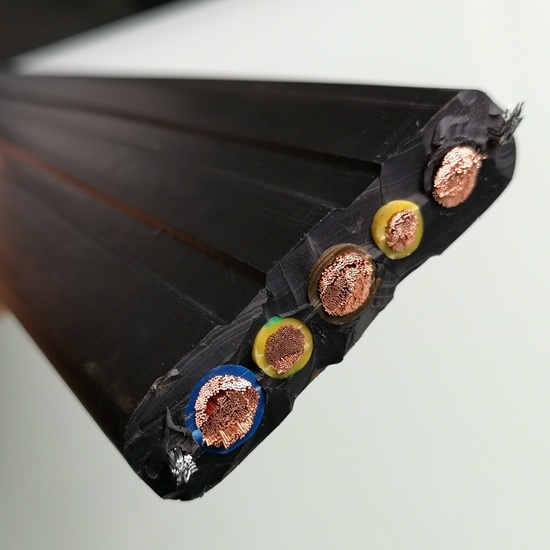
The flat ribbon carries integrated steel wire edge messengers, galvanized wire rope at 1 770 N/mm² vulcanized into both edges of the cable, that take the full tensile load of the festoon span. Because the messengers are built into the cable, the festoon is self-supporting across spans up to 60 m without a separate messenger cable to install or maintain. The flat profile loops cleanly in the festoon, with a packing density 30-50% better than a round cable and zero twist, so the loops stay organised as the boom luffs and the tripper car travels.
Jacket Selection — CR versus PUR
The outer jacket is CR (neoprene, black) or PUR (TMPU, halogen-free, black or yellow). CR carries MSHA mining certification, making it suitable for coal and ore dust, flame resistance, and the abrasive stockyard environment; its temperature range is -25°C to +70°C. PUR is the option for applications requiring halogen-free construction and cold-flex to -40°C, with a range of -40°C to +80°C. Both jackets are rated for permanent outdoor stockyard exposure to UV, weather, oil, and abrasion. The core can also integrate 6-24 single-mode fibers in a gel-filled stainless steel loose tube alongside the power (0.6/1 kV, 1.5-95 mm²) and control (300/500 V, 0.75-2.5 mm², up to 36 cores) elements, so one flat cable replaces several round cables.
Festoon Loop Dynamics and Bend Radius
The flat cable is built for festoon service with a minimum bend radius of 6× the cable thickness in the festoon loop, bending in the flat plane only. On the slewing platform of a reclaimer bridge the 360 degree rotation drives constant loop expansion and contraction, and the flat geometry keeps the loops organised where a round cable would invert and tangle. The CR jacket carries MSHA flame-retardant certification (IEC 60332-1-2) for coal and ore dust exposure, while the PUR option extends the cold-flex range to -40°C for winter stockyard operation.