Detailed Description
The Ultimate Cable for Applications Where Failure Is Not an Option
In most automation applications, a cable failure means 30 minutes of downtime — inconvenient, but manageable. In automotive transfer lines producing one vehicle every 57 seconds, a cable failure means tens of thousands of dollars in lost production before the line can be restarted. In semiconductor fabs, a cable failure can scrap an entire batch of wafers worth hundreds of thousands.
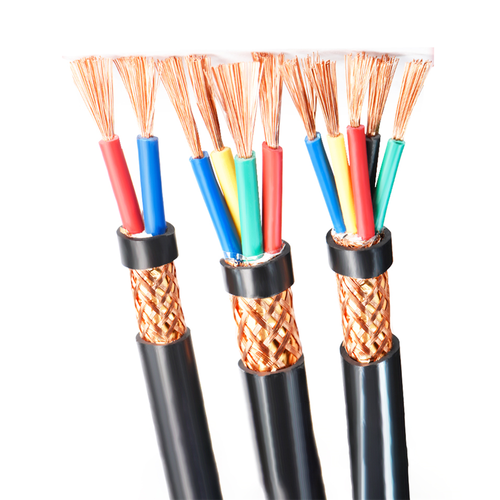
The Double-Jacket High-Flex Shielded Cable is engineered for these environments. It is not one improvement over standard cable — it is three independent reliability systems integrated into one design:
- Double-jacket shielding — inner jacket + braid + outer jacket — eliminates the dominant failure mode of shielded cables: braid abrasion
- High-flex conductor engineering — extra-short lay length, PP/TPE core insulation, Kevlar fillers — designed for 20 million cycles, not the 5 million of standard products
- Environmental protection — PUR outer jacket resistant to oil, coolant, UV, hydrolysis, and seawater — maintains jacket integrity when PVC would be swelling and softening
The Double-Jacket Advantage — Why the Inner Jacket Matters
In a single-jacket shielded cable, the braid is applied directly over the core assembly (with perhaps a thin fleece wrap between them). During bending:
- Individual cores press outward against the braid at the inside of the bend
- Braid strands embed into the core insulation, creating micro-grooves
- Over millions of cycles, these grooves deepen until the braid strand cuts through the insulation and contacts the conductor — a short circuit
- The extruded NBR/PVC inner jacket is a solid, smooth, cylindrical surface — the braid cannot embed into it the way it does into soft, stranded core insulation
- NBR/PVC has excellent compression recovery — it springs back after being compressed, maintaining a consistent surface for the braid
- The inner jacket decouples the shield's bending behavior from the core's. The core and the shield each bend independently, connected only through the compliant inner jacket layer
High-Flex + Double-Jacket — A Synergistic Combination
At first glance, high-flex stranding and double-jacket shielding seem like independent features. They are not — they reinforce each other:
| Failure Mechanism | Single-Jacket | High-Flex Only | Double-Jacket Only | High-Flex + Double-Jacket |
|---|---|---|---|---|
| Conductor fatigue from bending | Moderate life | ✅ Addressed | ❌ Unchanged | ✅ Addressed |
| Braid abrasion into core insulation | ❌ Primary failure mode | ❌ Still present (high-flex accelerates it) | ✅ Addressed | ✅ Addressed |
| Internal core friction at speed | Moderate | ✅ PP cores reduce friction | ❌ Unchanged | ✅ Addressed |
| Shield telescoping under acceleration | ❌ Common | ❌ More severe at high accel | ✅ Inner jacket stabilizes | ✅ Addressed |
| Jacket environmental degradation | Material dependent | Unchanged | Unchanged | ✅ PUR option |
The combination addresses failure modes that neither high-flex stranding nor double-jacket shielding alone can solve. This is the engineering case for specifying this cable in critical applications.
Why Standard Shielded Cable Fails Sooner — Quantified
Data from our CNAS-accredited flex testing laboratory (7.5×D bend radius, 35 cycles/minute, 20°C ambient):
| Cable Type | First Shield Failure (cycles) | First Conductor Failure (cycles) | Ultimate Failure Mode |
|---|---|---|---|
| Standard shielded PVC (single jacket, PVC insulation) | 1.8 million | 3.2 million | Shield strand cut into core insulation → short circuit |
| High-flex shielded (single jacket, PP insulation) | 3.5 million | 6.8 million | Shield fatigue → increased EMI → encoder faults |
| Double-jacket shielded (standard flex, NBR inner + PVC outer) | 8.2 million | 5.5 million | Conductor fatigue (shield still intact) |
| Double-jacket high-flex shielded (NBR inner + PUR outer, PP cores) | No shield failure at 20 million | 18.5 million | Conductor fatigue after shield outlasted cable |
The key insight: in the double-jacket high-flex configuration, the shield is no longer the life-limiting component. The cable fails when the conductors finally fatigue — not when the shield fails prematurely.
When to Specify This Cable — Decision Framework
Specify Double-Jacket High-Flex Shielded when any three of these conditions apply:
- [ ] Flex cycles exceed 5 million per year
- [ ] EMI environment is classified as severe (VFD drives, welding, or contactors in same carrier)
- [ ] Downtime cost exceeds USD 2 000 per hour
- [ ] Replacement access is restricted (cable buried in machine structure; replacement takes > 4 hours)
- [ ] Chemical exposure includes cutting oil, hydraulic fluid, coolant, or outdoor weather
- [ ] Carrier contains both power and precision signal cables in shared space
Inner Jacket Material Science — NBR/PVC Explained
The inner jacket uses a specifically formulated NBR/PVC (nitrile butadiene rubber / polyvinyl chloride) blend — not the same PVC used in outer jackets. Key properties:
- Shore hardness 80–85 A: Softer than the outer jacket (85–90 A) to provide compliance — it yields slightly as the core assembly bends, distributing contact pressure evenly
- Excellent adhesion to tinned copper: NBR's polarity creates a natural bond with the copper braid surface — the braid does not slide under vibration
- Low compression set: After millions of compression cycles, the inner jacket recovers more than 90% of its original thickness — meaning the braid does not loosen over time
- Compatible with PP/TPE insulation: No plasticizer migration that would degrade core insulation mechanical properties
Why Choose Yichi Cable Double-Jacket High-Flex Shielded?
- Proven 20-million-cycle performance: Test data from our CNAS-accredited lab — not extrapolated from 1-million-cycle tests
- Application review included: Send us your carrier dimensions, travel distance, speed, and EMI environment — we verify that this cable is the right choice for your application before you order
- Custom configurations: Inner jacket thickness, braid density, outer jacket material (PVC or PUR), core count, cross-section — built to your specification in 7–15 days
- Full traceability: Batch-specific test reports including shield continuity, conductor resistance, insulation resistance, and flex cycle data
- Reduced total cost of ownership: Higher purchase price, but 2–4× longer service life with zero shield-related failures — the economics favor this cable for applications above 5 million cycles per year