Detailed Description
What Is a Drag Chain Rated Network Cable?
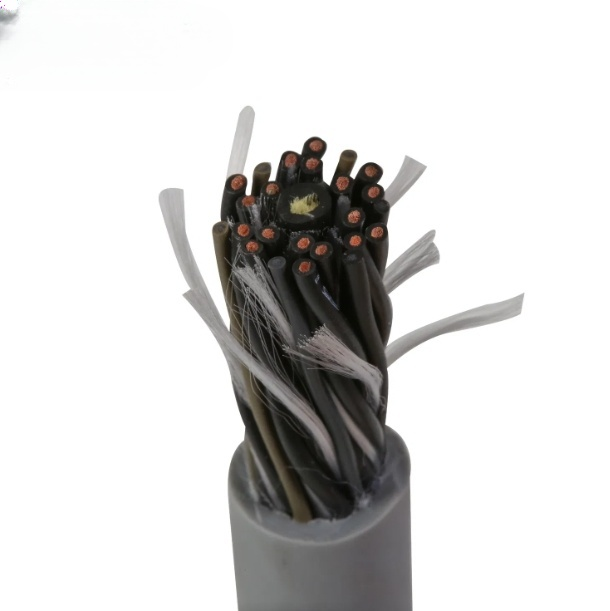
A drag chain rated network cable is an Ethernet data cable engineered for continuous flexing in a cable carrier or drag chain — the articulated plastic or metal chain that guides cables from a fixed connection point (the control cabinet) to a moving machine section (the pallet, slide, gantry, or robot arm). It delivers the same 1 Gbps Ethernet performance as a fixed-installation network cable, but the conductors, shield, and jacket survive millions of bend cycles where a solid-conductor office LAN cable would fracture within days.
The fundamental difference is the conductor stranding. In a fixed Ethernet cable, the conductors are solid copper — AWG 23, a single wire. Solid copper has the lowest DC resistance and insertion loss, which is ideal for permanent horizontal cabling. But solid copper work-hardens and fractures under repeated bending. In a drag chain, each conductor is AWG 26 stranded — typically 19 strands of 0.08 mm wire twisted together. The individual strands can slide relative to each other during bending, distributing the strain instead of concentrating it at a single point.
Fixed vs Drag Chain Network Cable — The Mechanical Difference
| Parameter | Fixed Installation LAN Cable | Drag Chain Rated Network Cable |
|---|---|---|
| Conductor | AWG 23 solid | AWG 26 stranded (19-strand, Class 6) |
| Flex life | <10 000 cycles (conductor fractures) | >5 000 000 cycles |
| Minimum bend radius | 8× OD (static installation) | 15× OD (dynamic, millions of cycles) |
| Jacket | PVC (indoor) or PUR (industrial fixed) | PUR only — oil, coolant, and flex fatigue resistance |
| Shield construction | Standard braid | Braid angle optimized for flex life (35–50°) |
| Typical application | Horizontal cabling in walls and trays | Cable carrier from control cabinet to moving machine axis |
Application Analysis
- Robot arm networking: The PROFINET cable connecting the robot controller to the gripper I/O block and wrist camera travels through the robot arm cable carrier from the base through the shoulder, elbow, and wrist joints — millions of flex cycles at varying bend radii on each axis
- Linear transfer and gantry axes: Ethernet cable in the horizontal and vertical drag chains of a 3-axis gantry system connecting the moving bridge network switch to axis drives and I/O
- Pick-and-place high-speed automation: Network cable in the rapid-cycling drag chain of a delta robot or SCARA pick-and-place cell, where acceleration forces of 50 m/s² stress both the conductors and the jacket
Why Choose Yichi for Drag Chain Rated Network Cables
- Class 6 stranded conductors — the correct stranding for drag chain duty: 19-strand AWG 26 construction provides the flex life that solid AWG 23 or the 7-strand AWG 26 found in some "flexible" LAN cables cannot match. The difference is 19 strands vs 7 strands — more strands = more flex life
- Flex life verified by continuous electrical monitoring: Yichi's drag chain test rig cycles a sample cable while continuously monitoring all four pairs for continuity. The test stops when any conductor fails — not when the jacket shows visible cracking. The >5 million cycle rating is based on electrical failure, not cosmetic
- Braid shield designed for flexing, not just shielding: The braid angle in a drag chain network cable is shallower (35–50°) than in a fixed cable (30–45°), allowing the braid wires to slide during bending without breaking. This is a design detail that is invisible at installation but determines whether the shield survives the first million cycles
- PUR jacket as standard: PUR is the only jacket material that combines the oil/coolant resistance, low-temperature flexibility, and flex fatigue resistance that a drag chain cable demands. PVC jackets crack from oil exposure and flex fatigue; TPE jackets survive flexing but degrade in coolant