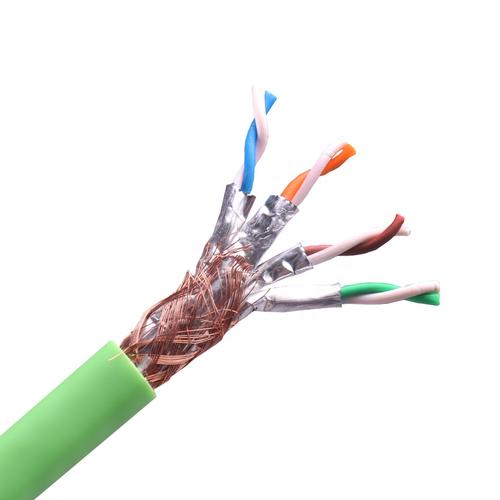
Detailed Description
What Is an Industrial Network Cable?
An industrial network cable is a shielded multi-pair data cable that carries multiple communication channels — Ethernet, serial data, fieldbus protocols, control signals — between network switches, controllers, I/O blocks, and field devices across the factory floor. It replaces multiple individual data cables with a single multi-pair cable, reducing cable tray fill, simplifying installation, and providing consistent shielding across all channels.
Unlike a protocol-specific cable (PROFINET, CAN bus) that is designed for one communication standard, the industrial network cable is protocol-agnostic. Each shielded pair can carry a different protocol — one pair for RS-485 Modbus, another for 100 Mbps Ethernet, a third for a proprietary serial link — because the per-pair foil shield isolates each channel electrically from its neighbours.
Application Analysis
- Distributed network architecture: A 12-pair cable from the central switch cabinet to a floor-level distribution cabinet carries multiple 100 Mbps Ethernet links, RS-485 fieldbus channels, and serial console connections in a single cable
- Multi-protocol machine networking: A packaging machine with Ethernet-based vision cameras, RS-485 barcode scanners, and CANopen servo drives — one multi-pair cable carries all three protocol types with pair-to-pair isolation
- Serial device consolidation: Legacy machines with RS-232 and RS-422 interfaces are consolidated onto a multi-pair industrial network cable back to terminal servers in the control room
Design Notes for Multi-Protocol Installations
- Per-pair shielding for protocol isolation: Each pair has its own foil shield and drain wire — RS-485 differential voltages do not couple onto adjacent Ethernet pairs
- PE insulation for consistent impedance: Polyethylene's low and stable dielectric constant provides consistent 100–120 Ω impedance across all pairs, independent of temperature and humidity
- Build-to-spec pair counts and cross-sections: The pair count and conductor size are specified to match the network architecture, rather than chosen from a fixed catalogue
Shielding and Impedance
Each twisted pair carries its own aluminium/polyester foil shield with 100 % coverage and a tinned copper drain wire. On top of that, an overall tinned copper braid at 85 % coverage or better rejects external noise from adjacent power cables and drives.
PE or PP pair insulation has a low dielectric constant, which holds pair capacitance at 60 pF/m or below and keeps characteristic impedance at 100 Ω ±15 Ω or 120 Ω ±10 Ω per pair, depending on specification. That stability is what keeps signal quality consistent across every pair in a multi-pair cable.
Pair Counts and Cross-Sections
Conductor sizes are 0.14, 0.22, 0.34 and 0.50 mm² in tinned copper, IEC 60228 Class 5 or Class 6 - Class 6 for continuous-flex machine applications. Standard pair counts run 2, 4, 6, 8, 10, 12, 16, 20 and 24 individually shielded twisted pairs, giving a cable outside diameter of 8-35 mm depending on the count.
Pairs are identified either per DIN 47100 or per TIA/EIA-568 colour code (blue, orange, green and brown, each paired with white), so termination at patch panels and device connectors is unambiguous.
Electrical Ratings and Factory Testing
- Rated voltage 300 V - adequate for every common industrial communication physical layer
- Test voltage 1 500 V AC for 5 minutes, applied pair-to-pair and pair-to-shield
- Insulation resistance 5 GΩ·km or better at 20 °C
- Flame retardant to IEC 60332-1-2
- Every pair is factory tested for continuity, pair-to-pair isolation and shield integrity
Jacket Options and Installation
| Jacket | Duty | Flexing | Fixed |
|---|---|---|---|
| PUR TMPU | Oil, coolant, drag chain and outdoor duty; cold-flex to -30 °C | -30 °C to +80 °C | -50 °C to +90 °C |
| PVC | Indoor, fixed cable tray installation | -5 °C to +70 °C | -30 °C to +80 °C |
Jacket wall thickness runs 0.8-2.5 mm in grey or black. Minimum bend radius is 10 × cable OD for flexing installation and 6 × cable OD for fixed installation. PUR jackets are oil and coolant resistant to IEC 60811-404.
Applications
- Factory network trunk cabling - multi-pair cable connecting floor-level network switches in distributed control cabinets to the central server room or main network rack
- Serial and fieldbus consolidation - RS-232, RS-422, RS-485 and proprietary serial links from multiple machine controllers carried in a single cable
- Control room to field junction box wiring - shielded multi-pair trunk cable from the central control room to remote I/O and field junction boxes
- Building automation network backbone - multi-pair cable for BACnet, Modbus and LonWorks building controller networking
- CCTV and access control data - PTZ control data, access card reader data and intercom audio between security equipment racks
- Machine-to-machine data links - dedicated data pairs for proprietary machine controller protocols between production line equipment