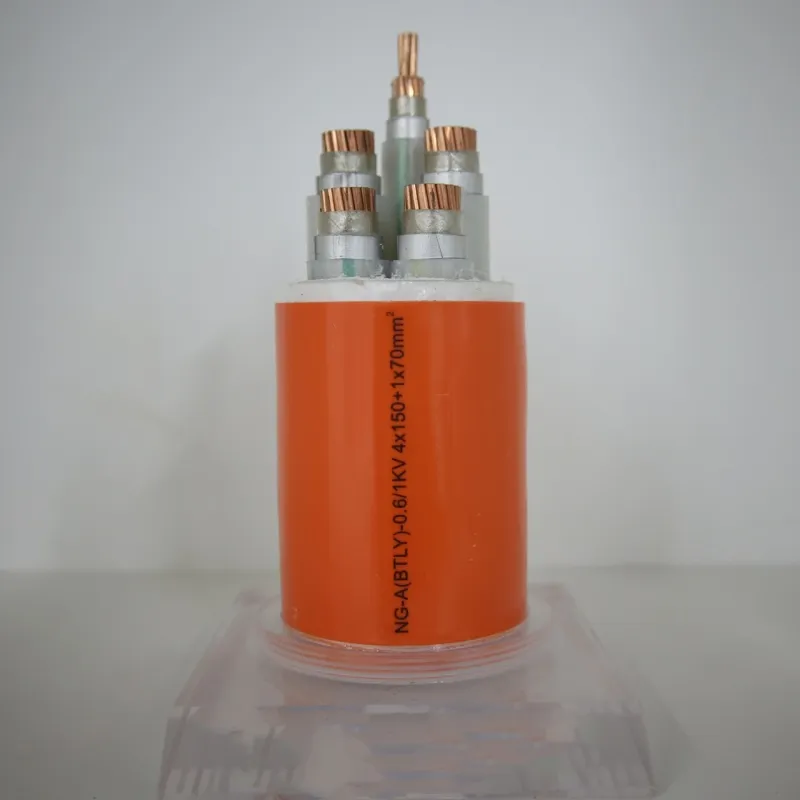
Fireproof Mineral Insulated Cable — BS 6207 / IEC 60702 Copper Sheath Magnesium Oxide Insulated Inorganic Cable with Zero Combustible Content, 1 083°C Copper Melting Point, Continuous Fire Survival Without Time Limit, for Fire Pumps, Smoke Extractors, Emergency Power, and Critical Life Safety Circuits in Buildings, Tunnels, and Industrial Plants
Fire Resistant, High Temperature & LSZH Cables /Fireproof Mineral Insulated

Fireproof Mineral Insulated Cable — BS 6207 / IEC 60702 Copper Sheath Magnesium Oxide Insulated Inorganic Cable with Zero Combustible Content, 1 083°C Copper Melting Point, Continuous Fire Survival Without Time Limit, for Fire Pumps, Smoke Extractors, Emergency Power, and Critical Life Safety Circuits in Buildings, Tunnels, and Industrial Plants

Fireproof mineral insulated cable: BS 6207 / IEC 60702 copper sheath, MgO insulation, zero organic content. Fireproof — no combustion, no smoke, continuous fire survival. 1.0–150 mm², 1–7 cores, 500V/750V. For fire pumps, smoke fans, emergency circuits requiring unlimited fire survival. CE, BASEC.

Key Features

100% inorganic construction — copper sheath + magnesium oxide (MgO) insulation + copper conductors; zero organic materials, zero combustible content, zero halogen, zero smoke emission; the cable cannot burn, cannot propagate fire, and cannot be a source of fire because there is nothing in it that can combust
Magnesium oxide (MgO) compressed powder insulation — MgO has a melting point of 2 852°C and is an excellent electrical insulator when dry; the MgO powder is densely compacted around the conductors inside the copper sheath, providing both the electrical insulation and the mechanical support that keeps the conductors precisely positioned at the centre of the sheath
Copper sheath — seamless or longitudinally welded copper tube that forms the cable's outer layer; copper has a melting point of 1 083°C, providing fire survival at temperatures far beyond what any organic-sheathed LSZH or mica-tape cable can withstand; the copper sheath also provides the cable's earth continuity and mechanical protection
Continuous fire survival with no time limit — unlike mica-tape fire resistant cables rated for 30, 60, or 120 minutes, an MI cable survives a fire until the copper sheath reaches its melting point (1 083°C) — generally far longer than any building fire duration; there is no rated survival time because the cable does not rely on a barrier that degrades with time at temperature
BS 6207 / IEC 60702 compliant — the international standards for mineral insulated cables with copper sheath and rated voltage 500 V (light duty) or 750 V (heavy duty); the standards cover the cable construction, the MgO insulation properties, and the fire performance characteristics
Waterproof and submersible — the seamless copper sheath is a 100% radial water barrier; properly terminated MI cable can operate continuously submerged with no water ingress into the MgO insulation; essential for fire pump cables that may be submerged in the pump room sump or in flooded tunnels
Electromagnetic shielding — the copper sheath forms a continuous Faraday cage around the conductors, providing 100% electromagnetic shielding effectiveness; MI cable emits zero EMI and is immune to external EMI; ideal for circuits in electrically noisy environments (adjacent to VFDs, generators, switchgear)
Mechanically robust — the solid copper sheath withstands crushing, impact, and bending without damage to the conductors or insulation; MI cable can be run over by vehicles, struck by falling debris, and immersed in concrete without loss of electrical integrity — it is the most mechanically durable cable construction available

Applications

Fire-fighting pump power supply — MI cable from the fire pump controller to the electric pump motor; the cable is fireproof for an unlimited duration, ensuring the fire pump operates until the building fire is extinguished or the fuel/water supply is exhausted; the definitive cable for fire pump circuits in high-rise and high-risk buildingsSmoke extraction and pressurization fan power — MI cable for smoke extraction fans and staircase pressurization fans that must operate throughout the fire; MI cable is specified where the fire strategy requires the fans to function until the fire is controlled, not for a limited 30–120 minute periodEmergency generator and essential power circuits — MI cable for circuits supplying power from the emergency generator to the life safety distribution board; the cable route from the generator (typically at ground level or basement) to the life safety switchboard may pass through fire-affected zones where mica-tape fire resistant cable's rated time may be insufficientTunnel life safety systems — MI cable for tunnel emergency lighting, ventilation fan power, and communication systems where the confined tunnel environment can produce fire temperatures exceeding 1 000°C and firefighting access is delayed, extending the fire duration beyond 120 minutesIndustrial high-temperature areas — MI cable for power and control circuits in steel mills, foundries, glass plants, and cement kilns where the ambient temperature exceeds 200°C continuously and organic-insulated cables (even silicone) have a limited service lifeNuclear power plant safety circuits — MI cable for reactor safety system circuits where fire survival, radiation resistance (MgO is highly radiation-resistant), and mechanical integrity under accident conditions are mandatory; MI cable is specified for nuclear safety-related circuits worldwideHeritage and high-value buildings — MI cable for fire safety circuits in historic buildings, museums, and archives where the zero-smoke, zero-combustion cable construction eliminates the risk of smoke damage to irreplaceable building fabric and contents from burning cable insulation

Technical Specifications

Standard — Cable BS 6207 (UK standard for mineral insulated cables with copper sheath, 500 V and 750 V); IEC 60702 (international standard for mineral insulated cables with copper sheath); BS EN 60702 replaces BS 6207 for international specification
Rated Voltage — Light Duty 500 V AC (U₀/U = 300/500 V); for fire alarm, emergency lighting, and control circuits where the voltage class is 300/500 V
Rated Voltage — Heavy Duty 750 V AC (U₀/U = 450/750 V); for power circuits including fire pumps, smoke fans, and essential power distribution up to 750 V operating voltage
Conductor Material Bare copper; solid circular conductors (the standard MI cable conductor); the conductors are positioned at precise spacing within the MgO insulation by the cable manufacturing process — the conductor-to-sheath distance determines the voltage rating
Conductor Cross-Sections — Light Duty 0.5, 0.75, 1.0, 1.5, 2.5, 4.0 mm²
Conductor Cross-Sections — Heavy Duty 1.0, 1.5, 2.5, 4, 6, 10, 16, 25, 35, 50, 70, 95, 120, 150 mm²
Core Count — Light Duty 2-core, 3-core, 4-core, 7-core
Core Count — Heavy Duty 1-core, 2-core, 3-core, 4-core, 7-core (limited cross-section ranges for higher core counts)
Conductor Configuration — Multi-Core The conductors are parallel and equally spaced within the circular copper sheath; for 3-core, the conductors are arranged at the vertices of an equilateral triangle centred on the cable axis
Insulation — Magnesium Oxide (MgO) High-purity (>96% MgO) magnesium oxide powder; compacted to >2.5 g/cm³ density around the conductors inside the copper sheath; MgO is an excellent electrical insulator when dry (resistivity >10¹² Ω·cm at room temperature) but is hygroscopic — it absorbs moisture from the air, reducing insulation resistance; this is why MI cable must be terminated with a moisture-proof seal immediately after the sheath is cut
Insulation Resistance — Dry MgO at 20°C (Before Termination) Typically >100 000 MΩ·km (the insulation resistance is extremely high when the MgO is dry; the cable is supplied with temporary seals on the cut ends to prevent moisture ingress during storage and transport)
Insulation Resistance — Dry MgO at 500°C Drops to approximately 1 MΩ·km at 500°C (MgO insulation resistance decreases with temperature — this is normal and calculated into the cable's design; the insulation resistance remains adequate to prevent conductor-to-conductor or conductor-to-sheath short circuits at the rated operating temperature)
Test Voltage — Light Duty (Routine) 1 500 V AC / 5 min per BS 6207
Test Voltage — Heavy Duty (Routine) 2 500 V AC / 5 min per BS 6207
Sheath — Copper Seamless or longitudinally welded and cold-drawn copper tube; phosphorus-deoxidized copper (Cu-DHP); the sheath wall thickness is determined by the cable diameter per BS 6207; the copper sheath provides the earth continuity (the sheath IS the earth conductor for MI cable circuits)
Sheath Thickness — Light Duty 0.5–0.9 mm depending on cable size per BS 6207 Table 1
Sheath Thickness — Heavy Duty 0.6–1.5 mm depending on cable size per BS 6207 Table 2
Sheath DC Resistance at 20°C — Used as Earth Continuity Conductor The copper sheath resistance serves as the circuit protective earth; for compliance with earth fault loop impedance requirements, the sheath resistance must be included in the circuit design calculations
Optional LSZH Oversheath An extruded LSZH (low smoke zero halogen) oversheath over the copper sheath; the oversheath provides corrosion protection for the copper sheath in aggressive environments (buried in soil, exposed to chemicals) and color identification (white for life safety, red for fire alarm); the oversheath is external to the cable's fireproof construction — it burns away in a fire, leaving the bare copper sheath as the fireproof element
Temperature — Continuous (Copper Sheath Surface) 70°C (standard with LSZH oversheath); the LSZH oversheath determines the maximum continuous operating temperature at the cable surface because the LSZH compound's continuous rating is 70°C; for higher ambient temperatures, the oversheath can be removed or a higher-temperature oversheath material specified
Temperature — Continuous (Conductor with Bare Copper Sheath) 250°C maximum (limited by the copper's oxidation rate at elevated temperatures; at 250°C the copper sheath oxidizes slowly and the MgO insulation remains dry and electrically stable)
Temperature — Fire Survival Up to 1 083°C (copper melting point); the cable survives a fire until the copper sheath melts — at typical building fire temperatures of 800–1 000°C, the cable survives the full fire duration plus post-fire cooling period
Fire Performance — BS 6387 Passes all categories (C, W, Z) without time limitation — MI cable is not rated for a specific time because it does not rely on a fire barrier that degrades with time at temperature; the copper sheath and MgO insulation are stable at fire temperatures indefinitely
Minimum Bend Radius — During Installation 6× cable OD (light duty); 8× cable OD (heavy duty, ≤ 19 mm diameter); 12× cable OD (heavy duty, > 19 mm diameter); MI cable is bent using a bending tool — the copper sheath cold-works during bending and retains its shape; do not attempt to straighten and re-bend MI cable as this can crack the copper sheath
Moisture Protection — Termination Seal MI cable terminations must be sealed with a moisture-proof compound and a pot seal or gland seal immediately after the copper sheath is cut and the MgO insulation is exposed; MgO absorbs moisture from the air within minutes, reducing the insulation resistance; the termination seal is a critical part of the MI cable system — a correctly terminated and sealed MI cable is waterproof and submersible; an unsealed cable will absorb moisture from the air and fail an insulation resistance test within hours
Maximum DC Conductor Resistance at 20°C Per BS 6207 / IEC 60228 for solid copper conductors; 36.0 Ω/km (0.5 mm²) to 0.0601 Ω/km (150 mm²)
Earth Fault Loop Impedance — Sheath as CPC The copper sheath resistance contributes to the circuit's earth fault loop impedance (Z_s); for circuit designs where the sheath is the sole circuit protective conductor (CPC), the sheath cross-sectional area must meet the adiabatic requirement for the prospective earth fault current and the protective device's disconnection time per BS 7671 / IEC 60364
Current Rating — Light Duty, 2-Core, 30°C Ambient (Typical) 1.0 mm² = 14 A; 1.5 mm² = 18 A; 2.5 mm² = 25 A; 4.0 mm² = 34 A; values from BS 7671 Table 4G1A for MI cable clipped direct; the current ratings account for the cable's higher thermal conductivity (copper sheath conducts heat away from the conductors)
Current Rating — Heavy Duty, 4-Core, 30°C Ambient (Typical) 6 mm² = 38 A; 10 mm² = 52 A; 16 mm² = 68 A; 25 mm² = 89 A; 35 mm² = 108 A; MI cable current ratings are typically 5–15% higher than equivalent-sized PVC or XLPE cable because the copper sheath provides excellent heat dissipation
Electromagnetic Shielding — Copper Sheath >100 dB shielding effectiveness across the full frequency spectrum (DC to GHz); the solid copper sheath with no openings or gaps is a near-perfect Faraday cage; MI cable does not radiate EMI and is immune to external EMI — ideal for sensitive measurement and communication circuits in industrial plant environments
Corrosion Protection — Oversheath The LSZH oversheath provides corrosion protection for the copper sheath in buried and damp environments; bare copper sheath is suitable for indoor dry and outdoor above-ground installations where the copper develops a stable green patina (copper carbonate) that protects the underlying copper from further corrosion; in aggressive environments (ammonia atmospheres, acidic soils), the oversheath is mandatory
Certifications CE; RoHS; BASEC (UK) on request; LPCB (UK) on request; BS 6207/Kitemark on request; ISO 9001 manufactured

Detailed Description

What Is Fireproof Mineral Insulated Cable?

Mineral insulated (MI) cable is the only truly fireproof cable construction: a seamless copper sheath filled with compressed magnesium oxide (MgO) powder, with solid copper conductors embedded in the MgO insulation. There is no plastic, no rubber, no glass fibre tape, no mica — nothing that can burn, melt below 1 000°C, or emit smoke or toxic gas. At 2 852°C (the melting point of MgO), the insulation remains solid and electrically insulating. At 1 083°C (the melting point of copper), the sheath melts — but until that temperature is reached, the cable functions normally. In a building fire at 800–1 000°C, the MI cable survives indefinitely.

This is fundamentally different from mica-tape fire resistant cable. Mica-tape cable relies on a thin (0.1 mm) tape barrier that is progressively degraded by the fire — the glass fibre carrier softens, the mica paper loses mechanical integrity, and after the rated time the barrier fails. MI cable has no such limitation — the MgO insulation is millimeters thick (not 0.1 mm), is solid (not a wrapped tape), and is mechanically supported by the copper sheath. An MI cable at 830°C after 3 hours is in the same condition as an MI cable at 830°C after 30 minutes — it does not degrade with time at temperature.

MI Cable vs Fire Resistant Cable — The Critical Differences

ParameterMica-Tape Fire Resistant CableMineral Insulated (MI) Cable
Fire barrierMica/glass tape wrapped around conductor (0.1 mm thick)Solid MgO powder insulation (1–3 mm thick between conductors)
Outer layerLSZH organic sheath (burns away in fire)Copper sheath (survives fire to 1 083°C)
Fire survivalTime-limited: 30, 60, or 120 minutes per the rated classificationUnlimited: the cable survives until the copper sheath melts (1 083°C)
Combustible contentLSZH sheath + XLPE/PE insulation + fillers — all organic, all combustibleZero — no organic materials anywhere in the cable
Smoke emissionLSZH produces low smoke (not zero)Zero smoke — nothing burns
Halogen emissionLSZH is halogen-freeZero halogen — no halogens present
Water resistanceModerate — LSZH is water-resistant but not water-blockedExcellent — seamless copper sheath is 100% waterproof when correctly terminated
EMI shieldingOptional foil/braid screen100% — solid copper sheath is a Faraday cage
Mechanical robustnessModerate — LSZH sheath provides mechanical protection at normal temperaturesExcellent — copper sheath resists crushing, impact, and vibration
InstallationStandard cable — pull, clip, terminateSpecialized — bending tool, pot seal or gland seal termination, larger bend radius
CostReference2–5× higher (material + installation labor)
Typical applicationsGeneral building life safety circuits (30–120 min requirement)Fire pumps, tunnels, nuclear safety, industrial high-temperature, where unlimited fire survival is required

The MgO Moisture Issue — Why Termination Sealing Is Critical

The one vulnerability of MI cable is moisture. Magnesium oxide is hygroscopic — it readily absorbs water vapor from the air. When MgO absorbs moisture, its insulation resistance drops from >100 000 MΩ·km (dry) to <1 MΩ·km (damp), making the cable electrically unusable. The moisture absorption begins at the cut end of the cable, where the MgO insulation is exposed, and progresses along the cable as water vapor diffuses through the MgO powder.

A new MI cable drum is delivered with temporary seals (brass caps with rubber gaskets, or heat-shrink caps) on both cable ends. When the cable is cut and terminated, the electrician must seal the cut end with a moisture-proof termination within minutes — not hours — of cutting. The termination seal (a brass pot filled with sealing compound, or a cold-pour resin seal, or a compression gland with integral seal) creates an airtight, waterproof barrier between the MgO insulation and the atmosphere.

The installation sequence is:

  1. Cut the cable to length using a hacksaw or MI cable cutter
  2. Strip the copper sheath to expose the conductors and MgO using an MI cable stripping tool (a rotary tool that cuts the sheath without damaging the conductors)
  3. Remove the exposed MgO powder to reveal clean conductor ends
  4. Fit the pot seal or gland seal to the cable end immediately — before moisture can penetrate the exposed MgO
  5. Test the insulation resistance between conductors and between each conductor and the sheath — the reading after termination should match the reading before cutting (typically >100 MΩ)
  6. If the insulation resistance has dropped, the termination must be re-stripped further back and a new seal fitted — the damp MgO section at the cut end cannot be "dried out" effectively on site
This is the installation skill that differentiates MI cable from standard cable — the moisture-protection discipline is absolute and non-negotiable.

Why Choose Yichi Fireproof MI Cables

  • BS 6207 / IEC 60702 compliant with full traceability: The copper is phosphorus-deoxidized (Cu-DHP), the MgO is high-purity (>96%) electrical-grade magnesium oxide, and the manufacturing process (tube filling, drawing, annealing) is controlled and verified. Every drum is tested for conductor resistance, insulation resistance, and high-voltage withstand before dispatch
  • 100% inorganic — zero combustible content: No polymer, no tape, no filler, no compound — the cable is copper + MgO + copper. For applications where the fire strategy requires the cable to function until the fire is extinguished (however long that takes), MI cable is the only construction that guarantees this
  • Continuous fire survival — no 30/60/120 minute limitation: The cable survives a fire until the copper sheath melts at 1 083°C — in a typical building fire at 800–1 000°C, the MI cable outlasts the fire. The fire test report is binary: the cable functions or it doesn't. There is no time rating because time is not a failure mechanism
  • Seamless copper sheath — waterproof when correctly terminated: The copper sheath is a continuous metal tube with no seams or welds in the final drawn product. Properly terminated MI cable is submersible — the MgO insulation stays dry at the bottom of a flooded fire pump sump or in a water-filled cable trench
  • Termination support — seals, glands, and tools: MI cable installation requires specialized tools and termination components. Yichi supplies the complete MI cable system — the cable, the pot seals, the gland seals, the stripping tool, and the termination instructions. A correctly terminated MI cable is as reliable as the copper and MgO it is made from

Frequently Asked Questions

How is a mineral insulated cable different from a mica-tape fire resistant cable?

MI cable is 100% inorganic — copper conductors, compressed magnesium oxide insulation, and a copper sheath — so there is nothing to burn and no time limit on fire survival. Mica-tape cables are rated for defined periods such as 30, 60, or 120 minutes. MgO melts at 2 852°C and the copper sheath at 1 083°C.

Why is termination sealing so critical on MI cable?

Insulation resistance is typically above 100 000 MΩ·km when the MgO is dry, but falls to around 1 MΩ·km at 500°C and drops sharply if moisture reaches the compound. The termination seal is what keeps the MgO dry, so it determines long-term performance.

Does the copper sheath provide earthing and shielding?

Yes. The sheath DC resistance serves as the circuit protective earth conductor, the continuous copper tube forms a Faraday cage giving 100% electromagnetic shielding, and it is a 100% radial water barrier. Properly terminated MI cable can operate continuously submerged.

What voltage and size range is available?

Light duty 500 V (300/500 V) from 0.5 mm² to 4.0 mm² in 2, 3, 4, or 7 cores, with a 1 500 V routine test. Heavy duty 750 V (450/750 V) from 1.0 mm² to 150 mm² in 1–7 cores, with a 2 500 V routine test, per BS 6207 and IEC 60702.

Product Inquiry

Product: Fireproof Mineral Insulated Cable — BS 6207 / IEC 60702 Copper Sheath Magnesium Oxide Insulated Inorganic Cable with Zero Combustible Content, 1 083°C Copper Melting Point, Continuous Fire Survival Without Time Limit, for Fire Pumps, Smoke Extractors, Emergency Power, and Critical Life Safety Circuits in Buildings, Tunnels, and Industrial Plants

Add technical specifications (optional)

The more detail you provide, the faster and more accurate our quotation.

No file chosen

PDF, Office, image or CAD file — up to 5 MB

Need Help?

Certifications

ISO 9001
Quality
CE
European
RoHS
Environmental
TÜV
Certification

Need a Quote for This Product?

Send us your requirements and receive a detailed quotation within 24 hours.