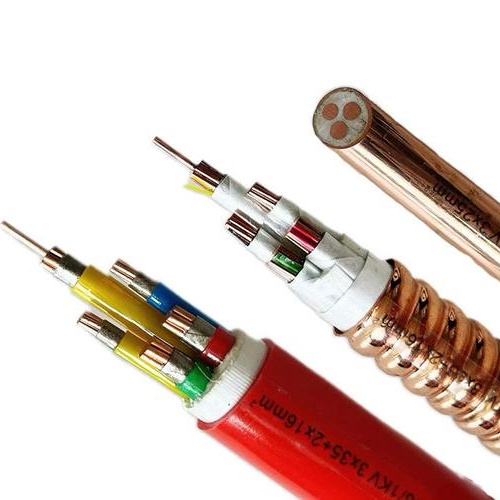
Mineral Insulated (MI) Cable — IEC 60702 / BS 6207 Copper Sheath Magnesium Oxide Insulated Cable for Industrial High Temperature Power and Instrumentation Circuits, Thermocouple Extension, Heating Elements, and Nuclear/Radiation-Hard Environments at Temperatures up to 250°C Continuous and 1 083°C Fire Survival
Fire Resistant, High Temperature & LSZH Cables /Mineral Insulated (MI) Cable

Mineral Insulated (MI) Cable — IEC 60702 / BS 6207 Copper Sheath Magnesium Oxide Insulated Cable for Industrial High Temperature Power and Instrumentation Circuits, Thermocouple Extension, Heating Elements, and Nuclear/Radiation-Hard Environments at Temperatures up to 250°C Continuous and 1 083°C Fire Survival

Mineral insulated MI cable: IEC 60702 / BS 6207, copper or alloy sheath, MgO insulation. For industrial high-temp circuits, thermocouple extension, heating elements, nuclear instrumentation. 250°C continuous, fireproof to 1 083°C. 1–7 cores, 0.5–150 mm². Waterproof, radiation resistant. CE, BASEC.

Key Features

IEC 60702 / BS 6207 compliant — the international standards for mineral insulated cables covering general purpose (copper sheath), high temperature (stainless steel or alloy sheath), and thermocouple (specific conductor alloys) MI cable types
Copper, stainless steel (304/316/321), or Alloy 825 sheath — copper for standard fireproof power and control circuits to 250°C; stainless steel for high-temperature industrial applications to 600–800°C continuous (furnace and kiln instrumentation); Alloy 825 for chemical plant corrosion resistance
Magnesium oxide (MgO) highly compacted powder insulation — melting point 2 852°C, electrically insulating to >10¹² Ω·cm at ambient, radiation resistant (>10⁶ Gy gamma), and thermally conductive; the MgO transfers heat from the conductors to the metal sheath, giving MI cable its high current-carrying capacity relative to its conductor cross-section
Available as power cable, instrumentation cable, thermocouple extension cable, and heating element cable — the same basic MgO + metal sheath construction is adapted for four distinct applications by selecting the conductor material, conductor configuration, and sheath material
Thermocouple extension and compensating cable — MI cable with thermocouple-specific conductor alloys (Type K: Chromel/Alumel; Type J: Iron/Constantan; Type T: Copper/Constantan; Type N: Nicrosil/Nisil) for accurate temperature measurement from the thermocouple hot junction to the instrumentation cold junction over long cable runs through high-temperature zones
Mineral insulated heating element (MI heating cable) — a single conductor or dual conductor MI cable where the conductor itself is the resistance heating element; can be formed into complex shapes before or during installation to fit the heated surface; operates at element temperatures up to 600–800°C for industrial process heating
Radiation resistant — the inorganic MgO insulation and metal sheath are inherently radiation-resistant; MI cable maintains electrical integrity after gamma radiation exposure >10⁶ Gy (100 Mrad); specified for nuclear power plant in-core instrumentation, spent fuel monitoring, and radiation processing facilities
Seamless metal sheath — provides 100% radial moisture barrier, inherent earth continuity, and near-perfect electromagnetic shielding (>100 dB attenuation across the full frequency spectrum); also prevents the escape of potentially explosive gases through the cable — MI cable is inherently explosion-proof when terminated with certified glands

Applications

Industrial high-temperature zone instrumentation — MI thermocouple extension cable for temperature sensors in furnaces, kilns, incinerators, and heat treatment ovens where the cable route passes through zones at 200–600°C that would destroy organic-insulated instrument cableNuclear reactor instrumentation — MI cable for in-core flux detectors, thermocouples, and pressure transducers where the cable must survive reactor operating temperatures and high radiation fields without degradation of the insulation or conductor propertiesProcess heater power supply — MI power cable for electric process heaters, trace heating circuits, and industrial oven heating elements where the cable operates at the heater terminal temperature (up to 250°C continuous for copper sheath) with direct connection to the heating element terminalsChemical and petrochemical plant — MI cable with Alloy 825 or stainless steel sheath for instrumentation and control circuits in corrosive chemical environments where organic sheathed cables would be degraded by acid vapors, solvent atmospheres, or caustic solutionsExplosive atmosphere (ATEX/IECEx) circuits — MI cable for intrinsically safe and explosion-proof circuits in Zone 0, Zone 1, and Zone 2 hazardous areas where the seamless metal sheath prevents gas migration through the cable and the metal-to-metal gland termination is flameproof-certifiedHigh-temperature trace heating — MI heating cable for process pipe temperature maintenance, vessel heating, and freeze protection in industrial plants where the heating element temperature (up to 600°C) exceeds the capability of polymer-insulated self-regulating or constant wattage heating cablesAerospace and defense — MI cable for airframe and engine bay instrumentation where the combination of high-temperature survival, mechanical robustness, small diameter, and lightweight (relative to the current rating) is essential

Technical Specifications

Standard — Cable IEC 60702-1 (Mineral insulated cables — cables with a rated voltage not exceeding 750 V); BS 6207 (UK standard for MI cables with copper sheath); IEC 60702-2 (terminations); ASTM B750 (US standard for MI cable, on request)
Standard — Thermocouple Extension IEC 60584-3 (Thermocouples — extension and compensating cables); ANSI MC96.1 (US standard); the MI thermocouple cable must match the thermocouple type (K, J, T, N, E, R, S, B) and the conductor alloy must be certified to the thermocouple EMF (electromotive force) vs temperature tables per the standard
Rated Voltage — Power/Control Cable 500 V AC (light duty) or 750 V AC (heavy duty) per BS 6207 / IEC 60702
Rated Voltage — Thermocouple/Instrumentation Typically not rated for power voltage — the cable is designed for millivolt-level thermocouple EMF signals and low-voltage instrumentation circuits; insulation resistance and EMF accuracy are the critical specifications, not voltage withstand
Sheath Material — Copper (Standard) Phosphorus-deoxidized copper (Cu-DHP); continuous operating temperature 250°C (limited by copper oxidation rate — above 250°C the copper sheath oxidizes rapidly, reducing wall thickness over time); melting point 1 083°C; standard for fireproof power/control and general industrial MI cable
Sheath Material — Stainless Steel 304/316 Austenitic stainless steel (18Cr-8Ni / 16Cr-10Ni-2Mo); continuous operating temperature 600°C (316) to 800°C (304 — with oxidation allowance); for high-temperature industrial instrumentation and furnace thermocouple cables
Sheath Material — Stainless Steel 321 Titanium-stabilized austenitic stainless steel (18Cr-10Ni-Ti); continuous operating temperature 800°C; preferred for thermocouple cables operating at the upper end of the stainless steel temperature range because the titanium stabilization prevents intergranular corrosion after prolonged exposure at 500–800°C
Sheath Material — Alloy 825 / Inconel Alloys Nickel-iron-chromium alloy with molybdenum and copper; continuous operating temperature 800°C (Alloy 825) to 1 100°C (Inconel 600); for the most demanding high-temperature and corrosive environment applications — chemical plant, refinery, aerospace
Sheath Diameter Range 1.0 mm to 22.0 mm (standard ranges per BS 6207); smaller diameters for thermocouple and instrumentation cable; larger diameters for power cable
Conductor Material — Power/Control Bare copper (standard); solid circular conductors; copper alloy on request for specific resistance or mechanical properties
Conductor Material — Thermocouple Extension (Type K) Chromel® (Ni-Cr, positive) / Alumel® (Ni-Al-Mn-Si, negative); Type K is the most common industrial thermocouple (0–1 100°C range in clean oxidizing atmospheres)
Conductor Material — Thermocouple Extension (Type J) Iron (positive) / Constantan (Cu-Ni, negative); Type J for 0–750°C in reducing atmospheres
Conductor Material — Thermocouple Extension (Type N) Nicrosil (Ni-Cr-Si, positive) / Nisil (Ni-Si-Mg, negative); Type N for 0–1 200°C — improved stability over Type K at high temperatures due to higher oxidation resistance of the Nicrosil alloy
Conductor Material — Thermocouple Extension (Type T) Copper (positive) / Constantan (Cu-Ni, negative); Type T for -200°C to +350°C — the most accurate base-metal thermocouple at low temperatures
Conductor Material — MI Heating Element Nichrome 80/20 (Ni-Cr), Kanthal (Fe-Cr-Al), or Cupronickel (Cu-Ni); the conductor material is selected for its electrical resistivity (Ω·mm²/m) to produce the required heating power per unit cable length (W/m) at the rated voltage
Core Count — Power/Control 1-core, 2-core, 3-core, 4-core, 7-core per BS 6207
Core Count — Thermocouple Extension 2-core (simplex — one thermocouple pair); 4-core (duplex — two thermocouple pairs for redundant measurement or hot and cold junction compensation); 6-core (triplex)
MgO Insulation High-purity (>96%) magnesium oxide powder; compacted density >2.5 g/cm³; the MgO serves as the electrical insulator, the thermal conductor (conducts heat from the conductor to the sheath for power cables and from the sheath to the conductor for thermocouple cables), and the mechanical spacer that maintains the conductors at a precise position relative to the sheath
Insulation Resistance — Dry MgO at 20°C >100 000 MΩ·km (before termination, with temporary seals intact)
Insulation Resistance — Dry MgO at 500°C Approximately 1 MΩ·km (the IR decreases with temperature per the MgO resistivity-temperature curve; for thermocouple circuits with <1 kΩ source impedance, an IR of 1 MΩ·km has a negligible shunting effect — the leakage current through the MgO is <0.1% of the thermocouple EMF current)
Thermocouple EMF Accuracy — Extension Grade Per IEC 60584-3; the MI thermocouple cable's EMF output must match the standard thermocouple EMF table within the specified tolerance limits (±1.5°C for Type K at 0–1 000°C, extension grade) when the measuring junction is at the reference temperature (0°C) and the cable is uniform in composition throughout its length
Test Voltage (AC) — Power Cable 1 500 V / 5 min (light duty); 2 500 V / 5 min (heavy duty) per BS 6207
Test Voltage — Thermocouple/Instrumentation Typically 500 V DC insulation resistance test (not an AC voltage withstand test — the MgO insulation at the thin walls used in small-diameter MI cable is not primarily rated for high-voltage AC withstand; the cable's purpose is millivolt signal transmission, and the 500 V DC IR test verifies the MgO is dry and electrically sound)
Temperature — Copper Sheath (Continuous) 250°C maximum (copper oxidation limit)
Temperature — Stainless Steel Sheath (Continuous) 600°C (316), 800°C (304/321, with oxidation allowance); the continuous operating temperature is limited by the sheath material's oxidation and creep resistance at temperature — the MgO insulation is stable to >2 000°C, far above the sheath material's limit
Temperature — Fire Survival (Copper Sheath) 1 083°C (copper melting point); the cable functions until the sheath melts
Temperature — Short-Term Excursion (SS Sheath) Up to 1 050°C (stainless steel melting range ~1 400°C; the cable can survive brief temperature excursions above the continuous rating, such as a furnace over-temperature event, but the sheath may oxidize and scale, reducing wall thickness)
Minimum Bend Radius — During Installation 6× cable OD (small diameter, <10 mm); 8–12× cable OD (larger diameter); MI cable is bent cold using a bending tool or former — the copper or alloy sheath work-hardens during bending and retains the bend permanently
EMI Shielding — Metal Sheath >100 dB attenuation (DC to GHz); the solid metal sheath is a continuous Faraday cage — no apertures, no gaps, no degradation at joints (if the gland and termination maintain metal-to-metal continuity)
Explosion Protection — ATEX/IECEx MI cable with certified flameproof glands provides 'Ex d' flameproof protection per IEC 60079-1; the seamless metal sheath prevents gas migration, and the gland termination provides a flameproof seal that prevents internal cable explosions from propagating to the external explosive atmosphere
Radiation Resistance — MgO + Metal Sheath Gamma radiation tolerance >10⁶ Gy (100 Mrad); the MgO insulation and metal sheath are not degraded by ionizing radiation; MI cable is the standard cable type for in-containment nuclear power plant circuits where the integrated radiation dose over the plant life can exceed 10⁶ Gy
Certifications CE; RoHS; BASEC (UK) on request; ATEX/IECEx on request for hazardous area installations; IEC 60702 / BS 6207 type testing; ISO 9001 manufactured

Detailed Description

What Is Mineral Insulated (MI) Cable?

Mineral insulated cable is a cable construction in which one or more solid conductors are embedded in highly compacted magnesium oxide (MgO) powder inside a seamless metal tube (typically copper, stainless steel, or a nickel alloy). There is no plastic, no rubber, no mica tape — the construction is entirely metal + mineral. This gives MI cable its defining characteristics: fireproof (no combustible materials), high-temperature capability (250°C to 800°C+ depending on sheath material), radiation resistant (inorganic MgO + metal), waterproof (seamless metal sheath), mechanically robust, and immune to electromagnetic interference (continuous metal shield).

MI cable spans four distinct applications, all using the same basic MgO + metal construction but with different conductor and sheath materials:

  1. Power and control cable: Copper sheath, copper conductors, rated 500 V or 750 V. For fire pumps, emergency circuits, and high-temperature industrial power. The "Fireproof Mineral Insulated Cable" described in the companion product page is this type
  2. Thermocouple extension cable: Stainless steel or alloy sheath, thermocouple alloy conductors (e.g., Chromel/Alumel for Type K). For transmitting the millivolt thermocouple signal from the hot junction to the instrumentation over cable runs that pass through high-temperature zones
  3. MI heating cable: Stainless steel or alloy sheath, single or dual resistance heating alloy conductors. The conductor is the heating element; the MgO insulation transfers heat from the conductor to the sheath, which radiates or conducts heat to the object being heated
  4. Instrumentation cable: Small-diameter (1.0–6.0 mm), typically stainless steel sheath, for pressure transducer, strain gauge, and flux detector connections in high-temperature and radiation environments
This page covers the general MI cable technology and the thermocouple, heating, and instrumentation applications. For fireproof power cable specifically, see the Fireproof Mineral Insulated Cable product page.

Sheath Material Selection — Temperature and Environment

Sheath MaterialMax Continuous TempMelting PointBest For
Copper (Cu-DHP)250°C1 083°CStandard fireproof power/control; building life safety circuits; general industrial to 250°C
Stainless Steel 316600°C~1 400°CChemical plant instrumentation; moderate temperature + corrosive environment
Stainless Steel 304/321800°C~1 400°CFurnace and kiln thermocouple cables; high-temperature process instrumentation
Alloy 825800°C~1 370°CSevere corrosion (acids, chloride stress corrosion) + high temperature; refinery and chemical plant
Inconel 6001 100°C~1 400°CExtreme temperature; aerospace engine instrumentation; nuclear reactor in-core

The sheath material determines the cable's continuous operating temperature and environmental resistance. The MgO insulation is stable to >2 000°C, so the sheath — not the insulation — is the limiting factor for continuous operating temperature. The copper sheath's 250°C limit is set by copper oxidation kinetics: above 250°C, the rate of copper oxide scale formation on the sheath surface becomes rapid enough that the sheath wall thickness decreases measurably over the cable's expected service life.

Why Choose Yichi Mineral Insulated Cables

  • Full MI cable range — power, thermocouple, heating, and instrumentation: One manufacturer for the complete MI cable product family. The same MgO compaction quality, the same sheath drawing and annealing process, and the same termination technology across all cable types
  • Sheath materials from copper to Inconel: Copper for standard fireproof circuits; 304/316 stainless steel for industrial instrumentation; 321 for high-temperature thermocouple; Alloy 825 and Inconel for the most demanding chemical and temperature environments. The sheath material is selected for the application — Yichi manufactures in all grades
  • Thermocouple alloy conductors — calibrated to IEC 60584 EMF tables: The Chromel, Alumel, Nicrosil, Nisil, Iron, and Constantan conductors used in Yichi MI thermocouple cables are calibrated to the IEC 60584-1 standard EMF vs temperature tables. The cable is supplied with a calibration certificate stating the EMF deviation from the standard table at the production test temperature
  • MgO purity >96% — verified on every production batch: The MgO powder is electrical-grade magnesium oxide, sourced from qualified suppliers, and tested for purity and particle size distribution before use. Impurities in the MgO (particularly iron oxide, Fe₂O₃) can reduce the insulation resistance at elevated temperatures and contaminate thermocouple conductors, causing EMF drift
  • Termination technology — seals, glands, and potting compounds: MI cable is only as reliable as its terminations. Yichi supplies the complete termination system — brass or stainless steel pot seals, cold-pour epoxy compounds, compression glands, and the tools (cable strippers, bending tools, seal crimping tools) required for correct MI cable installation
  • Nuclear and ATEX qualified on request: MI cable for nuclear safety-related circuits (IEC/IEEE qualification) and explosive atmosphere circuits (ATEX/IECEx) is manufactured with the enhanced quality assurance, material traceability, and documentation that these applications require

Product Inquiry

Product: Mineral Insulated (MI) Cable — IEC 60702 / BS 6207 Copper Sheath Magnesium Oxide Insulated Cable for Industrial High Temperature Power and Instrumentation Circuits, Thermocouple Extension, Heating Elements, and Nuclear/Radiation-Hard Environments at Temperatures up to 250°C Continuous and 1 083°C Fire Survival

Add technical specifications (optional)

The more detail you provide, the faster and more accurate our quotation.

No file chosen

PDF, Office, image or CAD file — up to 5 MB

Need Help?

Certifications

ISO 9001
Quality
CE
European
RoHS
Environmental
TÜV
Certification

Need a Quote for This Product?

Send us your requirements and receive a detailed quotation within 24 hours.