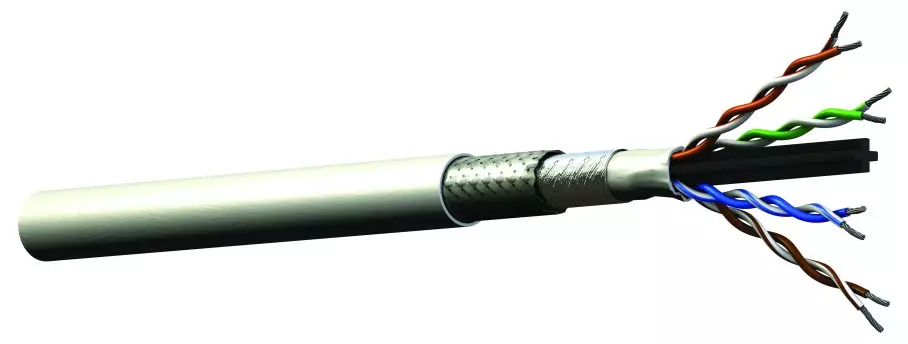
Detailed Description
What Is a High Speed Data Cable?
A high speed data cable is a precision-engineered multi-pair cable for digital signals in the tens to hundreds of Mbps — and, on the best pairs, up to several Gbps. It goes beyond a standard data transmission cable in three electrical parameters: lower capacitance (≤40 vs ≤60 pF/m), controlled differential impedance (100 Ω ±5 Ω verified by TDR), and tightly controlled intra-pair and inter-pair skew (≤10 ps/m and ≤50 ps/m respectively).
These three parameters determine whether a high-speed digital receiver can correctly recover the clock and data from the signal at the end of the cable. At multi-MHz to GHz frequencies, the cable behaves as a transmission line, not a lumped capacitance. The impedance must be consistent along the entire length to prevent signal reflections. The skew between the two conductors of a differential pair must be small enough that the differential signal edges arrive at the receiver within a fraction of the bit period.
Electrical Parameters and Their Effect on High-Speed Signals
| Parameter | Standard Data Cable | High Speed Data Cable | Why It Matters at High Speed |
|---|---|---|---|
| Capacitance | ≤60 pF/m | ≤40 pF/m | Lower capacitance → less edge rounding → longer usable cable at a given data rate |
| Impedance tolerance | ±15 Ω | ±5 Ω | Tighter impedance → less signal reflection → higher signal-to-noise ratio at the receiver |
| Intra-pair skew | ≤50 ps/m (typical) | ≤10 ps/m | Lower skew → the differential signal maintains its common-mode rejection; excess skew converts differential signal to common-mode noise |
| Conductor plating | Tinned copper | Silver-plated copper | Silver has lower high-frequency resistance → lower insertion loss at GHz frequencies (skin effect) |
Application Analysis
- USB 2.0 extension for industrial equipment: A USB camera or barcode scanner located 10–30 metres from the control PC — a high-speed data cable with active USB extender baluns at each end carries the 480 Mbps USB 2.0 signal reliably
- HDMI video extension over twisted pair: A remote monitor or digital signage display connected to the video source via HDMI extender baluns — the high-speed data cable carries the four TMDS differential pairs that make up the HDMI signal
- LVDS and Camera Link machine vision: High-resolution industrial cameras transmitting image data at hundreds of Mbps over LVDS or Camera Link interfaces — the cable's controlled impedance and low skew ensure error-free image capture at the frame grabber
- GigE Vision and USB3 Vision: Machine vision cameras transmitting at 1 Gbps (GigE Vision) or 5 Gbps (USB3 Vision) — the cable's electrical parameters directly determine the maximum cable length between camera and processor
Why Choose Yichi for High Speed Data Cables
- TDR-verified impedance on every pair: Each pair's 100 Ω differential impedance is measured and recorded per production length — not estimated from conductor geometry
- Silver-plated copper for lower high-frequency loss: At the skin-effect frequencies of high-speed digital signals (>10 MHz), silver plating provides measurably lower attenuation than tin
- Controlled skew for differential protocols: Intra-pair skew ≤10 ps/m means the differential signal edges arrive cleanly at the receiver — critical for protocols like HDMI TMDS and LVDS