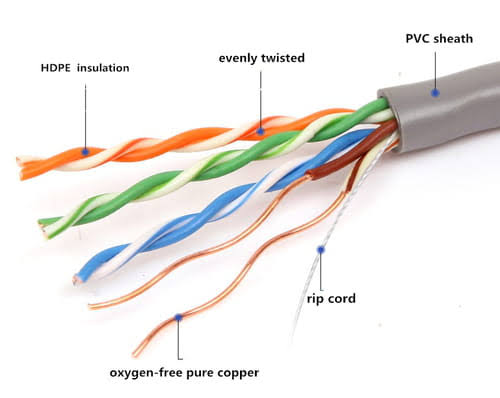
Detailed Description
What Is a Data Transmission Cable?
A data transmission cable is a low-capacitance shielded multi-pair cable specifically designed for serial digital communication — RS-232, RS-422, and RS-485 being the dominant standards in industrial and commercial equipment. Unlike an Ethernet cable (which is designed for 100 Ω differential pairs in a 4-pair configuration optimized for 100–250 MHz), a data transmission cable is a more general-purpose serial data cable: any number of pairs, optimized for the kHz-to-low-MHz frequency range of asynchronous and synchronous serial communication, with low capacitance as the primary electrical requirement.
The cable's most important electrical parameter is capacitance — specifically, capacitance per unit length of each pair. In a serial data link, signal edges are rounded off by the cable's capacitance acting as a low-pass filter. The higher the capacitance, the more rounded the edges, and the shorter the maximum cable length at a given data rate. PE insulation (dielectric constant ~2.3, capacitance ≤60 pF/m) is the standard for data transmission cable because PVC (dielectric constant 3.5–6, capacitance ≥120 pF/m) imposes a significantly shorter maximum cable length for the same data rate.
RS-232 vs RS-422 vs RS-485 — Cable Requirements by Standard
| Standard | Pairs | Data Rate (Max) | Cable Length (Max) | Impedance | Typical Cable |
|---|---|---|---|---|---|
| RS-232 | 3–5 cores (TX, RX, GND + handshake) | 115.2 kbps (standard); 1 Mbps (high-speed) | 15 m at 20 kbps; shorter at higher rates | Not specified (single-ended) | 3–5 core shielded, low capacitance |
| RS-422 | 1–2 twisted pairs (TX pair, RX pair) | 10 Mbps | 1 200 m at 100 kbps; 12 m at 10 Mbps | 100–120 Ω | 1–2 individually shielded pairs, 100 Ω |
| RS-485 (2-wire) | 1 twisted pair (A, B) | 10 Mbps | 1 200 m at 100 kbps; 12 m at 10 Mbps | 120 Ω | 1 shielded pair, 120 Ω |
| RS-485 (4-wire) | 2 twisted pairs (TX pair, RX pair) | 10 Mbps | Same as 2-wire | 120 Ω per pair | 2 individually shielded pairs, 120 Ω |
Application Analysis
- Modbus RTU networks: A shielded RS-485 data transmission cable connecting PLCs, drives, power meters, and I/O modules across a factory Modbus RTU multi-drop bus at distances up to 1 200 m at 9 600 bps
- CNC machine serial links: RS-422 data cable carrying high-speed G-code upload and DNC (Direct Numerical Control) data between the CAM server and CNC machine controllers on the shop floor
- Terminal server consolidation: A 12-pair data transmission cable from a 16-port serial device server to individual RS-232/485 field devices, replacing 12 individual serial cables
- Access control and BMS: RS-485 communication backbone between building access control panels, fire alarm panels, and HVAC controllers in commercial buildings
Why Choose Yichi for Data Transmission Cables
- PE insulation for low capacitance — the key electrical parameter: PE's low dielectric constant provides ≤60 pF/m capacitance vs ≥120 pF/m for PVC. Longer cable runs at higher data rates without signal conditioning
- Per-pair foil shielding with drain wire: Each RS-422/485 pair has its own shield. Multiple serial channels in one cable without crosstalk between pairs
- Protocol-agnostic design: The same cable carries RS-232 (single-ended, 3-core), RS-422 (differential, 1–2 pairs), and RS-485 (differential, 1–2 pairs). Specify the pair count and impedance for your protocol mix