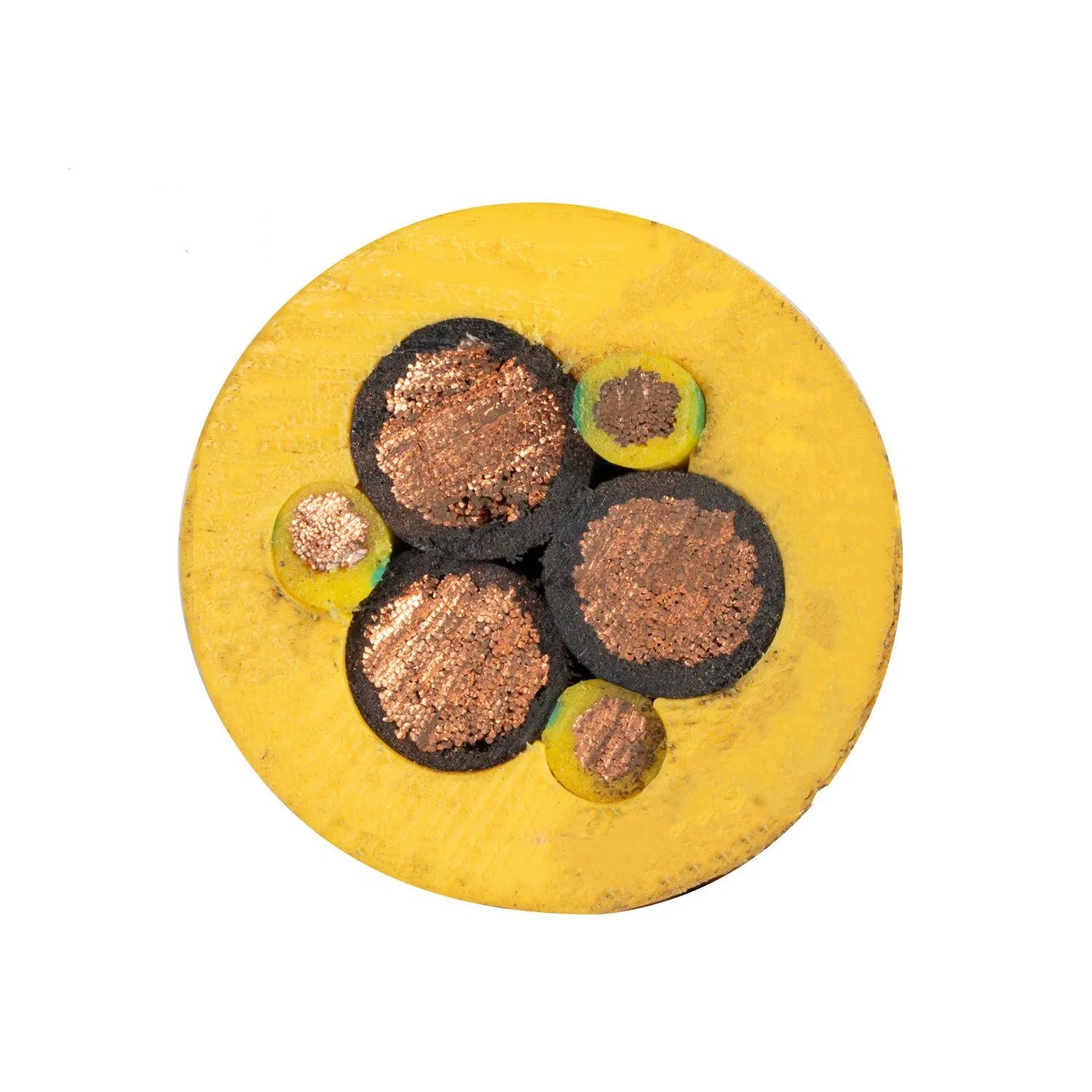
Detailed Description
What Are Type 241, 440, and 441 Mining Cables?
Type 241, Type 440, and Type 441 are the three standard Australian/New Zealand underground coal mining trailing cable types defined by AS/NZS 1802 and AS/NZS 2802. Each type is a heavy-duty flexible cable with EPR (ethylene propylene rubber) insulated power cores, integrated earth and control conductors, and a thick CR (neoprene) or CPE outer sheath — designed for a specific mining machine that drags, flexes, and abuses the cable every shift, every day, for years.
The three types are distinguished by the machine they serve and the voltage class:
| Type | Machine | Voltage | Power Cores | Key Features |
|---|---|---|---|---|
| 241 | Coal Cutter | 0.6/1 kV | 3 or 4 power cores + 3 earth | Flexible trailing cable for the coal cutting machine at the coal face |
| 440 | Shuttle Car | 0.6/1 kV | 3 power + 3 earth + 1 pilot | Trailing cable for the shuttle car transporting coal from the face to the conveyor |
| 441 | Continuous Miner | 1.1/1.1 kV to 3.6/6 kV | 3 power + 3 earth + 1 pilot + 1 ground check | Medium voltage trailing cable for the continuous miner cutting machine; the largest, highest-voltage mining trailing cable |
In North America, the equivalent cable types are defined by ICEA S-75-381 and certified by MSHA (Mine Safety and Health Administration) for underground coal mining use. The cable constructions are similar — EPR insulation, CR/CPE sheath, integrated earth and ground check conductors — but the conductor configurations and test requirements differ per the national standard.
The Underground Coal Mining Environment — Why Mining Cable Is Different
An underground coal mine is the most demanding cable environment on earth:
- Methane gas: Coal seams release methane (CH₄), which is explosive at concentrations of 5–15% in air. Any electrical equipment in the mine — including the trailing cable — must be designed so that it cannot become an ignition source. The cable must be mechanically robust enough that it cannot be damaged in a way that creates a spark or arc in the methane atmosphere. The flame-retardant sheath must prevent a cable fire from igniting the methane
- Coal dust: Finely divided coal dust is also explosive. The cable sheath must not create static electricity (rubber is inherently anti-static at the carbon black loading used for mining cable sheaths), and the cable must not accumulate coal dust that could be ignited by a cable fault
- Water: Mine roadways are wet — groundwater seeps through the coal and rock strata and is pumped to the surface but the floor is perpetually damp or flooded. The cable is continuously wet. The sheath must prevent water ingress, and the tinned copper conductors must resist corrosion if water does enter
- Mechanical abuse: The cable is dragged across the mine floor behind a moving machine, run over by the machine's own tracks or wheels, abraded against coal and rock fragments on the floor, struck by falling coal from the face, and subjected to the tension of being pulled by the machine. A cable that survives this for 6–12 months is a well-designed cable
- Acidic water: Mine water is often acidic (pH 3–5) due to the oxidation of pyrite (FeS₂) in the coal, which produces sulfuric acid. The cable sheath and any exposed metal (at connectors, if not properly sealed) must resist this acidic environment
- Flame safety: In the confined mine roadway, a cable fire would consume the available oxygen and fill the roadway with toxic smoke. The cable must be flame-retardant — it must not propagate fire along its length — and the sheath must be formulated for low toxicity combustion products
Why Choose Yichi Mining Cables
- AS/NZS 1802/2802 compliant — the definitive Australian mining cable standards: The cable construction, conductor configuration, insulation thickness, and sheath performance are manufactured to the requirements of the applicable AS/NZS standard. Type testing to the full standard's test schedule is available on request
- EPR insulation + CR/CPE sheath — the correct materials for mining trailing cable: EPR provides the electrical performance (dielectric strength, flexibility, compression resistance) and CR/CPE provides the mechanical protection — this material combination has been the standard for mining cables for over 70 years and is proven in the harshest cable application on earth
- Integrated earth, pilot, and ground check conductors — the complete mining electrical safety system: The earth conductors provide the equipment frame earth; the pilot conductors enable remote control and monitoring; the ground check conductor (Type 441) enables the ground continuity monitoring that is a mandatory safety system for underground coal mining in Australia, the US, and most international mining jurisdictions
- Tinned copper conductors — corrosion protection for the wet mine environment: Tinned copper resists the acidic mine water corrosion that would degrade bare copper conductors, increasing resistance and creating hot spots at terminations. The tinning is continuous and verified on every production batch
- Thick sheath wall — 3.0–8.0 mm of mechanical protection: The mining cable sheath is not designed for minimum material usage — it is designed for the mechanical survival of the cable in the mine. The sheath thickness is specified by the standard and verified by measurement on every production length
- Flame retardant per mining standards — verified by testing: The CR/CPE sheath compound and the complete cable construction are tested for flame propagation per the mining standard's test method. The test report demonstrates that the cable meets the flame safety requirements for underground coal mining — not a material supplier's claim