Detailed Description
What Is an RVVP Electrical Installation Shielded Cable?
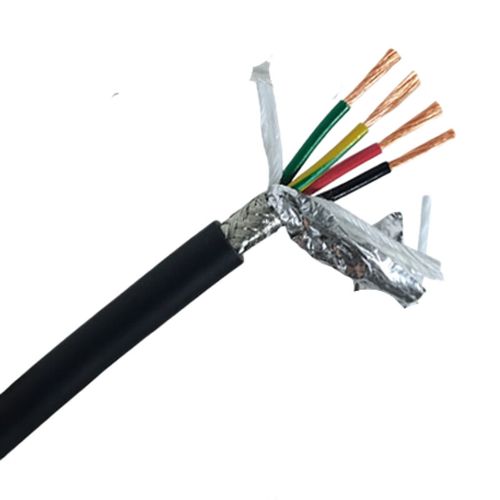
RVVP is the most widely specified shielded flexible cable in Chinese building and industrial electrical installation. The designation is unambiguous within the Chinese cable standard system:
| Letter | Chinese | English | Function |
|---|---|---|---|
| R | 软 (ruan) | Flexible | Class 5 fine stranded bare copper — flexible enough for routing through conduit bends and cable trunking |
| V | 聚氯乙烯 (ju-lv-yi-xi) | PVC insulation | PVC dielectric on each core — the standard insulation for indoor low-voltage signal and control circuits |
| V | 聚氯乙烯 | PVC sheath | PVC outer jacket — mechanical protection and the standard sheath for indoor fixed installation |
| P | 编织屏蔽 (bian-zhi-ping-bi) | Braid shield | Tinned copper wire braid — electromagnetic shielding for signal integrity and noise immunity |
The "Electrical Installation" in the product name distinguishes this general-purpose shielded cable from specialized variants like the VFD-dedicated RVVP (optimized for drive control signals in noisy electrical environments). The installation-grade RVVP is the cable you specify when you need a shielded multi-core for building wiring — access control, fire alarm, BMS, intercom — and you are following Chinese electrical installation standards.
RVVP vs Other Shielded Cables — When to Specify RVVP
| Cable Type | Standard | Insulation | Jacket | Shield Coverage | Best Application |
|---|---|---|---|---|---|
| RVVP (Installation) | JB/T 8734.5 | PVC | PVC | ≥80% | Building electrical installation — BMS, alarm, access control, intercom |
| RVVP (VFD) | JB/T 8734.5 + VFD adaptations | PVC | PVC | ≥80% | VFD control signal wiring in machine and drive cabinets |
| Industrial Shielded Cable | VDE 0812 | PVC or PE | PUR or PVC | ≥85% | Machine-mount sensors and control signals where oil/coolant resistance is needed |
| Shielded Control Cable | VDE 0812 | PVC | PUR or PVC | ≥85% | Relay, contactor, and solenoid control circuits on machinery |
The key distinction is the application environment. RVVP installation cable is designed for buildings — clean, dry, indoor, fixed installation in conduit or trunking. Its PVC jacket and standard braid coverage meet the requirements of Chinese building codes without the cost premium of a PUR jacket or higher braid coverage that a machine-tool cable would need.
Core Count Selection for Building Services
| Core Count | Typical Building Application | Example System |
|---|---|---|
| 2-core | Simple sensor loop, intercom audio | Temperature sensor to DDC, door station to indoor monitor |
| 3-core | 3-wire sensor, potentiometer | Humidity sensor (V+, signal, 0V), VRV/VRF communication |
| 4-core | Access control reader, RS-485 bus | Wiegand card reader (D0, D1, +12V, 0V), Modbus RTU bus |
| 6-core | Fire alarm zone, multi-sensor | Smoke/heat detector loop with sounder, zone module wiring |
| 8-core | Alarm zone with auxiliary | Intruder alarm zone (tamper, alarm, power) × 2 zones |
| 12-core | BMS field bus trunk | DDC controller to multiple field devices in a distribution frame |
| 16–24 core | Multi-signal riser/trunk | Floor distributor to main control panel in building riser |
The core identification follows DIN 47100 — each core is black with a printed white number. In a typical building electrical installation, this numbered system is preferred over color coding because it eliminates ambiguity when multiple cables enter the same control panel. Core 1 is always white, core 2 is brown, core 3 is green, and so on through the standard DIN table — but the printed number is the definitive identifier.
Shield Termination in Building Installations
Building installations differ from machine wiring in one important respect for shield handling: the Earth reference is not always consistent across long cable runs. The recommended practice for RVVP in building installations is:
- Single-end shield bonding at the control panel or DDC controller end — the shield drain wire is terminated to the panel earth bar
- Open at the field device end — the shield is trimmed and insulated, preventing ground-loop currents between different building earth references
- Exception: When two building zones share a common, verified earth reference (common earth bar in the same equipment room), double-end bonding may be used for improved high-frequency shielding
Application Analysis: Where RVVP Cables Are Used
- Commercial building BMS: A DDC controller in the floor electrical room connects to 20–30 field devices (temperature sensors, valve actuators, damper actuators, differential pressure switches) via multiple 2-core and 4-core RVVP cables run in the ceiling void cable tray
- Fire alarm and detection: Addressable loop wiring from the fire alarm control panel to smoke detectors, heat detectors, manual call points, and interface modules throughout the building — RVVP is specified for its shield that prevents false alarms from EMI on shared cable routes
- Access control systems: Card reader, door contact, REX button, and electric lock wiring from each secured door to the floor access controller — typically 4-core or 6-core RVVP in 20 mm conduit
- Video intercom and door entry: Multi-core RVVP from the building entrance panel to each apartment's indoor monitor — audio, video, and data on separate cores in a single shielded cable
- Industrial signal trunking: In factories and process plants where the electrical installation follows Chinese standards, RVVP is the default shielded cable for 4–20 mA transmitter loops and PLC I/O extension between field junction boxes and the control room
Why Choose Yichi for RVVP Electrical Installation Cables
- Manufactured to the standard your installation follows: RVVP per JB/T 8734.5 is the Chinese cable standard — familiar to every electrical engineer and installation contractor in the region. Yichi RVVP cables are manufactured to this standard with verified conductor cross-sections, insulation thickness, and braid coverage
- Full core-count range for building services: From 2-core sensor loops to 24-core BMS trunk cables — order the exact core count your installation design specifies, not the nearest catalog compromise
- DIN 47100 numbered cores as factory standard: Every core carries its printed number, visible at the terminal strip. For multi-cable installations where color coding alone is not sufficient, numbered cores reduce wiring errors and commissioning time
- Braid coverage verified at ≥80%: The shield is the noise barrier between your signal circuits and the power cables sharing the same trunking. Yichi verifies braid coverage optically — not by calculation from braid parameters
- Factory-direct supply for project quantities: For building projects with tens of kilometres of RVVP in the cable schedule, Yichi's factory-direct manufacturing provides consistent quality, full test documentation per drum, and competitive pricing without distributor markups