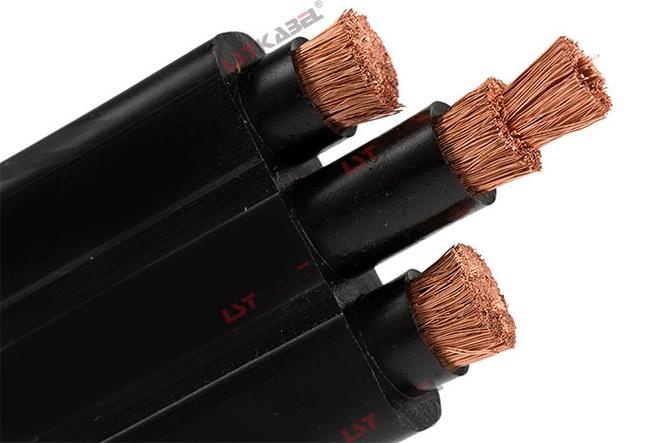
Detailed Description
Stacker Reclaimer vs Bucket Wheel — Different Machines, Different Cables
| Bucket Wheel Stacker Reclaimer | Stacker Reclaimer (Scraper/Boom) | |
|---|---|---|
| Reclaiming mechanism | Rotating bucket wheel (10–20 m diameter) | Scraper chain, boom scraper, or drag chain |
| Typical power | 1–3+ MW | 100–500 kW |
| Voltage | 3.6/6 kV to 6/10 kV | 0.6/1 kV to 3.6/6 kV |
| Travel distance | 100–500 m | 50–200 m |
| Throughput | 1 000–10 000+ tph | 200–2 000 tph |
| Typical location | Large coal/ore port terminals | Power plants, cement plants, smaller terminals |
| Cable emphasis | High tensile, deep-drum, MV | Moderate tensile, smaller drum, LV/MV |
Stacker reclaimers (scraper type) are the workhorses of smaller bulk material operations. They handle the same materials — coal, limestone, fertilizer, grain — but at lower throughput and with simpler reclaiming mechanisms. The cable requirements are proportionally lower: smaller cross-sections, lower voltage, shorter travel, fewer drum layers.
Common Applications by Industry
Power Plant Coal Yards
Stacker reclaimers feed coal from outdoor stockpiles to the power plant's conveyor system. The machines operate continuously during plant operation. The cable must handle coal dust (conductive, abrasive, and potentially explosive), outdoor exposure, and long travel distances.
Cable specification: CR jacket (coal dust resistance + MSHA flame safety), 0.6/1 kV or 3.6/6 kV, integrated control cores. PUR optional for wet/humid climates.Cement Plant Raw Material Yards
Limestone, clay, and additives are stacked and reclaimed in open or covered storage. The cable faces abrasive limestone dust (highly alkaline when wet), variable outdoor conditions, and continuous operation during production campaigns.
Cable specification: PUR jacket (alkaline resistance), 0.6/1 kV, integrated control and fiber.Fertilizer Terminals
Urea, potash, and phosphate fertilizers are hygroscopic (absorb moisture) and can be corrosive when wet. The cable jacket must resist chemical attack from fertilizer dust combined with humidity or rain.
Cable specification: PUR jacket (chemical resistance), 0.6/1 kV, sealed construction to prevent moisture ingress along the cable.Round vs Flat Profile Selection
| Machine Section | Cable Profile | Reason |
|---|---|---|
| Main power reel | Round | Deep-drum winding, high tensile from cable weight |
| Boom conveyor festoon | Flat | Loop formation, anti-twist, easy inspection |
| Tripper car | Flat | Compact drum, space-limited |
| Travel drive | Round or flat | Depends on reel design — flat for compact, round for standard |
Why Choose Yichi Cable Stacker Reclaimer?
- Right-sized engineering: We do not over-specify a bucket-wheel-grade cable for a scraper reclaimer. The cable is engineered for the actual machine power, travel, and environment
- Industry-specific experience: Power plant coal yards, cement plants, fertilizer terminals — we understand the material-specific jacket requirements
- CR or PUR jacket: MSHA-certified CR for coal; PUR for corrosive and wet environments
- Combined cable design: Power + control + fiber in one cable — one installation, one maintenance schedule
Cable Selection by Machine Size
| Machine class | Reclaiming capacity | Power cable | Control cores | Voltage |
|---|---|---|---|---|
| Small scraper reclaimer | 200–600 tph | 3 × 16–35 mm² | 7–14 | 0.6/1 kV |
| Medium boom reclaimer | 600–1 200 tph | 3 × 35–95 mm² | 14–24 | 0.6/1 kV |
| Large boom / drag chain | 1 200–2 000 tph | 3 × 95–185 mm² | 24–36 | 0.6/1 kV or 3.6/6 kV |
| High-reach reclaimer | 1 200–2 000 tph | 3 × 120–300 mm² | 24–36 | 3.6/6 kV |
Cross-section, core count, and voltage should follow the drive motor rating and the cable management system — not the machine's nominal tonnage alone. Reeling drums need a larger tensile core and a deeper winding reserve; festoon systems need a flat profile and a controlled loop height. Send us the motor nameplate data and the travel length, and we will size the cable to match.
Installation and Handling Notes
- Drum winding: respect the 12:1 minimum D/d (15:1 recommended). A tighter bend shortens reeling life faster than any other single factor.
- Festoon loops: set trolley spacing so the loop never closes below the minimum bend radius — check loop height at full travel, not at rest.
- Tensile core termination: clamp the steel core at both ends. The copper conductors must never carry the machine's pulling load.
- Lay direction: for reeling duty, wind in the direction that tightens the outer layer. Reverse winding causes layer crossover and premature jacket wear.
- Spare cores: order 15–20 % spare control cores. Adding cores after commissioning means replacing the whole cable run.