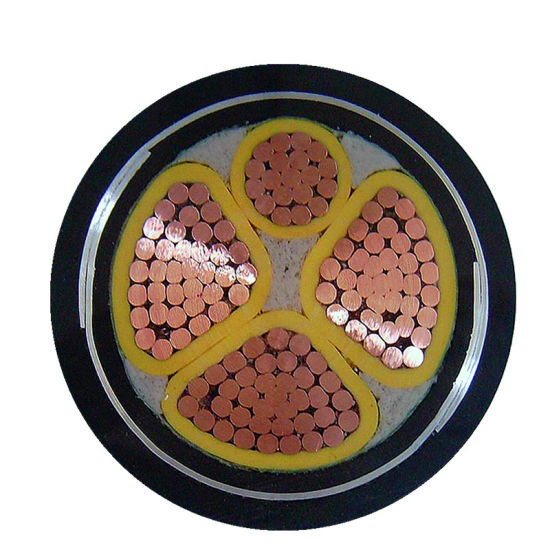
Detailed Description
What Is Steel Wire Armoured (SWA) Cable?
Steel Wire Armoured (SWA) cable is a power cable with a helical layer of galvanized steel wires applied over the insulated core assembly, providing the maximum mechanical protection available in a low voltage cable construction. SWA is the cable that goes underground — the cable that an electrician buries in a trench to supply a detached garage, a garden office, a street lighting column, or a factory sub-distribution board. It is the most widely used armoured cable in the world, defined by IEC 60502-1 and specified wherever a power cable leaves the protected indoor environment and enters the world of soil, water, vehicles, rodents, and accidental damage.
The steel wire armour is not simply "added protection" — it defines the cable and how it must be installed, terminated, and integrated into the electrical system. The armour serves as the circuit's earth continuity path. The armour must be terminated with armoured cable glands that grip the steel wires and provide the earth connection to the metal enclosure. And the armour must be sized — by the cable designer, per the adiabatic equation — to carry the prospective earth fault current for the time required for the protective device to clear the fault.
SWA vs No Armour — When Armouring Is Mandatory
| Installation Condition | Unarmoured Cable | SWA Cable |
|---|---|---|
| Indoor cable tray, no mechanical risk | Suitable | Acceptable (over-specified but safe) |
| Indoor surface-mounted, risk of impact | Not suitable | Required |
| Outdoor clipped to wall | Not suitable (UV degrades PVC sheath, no mechanical protection) | Required |
| Buried directly in soil | Not permitted (no crush or rodent protection) | Required — with PE sheath recommended |
| Buried in duct | Acceptable for plastic ducts in sand bedding | Required for duct pulling (tensile strength) and for ducts under roadways (crush protection) |
| Cable crossing under roadway | Not permitted | Required — minimum 1 000 mm burial depth |
| Industrial plant floor | Not suitable (forklift, dropped tools, vibration) | Required |
| Agricultural land | Not suitable (ploughing, livestock, rodent damage) | Required |
| Building riser shaft (vertical) | Requires separate catenary wire support | SWA carries its own weight — tensile armour used as catenary |
The rule of thumb for cable specification: if the cable is indoors, in a cable tray, in a clean and protected environment, and the installation method provides all necessary mechanical protection — unarmoured cable may be acceptable. For any other installation condition — outdoors, underground, industrial, agricultural, or any location with risk of mechanical damage — SWA is the minimum specification.
Why Choose Yichi SWA Cables
- IEC 60502-1 / BS 5467 compliant — the definitive SWA standard: The armour wire diameter per IEC 60502-1 Table 5, the bedding and sheath thickness, the galvanizing class per BS EN 10244-2, and the complete cable construction per the standard. SWA is manufactured to the standard — not to a reduced specification for cost saving
- Galvanized steel armour — verified zinc coating weight: The zinc coating on the armour wires is the corrosion protection for buried service. The coating weight is specified, measured, and verified on every armour wire batch. Underspecified zinc coating leads to armour corrosion, loss of earth continuity, and cable failure in buried service after 10–15 years — the SWA cable's design life is 30–50 years, and the armour corrosion protection must support that
- PE sheath recommended for direct burial — a better moisture barrier than PVC: PE ST7 is less permeable to water vapor than PVC ST2 and does not contain plasticizers that migrate out over time. For SWA cable that will be buried in soil for 30+ years, PE sheath is the recommended specification. PVC sheath is acceptable for indoor, surface-mounted, and ducted SWA installations
- Single-core SWA guidance — non-magnetic glands and AWA alternative: Our technical documentation includes clear guidance on the single-core SWA eddy current heating issue and the requirement for non-magnetic glands and gland plates. For single-core AC circuits, we offer aluminum wire armour (AWA) as the electrically preferred alternative to steel SWA
- Armour earth continuity verified — resistance data published: The armour DC resistance (Ω/km) is published for every SWA cable size and core configuration. Use this data to calculate the earth fault loop impedance and verify the armour's suitability as the CPC. If the armour cannot meet the adiabatic requirement, we recommend the appropriate additional copper earth core