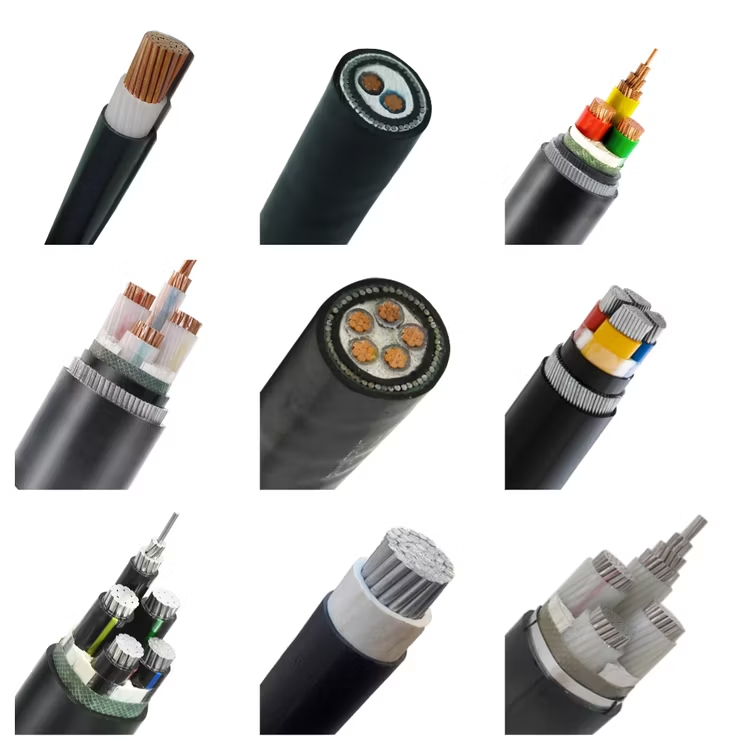
Underground Power Cable — IEC 60502-1 XLPE Insulated SWA/STA Armoured PE Sheathed 0.6/1 kV Direct Burial Power Cable with Moisture Barrier, Rodent Protection, and Mechanical Strength for Buried Installation in Soil, Duct Banks, and Underground Distribution Networks
Power & High Voltage Cables /Underground Installation Series

Underground Power Cable — IEC 60502-1 XLPE Insulated SWA/STA Armoured PE Sheathed 0.6/1 kV Direct Burial Power Cable with Moisture Barrier, Rodent Protection, and Mechanical Strength for Buried Installation in Soil, Duct Banks, and Underground Distribution Networks

Underground power cable: IEC 60502-1 XLPE insulated, SWA/STA armoured, PE sheathed, 0.6/1 kV, copper or aluminum 1.5–630 mm². Direct burial rated with moisture barrier, rodent protection, crush resistance. For buried distribution, street lighting, campus power, underground networks. UV-stable PE. CE, RoHS.

Key Features

IEC 60502-1 compliant with construction specifically engineered for direct burial — the combination of XLPE insulation, SWA/STA steel wire or steel tape armour, and PE (polyethylene) outer sheath provides the complete protection system that underground installation demands
PE (polyethylene) ST7 outer sheath — the preferred sheath material for direct burial cables because PE is more moisture-resistant than PVC, has better UV stability for the sections that rise above ground at terminations, and does not contain plasticizers that can migrate into the soil over decades of burial
SWA (steel wire armour) for tensile strength and rodent protection — galvanized steel wire armour provides the mechanical barrier that stops rodents (rats, gophers, moles) from gnawing through to the conductors, and provides the tensile strength to survive ground movement, settlement, and the pulling forces during cable laying in ducts and trenches
XLPE (cross-linked polyethylene) insulation rated 90°C — the standard insulation for underground cables because of its superior water treeing resistance; tree-retardant XLPE (TR-XLPE) available for installations in high water table, permanently wet soil, or where the cable is known to be in contact with groundwater for its service life
Copper or aluminum conductor, single-core or multi-core — copper for all standard cross-sections 1.5–630 mm²; aluminum for weight reduction in large feeders and long underground cable runs where the lighter aluminum conductor reduces pulling tension and cable reel weight
Moisture barrier construction options — water-swellable tapes under the sheath and/or longitudinally applied aluminum-polyethylene laminate (APL) moisture barrier for installations in permanently wet soil, high water table areas, and submarine shore-end landing sections
Direct burial without conduit — the armoured + PE sheathed construction is rated for direct soil contact without additional conduit; the PE sheath resists the alkaline and acidic soil conditions that would degrade PVC over time
UV-stabilized PE sheath for the above-ground transition — the cable sections that rise from the ground at pole terminations, transformer connections, and building entry points must withstand years of UV exposure; the carbon black content (≥2.5%) in the PE ST7 compound provides the necessary UV stabilization

Applications

Underground distribution networks — direct-buried cables from secondary substations to distribution pillars, street cabinets, and customer connection points in residential and commercial underground power distribution schemesStreet and highway lighting — buried armoured cable for street lighting column feeders, highway lighting circuits, and traffic signal power supply; the armoured construction protects against accidental excavation damage and rodent attackCampus and site power distribution — underground power cable between buildings in university campuses, hospital complexes, industrial sites, and military bases where overhead lines are not permitted and all power distribution is buriedUnderground duct bank installation — cables pulled through buried PVC or concrete ducts and conduits; the armoured construction provides the pulling strength and crush resistance for installation in multi-way duct banks under roadways and paved areasWind and solar farm underground collection — buried cables connecting wind turbine generators to the wind farm substation, and solar inverter stations to the solar farm substation; the PE sheath and armoured construction are specified for the 25+ year design life of renewable energy installationsBuilding underground service entrance — buried cable from the property boundary or utility connection point to the building main switchboard; the armoured + PE sheathed construction is the standard specification for underground utility service entrance cablesTemporary site power with direct burial — armoured cable for construction site power distribution where the cable is buried in a shallow trench across the site for the duration of the construction project; the armour provides protection against accidental mechanical damage during site operations

Technical Specifications

Standard IEC 60502-1: Power cables with extruded insulation and their accessories for rated voltages from 1 kV (Um = 1.2 kV) up to 30 kV; the standard covers all cable components for underground installation
Rated Voltage (U₀/U) 0.6/1 kV (Um = 1.2 kV); also available at 3.6/6 kV, 6/10 kV, and 12/20 kV per IEC 60502-2 for medium voltage underground distribution
Conductor Material — Copper Bare copper; IEC 60228 Class 1 (solid ≤4 mm²) or Class 2 (stranded ≥6 mm²); circular or compacted circular; water-blocked conductor (stranded with water-swellable yarns in the interstices) available for enhanced moisture protection
Conductor Material — Aluminum Aluminum (99.5%); IEC 60228 Class 2 stranded; ≥16 mm²; for weight reduction in long underground runs; bi-metallic terminations required at connection points
Conductor Cross-Sections — Copper 1.5, 2.5, 4, 6, 10, 16, 25, 35, 50, 70, 95, 120, 150, 185, 240, 300, 400, 500, 630 mm²
Conductor Cross-Sections — Aluminum 16, 25, 35, 50, 70, 95, 120, 150, 185, 240, 300, 400, 500, 630 mm²
Core Configuration Single-core; 2-core; 3-core; 3.5-core; 4-core; 5-core; per standard IEC 60502-1 core configurations for underground distribution
Core Insulation — XLPE Cross-linked polyethylene; 90°C continuous; 250°C short-circuit; tree-retardant XLPE (TR-XLPE) optional for permanently wet buried conditions; the insulation thickness per IEC 60502-1 Table 3 provides the rated 0.6/1 kV withstand plus margin
Core Identification Per HD 308 S2: brown, black, grey (L1, L2, L3), blue (N), green-yellow (PE); numbered black cores on request
Core Assembly — Multi-Core Concentric stranding with non-hygroscopic filler elements; optional water-swellable filler yarns for longitudinal moisture blocking — if the sheath is damaged at one point, water migration along the cable is blocked by the swelling fillers
Water Blocking (Optional) — Core Interstices Water-swellable yarns (super-absorbent polymer on polyester carrier) stranded in the conductor and laid in the core interstices; swells on contact with water to form a gel plug that blocks water migration along the cable
Inner Covering / Bedding Extruded PVC ST2 or PE ST7; provides a smooth cylindrical surface for armour wire application and an additional moisture barrier layer
Water Blocking (Optional) — Under Sheath Water-swellable tape(s) applied helically over the bedding (for armoured) or core assembly (for unarmoured); the tape swells radially on water contact, forming a gel barrier that seals the gap between the bedding and the outer sheath
Moisture Barrier (Optional) — APL Laminate Longitudinally applied aluminum-polyethylene laminate bonded to the PE outer sheath; provides a 100% radial moisture barrier (aluminum foil is impermeable to water vapor); used for submarine shore-end and permanently submerged underground cable
Armour — SWA Galvanized steel wire armour; wire diameter per IEC 60502-1 Table 5 (1.25–5.0 mm); applied helically with controlled lay; the armour serves as mechanical protection, tensile strength element, and earth fault current return path
Armour — STA Galvanized steel tape armour; double tape with ≥25% overlap; 0.2–0.8 mm tape thickness; for installations where tensile strength is less critical but crush and rodent protection are required
Armour — DSA (Double Steel Tape Armour) For enhanced mechanical protection in particularly aggressive environments — rocky soil, areas with heavy vehicle traffic directly above the cable, or known rodent-infested ground
Outer Sheath — PE ST7 Extruded medium-density or high-density polyethylene (MDPE/HDPE); black RAL 9005; carbon black content ≥2.5% for UV stabilization; the definitive sheath material for direct burial because of its moisture resistance, chemical stability in soil, and UV resistance for above-ground sections
Outer Sheath — PVC ST2 (Alternative) For indoor or ducted underground installations where the cable is not in direct soil contact; lower cost than PE but not recommended for direct burial due to lower moisture resistance and plasticizer migration over time
Sheath Thickness Per IEC 60502-1 Table 7; from 1.4 mm (smallest cable) to 3.4 mm (largest cable); the PE sheath thickness ensures mechanical protection during cable laying and long-term soil pressure resistance
Maximum DC Conductor Resistance at 20°C — Copper Per IEC 60228 Class 2; 12.1 Ω/km (1.5 mm²) to 0.0283 Ω/km (630 mm²)
Maximum DC Conductor Resistance at 20°C — Aluminum Per IEC 60228 Class 2; 1.91 Ω/km (16 mm²) to 0.0469 Ω/km (630 mm²)
Insulation Resistance at 20°C — XLPE ≥1 000 MΩ·km (core-to-core and core-to-earth at 500 V DC, 1 min)
Test Voltage (AC — Routine) 3 500 V AC / 5 min (0.6/1 kV); per IEC 60502-1
Temperature Range — Continuous (Conductor) 90°C (XLPE); sheath surface: PE 80°C max; the soil thermal resistivity at the installation site affects the cable's ampacity — for direct burial, the cable rating is calculated using the soil thermal resistivity (typically 1.0–2.5 K·m/W) per IEC 60287
Short-Circuit Temperature — XLPE 250°C (max 5 s) per IEC 60949; the earth surrounding the cable provides additional thermal mass that absorbs short-circuit energy, reducing the conductor temperature rise compared to a cable in free air
Minimum Bending Radius — Single-Core 15× cable OD
Minimum Bending Radius — Multi-Core Unarmoured 12× cable OD
Minimum Bending Radius — Multi-Core Armoured 15× cable OD
Maximum Pulling Tension 50 N/mm² total copper conductor cross-section; 30 N/mm² aluminum; pulling by conductor only — do not pull by armour; use a cable stocking over the outer sheath for pulling through ducts and trenches
Installation Temperature — PE Sheath -20°C minimum (PE retains flexibility at low temperatures); 0°C minimum (PVC sheath) — if installing PVC sheathed cable below 0°C, the cable must be pre-heated
Burial Depth — Minimum (Pedestrian Areas) 600 mm (per IEC 60364 / typical national regulations); cable warning tape at 250 mm above the cable; the tape provides a visual warning to anyone excavating above the cable
Burial Depth — Minimum (Roadways) 1 000 mm; the cable must be in a duct or conduit under roadways; direct burial under roadways is not permitted in most jurisdictions
Cable Bedding and Surround The cable must be laid on a 100 mm bed of sand or fine soil (free of stones, sharp objects) and covered with 100 mm of sand before backfilling with excavated soil; the sand bed protects the PE sheath from puncture by stones during backfill compaction
Current Rating (Typical, Copper/XLPE/PE Sheath, 3-Core SWA, Direct Buried, Soil 1.5 K·m/W, 20°C) Per IEC 60287; 16 mm² ≈ 82 A; 35 mm² ≈ 125 A; 70 mm² ≈ 186 A; 120 mm² ≈ 256 A; 240 mm² ≈ 386 A; the buried rating is typically lower than the in-air rating due to the higher thermal resistance of soil compared to air
Flame Retardant — PE Sheath PE is not inherently flame-retardant — for installations where the above-ground sections require flame retardance, specify a PVC oversheath on the exposed sections or use LSZH-sheathed cable
Certifications CE, RoHS; BASEC, KEMA KEUR, VDE on request per national market; type test certificates per IEC 60502-1 available

Detailed Description

What Is an Underground Power Cable?

An underground power cable is a cable designed and constructed specifically for installation in direct contact with soil — buried in a trench, laid on a sand bed, and backfilled. It is not simply an indoor power cable that happens to be buried. Every component of the cable construction is selected to survive the underground environment for 30–50 years without maintenance: moisture from groundwater, chemical attack from soil acids and alkalis, mechanical pressure from the weight of soil and surface traffic, rodent gnawing, and the physical stress of ground movement and settlement.

The construction that defines an underground cable is: XLPE insulation + SWA/STA steel armour + PE outer sheath. Each layer addresses a specific underground hazard:

  • XLPE insulation: Resists water treeing in wet soil — the dominant long-term failure mechanism for buried cables
  • SWA/STA steel armour: Stops rodents from reaching the conductors; provides crush resistance against stones in the backfill and construction activity above the cable; provides the tensile strength to survive ground settlement without conductor breakage
  • PE outer sheath: Impermeable to water vapor over decades; chemically inert in soil — does not react with acids, alkalis, or soil microorganisms; UV-stabilized for the cable sections that rise above ground at terminations

Why PE Sheath for Direct Burial? — The PVC Underground Problem

PVC sheathed cable can be buried underground — it has been for decades. But PVC underground has a fundamental limitation: plasticizer migration. The plasticizers that give PVC its flexibility are not chemically bonded to the polymer — they are dispersed in the PVC matrix. Over decades in wet soil, these plasticizers slowly migrate out of the PVC and into the surrounding soil. As the plasticizer content decreases, the PVC sheath becomes progressively more brittle, eventually cracking under the soil pressure or ground movement. A crack in the sheath allows groundwater to reach the armour, which corrodes, and eventually reach the core insulation.

PE (polyethylene) does not contain plasticizers — it is inherently flexible without additives. PE is also more resistant to water permeation than PVC, and it is chemically more inert in soil. For a cable that is expected to function for 30–50 years in direct soil contact, PE is the correct sheath material. PVC sheathed cable should be reserved for indoor, ducted, and above-ground installations where the environmental exposure is less severe.

PropertyPE Sheath (Underground Cable)PVC Sheath
Moisture permeationLow — PE is a better moisture barrier than PVCModerate — water vapor permeates more readily through PVC
Chemical stability in soilExcellent — PE is chemically inert; does not react with soil acids, alkalis, or microorganismsModerate — plasticizers can be extracted by soil microorganisms and chemicals
Plasticizer contentZero — PE is inherently flexible; no plasticizers to migrate20–40% — plasticizers migrate out over decades, causing embrittlement
UV resistance (above ground)Excellent — carbon black provides full UV stabilizationGood (black PVC); poor (grey/white PVC)
Low-temperature flexibility-20°C (PE remains flexible at typical winter installation temperatures)0°C (PVC becomes brittle; pre-heating required for cold-weather installation)
CostReference5–10% lower
Recommended for direct burialYes — the standard sheath material for direct burialNo — not recommended for long-term direct soil contact

Installation — The Cable Trench Detail That Prevents Failure

The single most common cause of premature underground cable failure is incorrect trench preparation — specifically, backfilling the cable trench with the excavated soil without first surrounding the cable with a sand bed. Native soil contains stones, sharp rock fragments, construction debris, and other objects that, under the weight of the backfill, slowly indent the cable sheath. Over years, this indentation punctures the sheath, water enters, the armour corrodes, and the cable fails.

The correct installation method (per IEC 60364 / national wiring regulations) is:

  1. Trench excavation: Minimum 600 mm depth for pedestrian areas, 1 000 mm for roadways. The trench bottom must be flat and free of stones and sharp objects
  2. Sand bed: 100 mm of clean sand or screened fine soil placed on the trench bottom. The cable is laid on this bed — it must not be in direct contact with the native soil
  3. Cable laying: The cable is laid with gentle snaking (not pulled taut) to allow for thermal expansion and ground settlement without tension. The minimum bending radius must be maintained throughout the cable route
  4. Sand surround: 100 mm of sand placed over the cable. The sand must be hand-compacted around and above the cable — mechanical compaction directly above the cable can crush it
  5. Cable protection: Cable tiles (concrete or plastic protective covers) placed over the sand layer for mechanical protection against future excavation. Cable warning tape laid 250 mm above the tiles
  6. Backfill: The remaining trench filled with excavated soil, mechanically compacted in 150–200 mm layers. The first layer above the cable protection must be hand-compacted or lightly mechanically compacted

Why Choose Yichi Underground Power Cables

  • PE sheath as standard for all underground cable: We manufacture underground cable with PE ST7 sheath — not PVC. The PE compound is specified for direct burial with ≥2.5% carbon black content for UV stability and verified moisture permeation resistance per IEC 60502-1 material requirements
  • SWA/STA armour — rodent-proof and crush-resistant: The galvanized steel armour is the mechanical barrier that protects the cable from rodent attack (the primary cause of cable damage in buried installations), stone puncture during backfill, and accidental excavation damage. Armour wires are galvanized to ASTM A641 / BS EN 10244 for corrosion resistance in buried service
  • TR-XLPE option for high water table installations: For installations where the cable is known to be in permanent contact with groundwater, tree-retardant XLPE insulation compound provides the additional water treeing resistance that extends the cable's design life significantly compared to standard XLPE in wet soil conditions
  • Water-blocking options for enhanced moisture protection: Water-swellable tapes, water-swellable filler yarns in the core interstices, and APL (aluminum-polyethylene laminate) moisture barrier under the sheath — specify the level of water blocking appropriate for the installation site's groundwater conditions
  • Application engineering for buried cable rating: The ampacity of a buried cable depends on the soil thermal resistivity at the installation site, the burial depth, the cable spacing (for multiple circuits in the same trench), and the ambient soil temperature. Provide your site conditions and we calculate the derated ampacity per IEC 60287 and recommend the conductor cross-section that meets your load requirement under buried conditions

Product Inquiry

Product: Underground Power Cable — IEC 60502-1 XLPE Insulated SWA/STA Armoured PE Sheathed 0.6/1 kV Direct Burial Power Cable with Moisture Barrier, Rodent Protection, and Mechanical Strength for Buried Installation in Soil, Duct Banks, and Underground Distribution Networks

Add technical specifications (optional)

The more detail you provide, the faster and more accurate our quotation.

No file chosen

PDF, Office, image or CAD file — up to 5 MB

Need Help?

Certifications

ISO 9001
Quality
CE
European
RoHS
Environmental
TÜV
Certification

Need a Quote for This Product?

Send us your requirements and receive a detailed quotation within 24 hours.