Detailed Description
What Is XLPE Insulated Power Cable?
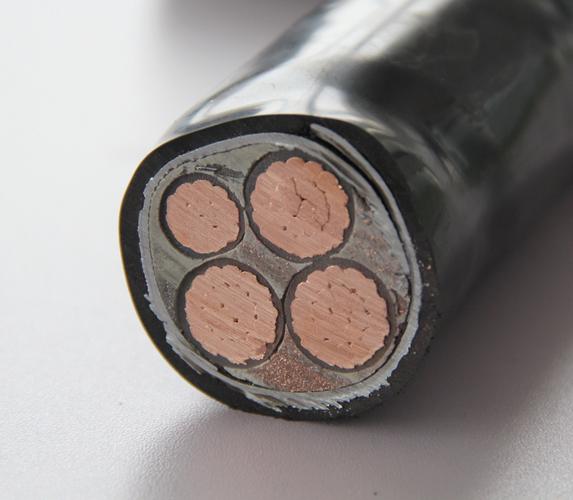
XLPE (cross-linked polyethylene) insulated power cable is the modern standard for low voltage power distribution. In an XLPE cable, the polyethylene insulation molecules are chemically cross-linked — the long polymer chains are bonded together at multiple points, converting a thermoplastic material (one that softens when heated) into a thermoset material (one that remains solid and dimensionally stable up to its decomposition temperature). This cross-linking is what gives XLPE its defining properties: a continuous conductor temperature rating of 90°C (versus 70°C for PVC), a short-circuit temperature rating of 250°C (versus 160°C for PVC), and the ability to operate at 130°C for emergency overload conditions.
The practical consequence of cross-linking is that for the same conductor cross-section and installation conditions, an XLPE cable carries approximately 20–30% more current than a PVC cable. Or, for the same load current, an XLPE cable can use the next smaller standard conductor cross-section — a 35 mm² XLPE cable carries 139 A (in air), approximately equal to a 50 mm² PVC cable (141 A). The conductor material saving often offsets the slightly higher insulation material cost.
XLPE vs PVC — The Decisive Comparison
| Property | PVC (70°C) | XLPE (90°C) | Practical Impact |
|---|---|---|---|
| Continuous temperature | 70°C | 90°C | XLPE carries ~25% more current at same cross-section |
| Short-circuit temperature | 160°C | 250°C | For the same fault level, XLPE needs only 60% of the PVC conductor cross-section to survive the fault without damage |
| Overload temperature | 100°C (limited, degrades PVC) | 130°C (rated, limited hours/year) | XLPE survives contingency loading that would damage PVC |
| Insulation resistance (20°C) | ≥36.8 MΩ·km | ≥1 000 MΩ·km (27× higher) | XLPE has lower leakage current — important for long runs |
| Dielectric loss (tan δ) | ≤0.1 | ≤0.004 (25× lower) | XLPE generates less heat in the insulation — better efficiency |
| Water treeing resistance | Poor | Good (excellent with TR-XLPE) | XLPE lasts longer in buried and wet installations |
| Insulation thickness (same voltage) | Thicker (e.g., 1.4 mm for 50 mm²) | Thinner (e.g., 1.0 mm for 50 mm²) | XLPE cable OD is ~5–10% smaller — lighter, smaller bending radius |
| Low-temperature flexibility | Brittle below -5°C | Flexible to -20°C | XLPE installs at lower temperatures without pre-heating |
| Ageing resistance | Plasticizer migration limits life to 25–30 years | Thermoset — no plasticizers to migrate; 40+ year design life | XLPE has longer useful life before replacement |
| Cost | 100% (reference) | 100–115% (for cross-section ≤35 mm², the insulation premium is a small fraction of the total cable cost); at larger cross-sections, the conductor cost dominates and the percentage premium is negligible | XLPE is often cost-neutral when ampacity advantage is considered |
XLPE is the dominant insulation for new low voltage power cable installations worldwide. PVC remains available for cost-sensitive indoor installations, but for any new-build project with a 30+ year design horizon — a commercial building, an industrial plant, a solar farm — XLPE is the correct technical and economic choice.
The Cross-Linking Process — How XLPE Is Made
The conversion from thermoplastic PE to thermoset XLPE is achieved through a chemical cross-linking reaction. The most common industrial process uses dicumyl peroxide (DCP) as the cross-linking agent:
- Compounding: Low-density polyethylene (LDPE) resin is mixed with DCP peroxide, antioxidants, and stabilizers. The DCP is uniformly dispersed in the PE matrix at a compounding temperature below the peroxide decomposition temperature (typically <130°C) to prevent premature cross-linking
- Extrusion: The compounded material is extruded over the conductor in a continuous process. In an LV cable (0.6/1 kV), the XLPE is extruded directly over the conductor without semiconductive screens (unlike MV/HV cable)
- Cross-linking (Vulcanization): The extruded cable passes through a continuous vulcanization (CV) tube — a long, heated, pressurized tube. The temperature (200–300°C) decomposes the DCP into free radicals, which abstract hydrogen atoms from the PE chains and create cross-links between adjacent chains. The pressure (typically nitrogen gas at 10–15 bar) prevents void formation in the insulation during the cross-linking reaction
- Cooling and degassing: The cross-linked cable is cooled under pressure, then wound onto reels. Residual cross-linking by-products (cumyl alcohol, acetophenone, methane) diffuse out over time — for LV cables, the thinner insulation wall means degassing is rapid and does not require the extended heated degassing cycle used for MV and HV XLPE cables.
Insulation Thickness Comparison — Why XLPE Cable Is Smaller
| Conductor Cross-Section | PVC Insulation Thickness (mm) | XLPE Insulation Thickness (mm) | Thickness Reduction |
|---|---|---|---|
| 1.5–6 mm² | 0.8 | 0.7 | 12.5% |
| 10–16 mm² | 1.0 | 0.7 | 30% |
| 25–35 mm² | 1.2 | 0.9 | 25% |
| 50 mm² | 1.4 | 1.0 | 29% |
| 70–95 mm² | 1.4 | 1.1 | 21% |
| 120–150 mm² | 1.6 | 1.2 | 25% |
| 185–240 mm² | 1.8 | 1.4 | 22% |
| 300 mm² | 2.0 | 1.6 | 20% |
| 400 mm² | 2.2 | 1.8 | 18% |
XLPE's higher dielectric strength (20–30 kV/mm vs 15–20 kV/mm for PVC) allows the use of a thinner insulation wall for the same 0.6/1 kV rated voltage per IEC 60502-1. The thinner insulation reduces the overall cable diameter, which in turn reduces the weight, the minimum bending radius, the required cable trench width, and the quantity of sheath, bedding, and armour materials. This is a compounding benefit: the XLPE cable is not just electrically superior, it is mechanically smaller and lighter at every standard cross-section.
Why Choose Yichi XLPE Insulated Power Cables
- IEC 60502-1 compliant XLPE compound — the correct material for modern power distribution: Our XLPE insulation is a peroxide-cured LDPE-based compound qualified per the full IEC 60502-1 type test program. The 90°C continuous rating, 250°C short-circuit rating, and 130°C overload rating are not nominal values — they are verified by type testing
- Peroxide-cured CV process — verifiable cross-linking quality: The curing parameters (temperature profile, line speed, gas pressure) are monitored and recorded for every production run. The degree of cross-linking is verified by hot-set elongation testing per IEC 60811-507 — the insulation must elongate less than 175% under a 0.2 MPa load at 200°C, and the permanent set after cooling must be less than 15%. This test is the definitive check that the XLPE is fully cross-linked
- TR-XLPE option for wet installations: For direct-buried cables in high-water-table soils, tree-retardant XLPE (TR-XLPE) compound is available. TR-XLPE contains additives that inhibit the growth of water trees — the primary long-term degradation mechanism for buried medium and high voltage cables. For LV cables in permanently wet service, TR-XLPE extends the design life significantly
- Custom core configurations with XLPE insulation: Any core count and cross-section combination from the standard IEC 60502-1 range, manufactured with the same qualified XLPE compound. No minimum order quantity for custom configurations — specify what your design requires
- Type test data and factory test certificates: Full IEC 60502-1 type test reports and routine test certificates for every production batch shipped. The test data demonstrates that the XLPE insulation meets the specified electrical and mechanical properties — not a claim, but a measurement