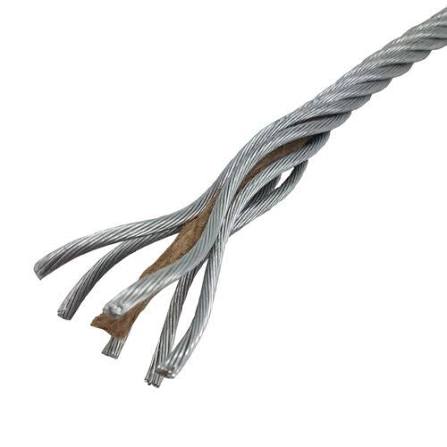
Wire Rope Cable (Steel Core) — Galvanized Steel Wire Rope Integrated Multi-Core Flexible Power and Control Cable with Central or Distributed Steel Tensile Strength Members for Overhead Crane Pendant Controls, Hoist Suspension Cables, Vertical Lift Applications, and High-Tensile Mobile Equipment Power Supply
Industrial, Mining & Control Cables /Wire Rope Cable

Wire Rope Cable (Steel Core) — Galvanized Steel Wire Rope Integrated Multi-Core Flexible Power and Control Cable with Central or Distributed Steel Tensile Strength Members for Overhead Crane Pendant Controls, Hoist Suspension Cables, Vertical Lift Applications, and High-Tensile Mobile Equipment Power Supply

Wire rope cable steel core: integrated galvanized steel wire rope strength member + multi-core power/control cable. Class 5/6 copper, PVC/PUR/CR jacket. For crane pendants, hoist suspension, vertical lifts, tensile load-bearing cable applications. CE, RoHS.

Key Features

Integrated galvanized steel wire rope core — the central steel wire rope (construction 7×7, 7×19, or 6×19 + FC per the tensile load requirement) carries 100% of the cable's tensile load; the electrical conductors are stranded around the steel core and carry zero tension — the steel rope is the strength member, not the copper conductors
Self-supporting — the steel core enables the cable to hang vertically under its own weight without catenary support; the cable supports itself over vertical distances of 50–100 m+ in hoist, crane, and lift applications where the cable is suspended from the top and the load is applied at the bottom
Multi-core power and control conductors stranded around the central steel core — the copper conductors are arranged in concentric layers around the central steel rope; the lay length and stranding direction are controlled to ensure the conductors flex uniformly with the steel core during bending and do not separate, kink, or fatigue
PVC, PUR, or CR (neoprene) outer jacket — PVC for general indoor wire rope cable applications (crane pendant controls, pushbutton stations) where cost is the primary consideration; PUR for outdoor and mobile equipment applications requiring superior abrasion, oil, and UV resistance; CR for the cable to be used in outdoor construction and mining environments requiring weather, oil, and flame resistance
Flexible Class 5 or Class 6 stranded bare copper or tinned copper conductors — the flexible stranding allows the copper conductors to bend with the steel core without conductor fatigue; Class 6 ultra-fine stranding for the most demanding flex applications (crane pendant cables that are constantly handled and moved by the operator)
Available as round or flat construction — round wire rope cable for circular cross-section applications (hoist suspension, vertical lift); flat wire rope cable (conductors laid parallel alongside the steel cores at the cable edges) for pendant control applications where the flat profile prevents the cable from twisting and tangling
Rated voltage 300/500 V — the standard for pendant control station circuits (pushbuttons, joysticks, indicator lamps) and hoist control power; the 300/500 V rating covers the 24–230 V control circuits used in crane and hoist applications
Tensile strength rated — the steel core is sized for the maximum expected tensile load (cable weight + dynamic loading from acceleration/deceleration + wind loading for outdoor cranes); the tensile rating is verified by a break-load test on the steel core

Applications

Overhead crane pendant control station — wire rope cable suspending the pushbutton pendant from the crane bridge or trolley; the cable supports its own weight over the pendant drop length (typically 2–10 m) and carries the control signals from the operator's pushbuttons to the crane's control panelElectric hoist power and control — wire rope cable for the hoist's up/down control and the power supply to the hoist motor; the cable hangs from the hoist and the operator pulls the control pendant to operate the hoist; the steel core supports the cable weight and the tension from the operator pulling the pendantVertical lift and elevator traveling cable — wire rope cable for the flexible connection between the fixed building wiring and the moving elevator car; the steel cores provide the tensile strength and the flat cable profile fits the elevator shaft cable management systemCrane cable reel tension member — wire rope cable used as the tensile element in crane cable reeling systems where the cable is wound onto a drum; the steel core carries the winding tension and the copper conductors carry power and control signals to the moving crane trolleyMining and construction hoist control — wire rope cable for the control pendant of mining hoists, construction winches, and shaft-sinking equipment where the cable is subject to high tensile loads, mechanical abuse, and outdoor weather conditionsSuspended equipment power — wire rope cable for the power supply to suspended lighting, suspended tool balancers, and suspended equipment in assembly lines and workshops where the cable supports its own weight and the weight of the suspended equipment

Technical Specifications

Steel Core — Construction Galvanized steel wire rope per BS EN 12385 (steel wire ropes — safety); 7×7 (7 strands of 7 wires — standard for smaller cables); 7×19 (7 strands of 19 wires — more flexible, for smaller bend radii); 6×19 + FC (fibre core — for larger cables requiring higher tensile strength); the steel core diameter is selected for the cable's rated tensile load
Steel Core — Galvanizing Hot-dip galvanized per BS EN 10244-2 Class A for corrosion protection in indoor and covered outdoor applications; heavy galvanized (Class B) for outdoor, marine, and mining environments
Steel Core — Tensile Load Rating Calculated from the steel wire rope's minimum breaking force per BS EN 12385; the safe working load (SWL) is typically 20–25% of the minimum breaking force (safety factor 4–5 for lifting and suspension applications); the SWL must exceed the maximum expected tensile load in service by the specified safety factor
Rated Voltage 300/500 V (U₀/U); the standard control circuit voltage class; 450/750 V available for wire rope cables with thicker core insulation for higher voltage applications
Conductor Material Bare copper or tinned copper; IEC 60228 Class 5 (flexible) or Class 6 (extra-flexible); the stranding class depends on the cable's flex life requirement
Conductor Cross-Sections — Control Cores 0.5, 0.75, 1.0, 1.5, 2.5 mm²; 4–24 cores depending on the control station's pushbutton and joystick count
Conductor Cross-Sections — Power Cores (Optional) 4, 6, 10, 16 mm² for hoist motor power integrated with the control cores in the same cable
Core Insulation — PVC PVC type TI1; 70°C; thin-wall insulation to minimise the overall cable OD and weight
Core Insulation — PP (Optional) Polypropylene; 90°C; lower capacitance than PVC; for control cables with long pendant drop lengths where the cable capacitance affects the control signal integrity
Core Assembly — Round Cable The control (and optional power) cores are concentrically stranded around the central steel wire rope core; anti-torsion filler elements maintain cable circularity and balance the torsional forces between the steel core and the copper conductors
Core Assembly — Flat Cable The conductors are laid parallel in a single plane, with the steel wire rope cores at the two edges of the flat cable; the flat profile prevents the pendant cable from twisting (a twisted pendant cable is difficult for the operator to control and prone to internal conductor breakage at the twist point)
Binder Tape Polyester or PP tape wrap over the core assembly; secures the conductors in position before the jacket extrusion
Outer Jacket — PVC (Standard) PVC type ST5; black (standard industrial), yellow (high-visibility for crane pendants), or red (emergency stop pendant identification); the jacket is thick enough to withstand the mechanical handling of the pendant cable — typically 1.5–3.5 mm wall
Outer Jacket — PUR (Premium) Polyurethane TMPU; excellent abrasion resistance (Taber <5 mg), oil resistance, and cold-flex to -40°C; for crane pendants in steel mills, foundries, and heavy industrial environments
Outer Jacket — CR (Neoprene, Heavy Duty) Polychloroprene rubber; excellent oil, weather, and flame resistance; for mining, construction, and outdoor crane applications
Maximum DC Conductor Resistance at 20°C Per IEC 60228 for the conductor class and cross-section
Insulation Resistance at 20°C ≥20 MΩ·km (at 500 V DC, 1 min)
Test Voltage (AC) — Routine 2 000 V AC / 5 min (core-to-core, core-to-steel core)
Temperature — PVC Jacket (Flexing) -5°C to +60°C
Temperature — PUR Jacket (Flexing) -40°C to +80°C
Temperature — CR Jacket (Flexing) -25°C to +60°C
Minimum Bend Radius — Round Cable 10× cable OD (the steel core limits the bend radius — tighter bends can kink the steel wire rope, permanently deforming it and reducing its tensile strength)
Minimum Bend Radius — Flat Cable (In-Plane) 8× cable thickness
Minimum Bend Radius — Flat Cable (Out-of-Plane) Not intended — flat cable is designed to bend in one plane only (the flat plane); bending out-of-plane can damage the conductor-to-steel-core assembly
Flame Retardant IEC 60332-1-2 (PVC and CR jackets); PUR — flame-retardant grade on request
Certifications CE; RoHS; BS EN 12385 compliance for the steel core; ISO 9001 manufactured

Detailed Description

What Is Wire Rope Cable (Steel Core)?

Wire rope cable is a composite cable in which a central galvanized steel wire rope provides the tensile strength, and the multi-core electrical conductors (copper, stranded around the steel core) provide the electrical circuits. It is the cable that hangs from the overhead crane bridge, suspends the pushbutton pendant at the operator's hand height, and carries the control signals from the operator's fingers to the crane's contactors and VFDs. The steel core supports the cable's own weight and the dynamic loads from the operator handling the pendant; the copper conductors carry zero tension.

Without the steel core, a standard flexible control cable suspended vertically would stretch under its own weight — the copper conductors would elongate (neck down), increasing in resistance, and eventually break. The steel core eliminates this failure mode. The cable is designed so that the steel carries the tension and the copper carries the current — each material performing the function it is designed for.

Why Choose Yichi Wire Rope Cables

  • Galvanized steel core per BS EN 12385 — tensile strength verified: The steel wire rope construction, galvanizing class, and minimum breaking force are specified per the steel wire rope standard. The SWL (safe working load) is calculated with the appropriate safety factor (4–5 for crane pendant applications) — the steel core is not underspecified for cost saving
  • Round or flat — select for the application geometry: Round wire rope cable for hoist suspension and vertical lift where the cable hangs in a straight line. Flat wire rope cable for crane pendant controls where the flat profile prevents the pendant from twisting — the operator can feel the correct orientation of the pushbuttons by the flat cable profile in their hand
  • PVC, PUR, or CR jacket — select for the environment: PVC for indoor crane pendants in clean environments; PUR for pendants in steel mills, foundries, and heavy industrial cranes where oil, abrasion, and outdoor exposure demand the highest mechanical and chemical resistance; CR for mining and construction crane pendants
  • Custom core counts and cross-sections — to the crane manufacturer's pendant wiring diagram: The conductor count, cross-sections, and steel core size are manufactured to the crane OEM's specification. A typical pendant has 6–14 pushbuttons plus an emergency stop, requiring 8–18 control cores. Yichi manufactures the wire rope cable to match your pendant's wiring diagram exactly — no unused cores, no missing circuits

Product Inquiry

Product: Wire Rope Cable (Steel Core) — Galvanized Steel Wire Rope Integrated Multi-Core Flexible Power and Control Cable with Central or Distributed Steel Tensile Strength Members for Overhead Crane Pendant Controls, Hoist Suspension Cables, Vertical Lift Applications, and High-Tensile Mobile Equipment Power Supply

Add technical specifications (optional)

The more detail you provide, the faster and more accurate our quotation.

No file chosen

PDF, Office, image or CAD file — up to 5 MB

Need Help?

Certifications

ISO 9001
Quality
CE
European
RoHS
Environmental
TÜV
Certification

Need a Quote for This Product?

Send us your requirements and receive a detailed quotation within 24 hours.