Detailed Description
What Is Accumulator Basket Spreader Cable?
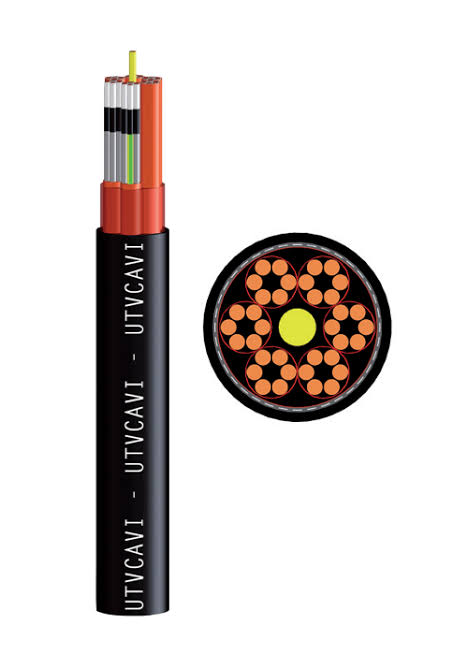
An accumulator basket spreader cable is a heavy-duty flexible composite reeling cable designed specifically for the accumulator basket cable management system on container crane spreaders. The "accumulator basket" is a suspended metal basket on the crane trolley that stores the cable looped inside it — as the spreader is hoisted, the cable coils into the basket; as the spreader is lowered, the cable pays out of the basket. The basket system eliminates the mechanical complexity of a powered cable reel and is the standard cable management method for container crane spreaders.
The cable must survive a unique mechanical duty: coiling and uncoiling in a basket hundreds of times per day, with the cable loops lying on top of each other in the basket under their own weight, while also bending as the cable exits the basket, twisting as the spreader rotates, and being exposed to the marine atmosphere of the container port. The composite construction — power + control + fiber in one cable — eliminates the need for multiple separate cables in the basket, where multiple cables would tangle together and fail prematurely.
Material and Configuration Choices
- EPR insulation + CR sheath — the proven reeling cable material combination: EPR provides the flexibility, compression recovery, and torsion resistance for the basket coiling duty. CR provides the mechanical protection, oil resistance, and weather resistance for the container terminal environment. This material combination has been the standard for reeling cables for decades
- Custom composite configuration — to the crane OEM spreader wiring diagram: The power core count and cross-section, the control core count, and the fiber count are manufactured to match the specific spreader electrical schematic. The cable is a custom design, not a standard catalogue product
- Tinned copper — mandatory for the marine port environment: The salt-laden marine atmosphere of a container port corrodes bare copper within months. Tinned copper resists this corrosion and maintains stable conductor resistance and terminal contact resistance through the cable's service life
Conductor and Core Configuration
The power cores are supplied in cross-sections of 6, 10, 16, 25, 35, and 50 mm², in 3 or 4 core counts, rated at 0.6/1 kV. These feed the spreader electric motors, the pump motor that operates the hydraulic power pack and the twistlock motors that lock and release the container. The control cores are supplied in cross-sections of 0.75, 1.0, 1.5, and 2.5 mm², in 8 to 36 cores, rated at 300/500 V. These carry the signals for the solenoid valves and limit switches that sequence the spreader open, close, and locking operations. The core count is matched to the spreader solenoid valve and sensor count so the cable carries exactly the circuits the spreader requires.
All conductors are tinned copper, stranded to IEC 60228 Class 5. Tinning is mandatory in the marine port environment because the salt-laden atmosphere would otherwise oxidise bare copper, raising conductor resistance and causing connection failures at the spreader junction box.
Fiber Optic Integration and Anti-Torsion Assembly
Where the spreader carries a condition monitoring system, camera, or automation data link, the cable is built with single-mode fibers (G.652D), 2 to 6 fibers in a gel-filled stainless steel loose tube. The gel and stainless steel tube protect the fibers from water ingress and mechanical crush while the cable coils in the basket, and the fibers are designed for the same coiling flex life as the copper conductors.
To keep the cable from twisting into a figure-8 or spiral as the basket rotates, the conductors and fillers are stranded with a controlled lay length and built with anti-torsion elements. This prevents tangling, kinking, and conductor fatigue during the continuous hoisting cycle. The EPR insulation, rated to 90 °C and built to IEC 60502-1 thickness, provides the flexibility, compression recovery, and torsion resistance needed because the cable is stacked on itself in the basket under its own weight.
Mechanical Ratings and Service Life
The CR outer sheath is supplied in a wall thickness of 3.0-6.0 mm, with Shore A hardness 60-70, and protects the cable from impact by the container, abrasion against the spreader steelwork and basket, oil from the crane hydraulic and lubrication systems, and outdoor weather and UV exposure. The minimum bend radius during basket coiling is 8 times the cable outside diameter, and the flex life exceeds 200 000 coiling cycles at the designed basket diameter per the crane OEM specification. The cable is tested at 3 500 V AC for 5 minutes on the power cores and 2 000 V AC for 5 minutes on the control cores, and the CR sheath meets IEC 60332-1-2 flame retardance.