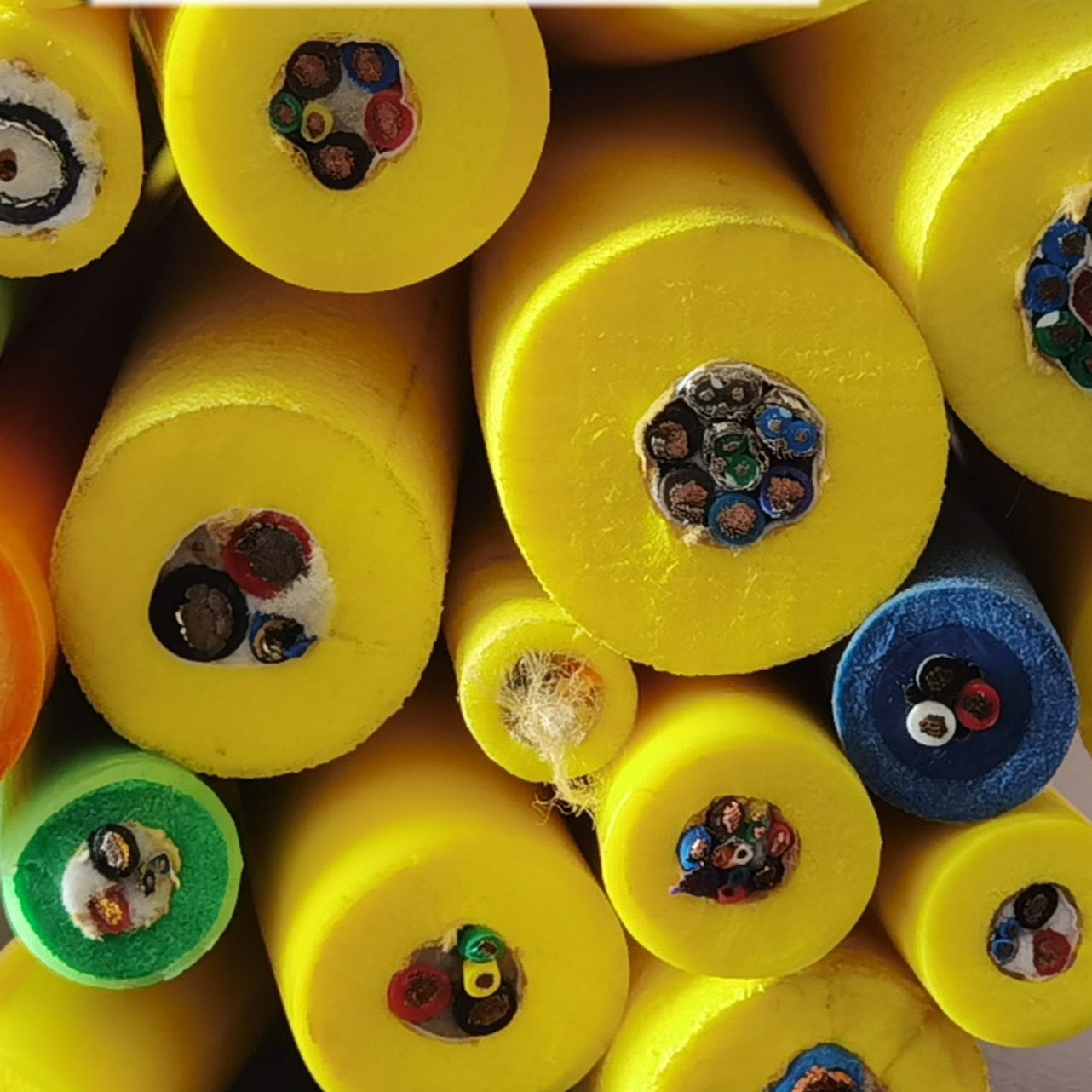
Detailed Description
What Is a Floating (Positively Buoyant) Cable?
A floating cable is an underwater electrical cable whose overall density is engineered to be less than that of water — typically 0.85–0.95 g/cm³, compared to fresh water at 0.998 g/cm³ and seawater at 1.025 g/cm³. When placed in water, the cable rises to the surface and stays there. It floats.
This is the opposite of the neutrally buoyant cable (density 1.025 g/cm³, stays suspended) and the negatively buoyant cable (density >1.025 g/cm³, sinks). The positive buoyancy is achieved not by adding external floats — which increase drag, cost, and complexity — but by engineering the cable's internal materials to be lighter than the water they displace.
The key engineering approaches are:
- High-percentage foam insulation — the PE or PP dielectric on each conductor is foamed to 40–60% gas content, reducing its density to 0.50–0.65 g/cm³ (compared to 0.92 for solid PE)
- Low-density filler elements — the spaces between the cabled cores are filled with PE foam rods or hollow PP tubes rather than solid filler yarns, contributing buoyancy rather than dead weight
- Lightweight PUR jacket — at 1.15 g/cm³, PUR is already lighter than most cable jacket materials. Combined with the buoyant core assembly, the overall cable density stays below 1.0 g/cm³
Positive vs Neutral vs Negative Buoyancy — When Each Is Used
| Buoyancy Type | Density (g/cm³) | Behaviour in Water | Typical Application |
|---|---|---|---|
| Positive (Floating) | <1.0 | Rises to surface and floats | Floating solar, surface buoys, floating docks, surface-deployed sensors |
| Neutral (Zero) | 1.0–1.025 | Stays suspended at deployment depth | ROV tethers, subsea instruments, oceanographic sensors, towed arrays |
| Negative (Sinking) | >1.025 | Sinks to bottom | Submersible pump cables, seabed power cables, buried cables |
A positively buoyant cable is the correct specification whenever the cable must remain at the surface for visibility, accessibility, or operational reasons — or when the supported equipment (floating platform, buoy, solar array) is itself at the surface and a submerged cable would create downward pull and entanglement risk.
Foam Insulation for Positive Buoyancy — How Much Foam?
The copper conductor (8.9 g/cm³) is the heaviest component in any cable. To make a cable float, the volume of low-density material around each conductor must be sufficient to bring the average conductor + insulation density below 1.0 g/cm³.
| Foam Content | PE Density (g/cm³) | Conductor+Insulation Effective Density (1.5 mm² Cu) | Buoyancy |
|---|---|---|---|
| 0% (Solid PE) | 0.92 | ~2.1 g/cm³ | Strongly negative |
| 20% | 0.74 | ~1.6 g/cm³ | Negative |
| 40% | 0.55 | ~1.15 g/cm³ | Slightly negative — buoyancy from filler can compensate |
| 50% | 0.46 | ~0.95 g/cm³ | Positively buoyant — conductor + insulation alone is lighter than water |
| 60% | 0.37 | ~0.78 g/cm³ | Strongly positive — substantial buoyancy margin |
At 50% foam content, even the copper + insulation assembly is positively buoyant — the filler elements and jacket add further buoyancy. The engineering trade-off is that higher foam content reduces the insulation's mechanical strength and dielectric breakdown voltage. For 0.6/1 kV rated cable, 40–50% foam with a thin solid skin provides an appropriate balance.
Application Analysis: Where Floating Cables Are Used
- Floating solar (FPV) installations: Rows of photovoltaic panels mounted on floating pontoons on reservoirs, lakes, and coastal waters — positively buoyant DC string cables and AC collection cables that float between the panel arrays and the shore-based inverter station, eliminating the cost and risk of submerged cable routing
- Oceanographic and weather buoys: Surface buoys with underwater sensor strings — the cable floats at the surface from the buoy to a surface junction point, keeping it accessible for maintenance and visible to vessels
- Aquaculture platforms: Fish farm feeding barges, monitoring stations, and net-cleaning robots that operate from floating platforms — power and data cables that float alongside the platform, reducing entanglement with mooring lines and nets
- Floating docks and marinas: Shore power connections to floating docks — a positively buoyant cable floats on the water between the shore pedestal and the dock, moving with the dock as water levels change
- Temporary deployed systems: Short-term scientific instruments, security sensor lines, and floating barriers — the cable's positive buoyancy ensures it stays at the surface for easy deployment and recovery
Why Choose Yichi for Floating Cables
- Calculated buoyancy, verified by immersion: The cable's overall density is calculated from the exact material volumes during the design phase, and each production length is tested in a freshwater tank — the cable must float. A buoyancy certificate accompanies each delivery
- High-percentage foam PE manufactured in controlled extrusion: Foam content (40–60%) is controlled by gas injection during the PE extrusion process, producing a uniform foam cell structure with a solid skin for dielectric integrity — not a separate foam tape wrap that can delaminate
- Buoyancy margin for both fresh and seawater: A cable that floats in seawater (density 1.025) may sink in fresh water (density 0.998) if the buoyancy margin is too small. Yichi floating cables are specified to float in fresh water, providing an additional margin in seawater
- UV-stabilized PUR jacket for long-term surface exposure: Floating cables are exposed to direct sunlight for years. The PUR jacket is formulated with carbon black and UV stabilizers, tested per ISO 4892-2 for accelerated UV ageing
- Factory-direct with full buoyancy and electrical test documentation: Conductor resistance, insulation resistance, HV test, and positive buoyancy certificate — the complete documentation package for marine and floating infrastructure projects