Detailed Description
What Is an SYV Video Transmission Installation Cable?
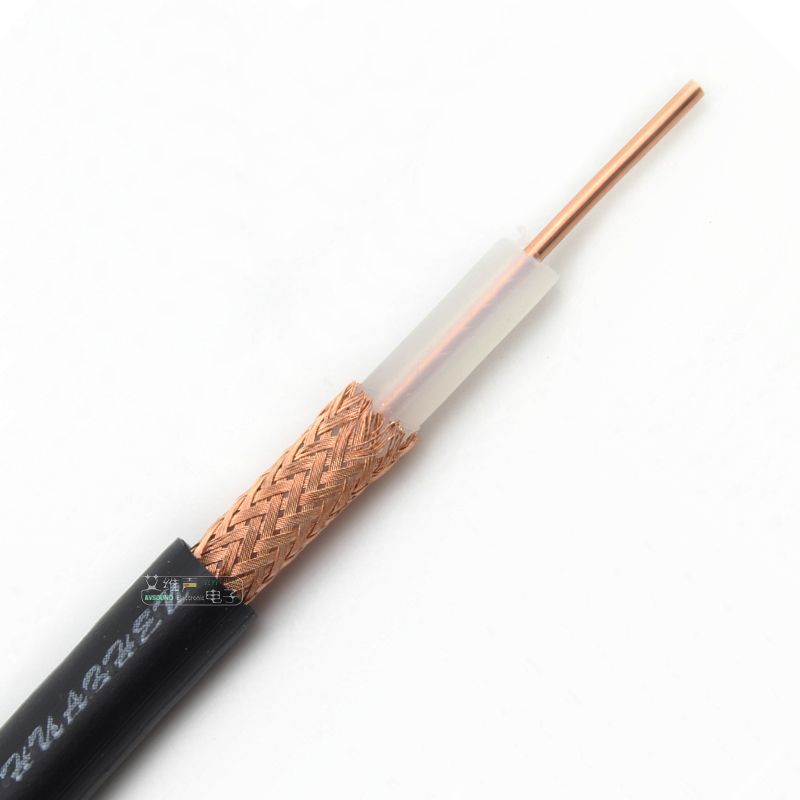
SYV is a 75 Ω coaxial cable designed specifically for analog video signal transmission. Unlike the multi-conductor shielded cables that carry low-frequency control and sensor signals, SYV is a transmission line — a precisely engineered coaxial structure where the center conductor, dielectric, and shield form a controlled-impedance path for high-frequency (MHz-range) video signals.
The name SYV comes from the Chinese cable designation system:
| Letter | Meaning | Function in the Cable |
|---|---|---|
| S | 同轴 (coaxial) | Coaxial construction — center conductor surrounded by a concentric dielectric and outer shield |
| Y | 聚乙烯 (polyethylene) | PE dielectric — the insulating layer between the center conductor and the shield, whose dimensions and dielectric constant set the cable's characteristic impedance (75 Ω) |
| V | 聚氯乙烯 (PVC) | PVC outer jacket — mechanical and environmental protection |
A coaxial cable carries the video signal as a voltage between the center conductor (signal) and the braid shield (ground/return). The 75 Ω characteristic impedance is the international standard for analog video, matching the output impedance of standard video sources (cameras, pattern generators) and the input impedance of video receivers (monitors, DVRs, frame grabbers). When the cable impedance matches the source and load, there is no signal reflection at the cable ends — all of the signal energy is transferred.
SYV Size Selection — Choosing the Right Cable for Run Length
The choice of SYV-75-3, SYV-75-5, or SYV-75-7 is driven primarily by the cable run length and the maximum acceptable signal attenuation:
| Parameter | SYV-75-3 | SYV-75-5 | SYV-75-7 |
|---|---|---|---|
| Nominal OD | 5.0 mm | 7.2 mm | 10.3 mm |
| Attenuation at 10 MHz (100 m) | 5.0 dB | 3.0 dB | 2.0 dB |
| Attenuation at 100 MHz (100 m) | 18 dB | 12 dB | 8.0 dB |
| Practical Max Length (CCTV) | 150 m | 300 m | 500 m |
| Bending Effort | Easy — compact, flexible | Moderate — standard for most installations | Stiffer — requires larger bend radius |
| Typical Application | Short patch cables, camera pigtails, indoor runs under 50 m | The workhorse — camera-to-DVR runs up to 300 m in commercial CCTV | Long outdoor runs, building-to-building, trunk cabling |
For a standard CCTV camera producing 1 Vpp composite video, a typical DVR or monitor can tolerate up to ~6 dB of signal attenuation before the image quality degrades noticeably (loss of sharpness, increased noise in dark areas). The SYV-75-5 at 300 metres attenuates approximately 6 dB at the upper end of the video bandwidth (~5–6 MHz for PAL), making it the practical maximum for acceptable picture quality without amplification.
SYV vs Other Coaxial Video Cables — How It Compares
| Cable Type | Impedance | Dielectric | Shield | Jacket | Primary Application |
|---|---|---|---|---|---|
| SYV-75-5 | 75 Ω | Solid PE | Single braid (≥90%) | PVC | CCTV, analog video, RF — the standard in Asia |
| RG-59 | 75 Ω | Solid PE | Single braid (≥95% typical) | PVC | CCTV, analog video — the standard in North America |
| RG-6 | 75 Ω | Foam PE | Dual (foil + braid) | PVC | CATV, satellite, digital video — lower loss than RG-59, larger OD |
| RG-11 | 75 Ω | Foam PE | Dual (foil + braid) | PVC | Long trunk runs, backbone — significantly lower loss, much larger OD (10.3 mm) |
| RG-58 | 50 Ω | Solid PE | Single braid | PVC | RF instrumentation and 50 Ω systems — NOT for video (impedance mismatch) |
The three cables — SYV-75-5, RG-59, and RG-6 — are electrically similar (all 75 Ω) and mechanically interchangeable in BNC connectors. The main practical difference is regional: SYV is the standard in China and much of Asia, RG-59 in North America. In terms of performance, a good-quality SYV-75-5 with ≥90% braid coverage and solid PE dielectric delivers video quality equivalent to RG-59 at typical CCTV run lengths.
For installations where both analog CCTV and future IP camera upgrade are being considered, RG-6 with its lower attenuation and foam dielectric may be preferred — but if the existing infrastructure uses SYV connectors and accessories, continuing with SYV is the practical choice.
Shield Coverage and Video Signal Quality
In a coaxial video cable, the braid shield serves a dual purpose:
- Signal return path: Unlike a balanced twisted-pair cable (where two conductors carry the differential signal), a coaxial cable is unbalanced — the center conductor carries the signal voltage and the braid is the return path. Any discontinuity or high resistance in the braid directly affects the video signal
- EMI shielding: The braid shields the center conductor from external electric fields. A coaxial cable with ≥90% braid coverage provides approximately 40–50 dB of shielding effectiveness at video frequencies
Yichi SYV cables are manufactured with ≥90% braid coverage for video-grade applications. For the most demanding installations — near VFD drives, welding equipment, or broadcast transmitters — double-braid (≥95% total coverage) is available on request.
Application Analysis: Where SYV Video Cables Are Used
- Commercial CCTV systems: The standard video transmission medium in shopping malls, office buildings, factories, and warehouses across Asia — an SYV-75-5 from each camera position back to the central DVR or NVR rack
- Industrial process monitoring: Fixed cameras on conveyor lines, furnace viewing ports, and remote equipment monitoring stations in factories, where the camera-to-monitor cable run may be 100–200 metres through machinery areas
- Machine vision and quality inspection: Analog cameras on automated inspection stations — the SYV-75-3 patch cable from the camera to the frame grabber or vision processor, typically under 5 metres in the control cabinet
- Traffic and perimeter surveillance: Outdoor PTZ cameras on poles and building perimeters, where the SYV cable (in UV-resistant black PVC) runs in underground duct or overhead catenary from the camera to the control room
- Video intercom and access control: Composite video from outdoor entry stations to indoor monitors in apartment buildings, office reception areas, and gated communities
- Legacy system maintenance and expansion: Extending or replacing cables in existing analog CCTV installations where migrating to IP cameras would require replacing the entire cable infrastructure — SYV cable maintains compatibility with the existing cameras, connectors, and DVRs
Why Choose Yichi for SYV Video Cables
- Controlled 75 Ω impedance verified in production: The impedance of a coaxial cable depends on the ratio of the dielectric OD to the center conductor diameter. Yichi SYV cables are manufactured with tight dimensional control on both, and impedance is spot-checked on every production run
- Braid coverage ≥90% as the video-grade standard: Lower braid coverage saves copper but compromises both the signal return path and the EMI shielding — a false economy that shows up on the monitor. Yichi SYV video-grade cables maintain ≥90% coverage
- Solid PE dielectric for stable impedance over temperature and time: Foam PE (used in RG-6 and some RG-59) has lower attenuation but is more susceptible to moisture ingress and compression damage during installation. Solid PE — as used in SYV — is mechanically robust and retains its electrical properties over decades of service in building installations
- Three standard sizes from stock: SYV-75-3 for patch cables and short runs, SYV-75-5 for general-purpose CCTV installations, SYV-75-7 for long outdoor runs — all available from factory stock with short lead times on volume orders
- UV-resistant outdoor jacket: Black PVC with carbon black for UV protection — suitable for outdoor cable runs in conduit, on catenary wire, or direct-buried (in duct). The outer jacket is formulated for long-term outdoor exposure without cracking or chalking