Detailed Description
What Is a Battery Interconnect Cable?
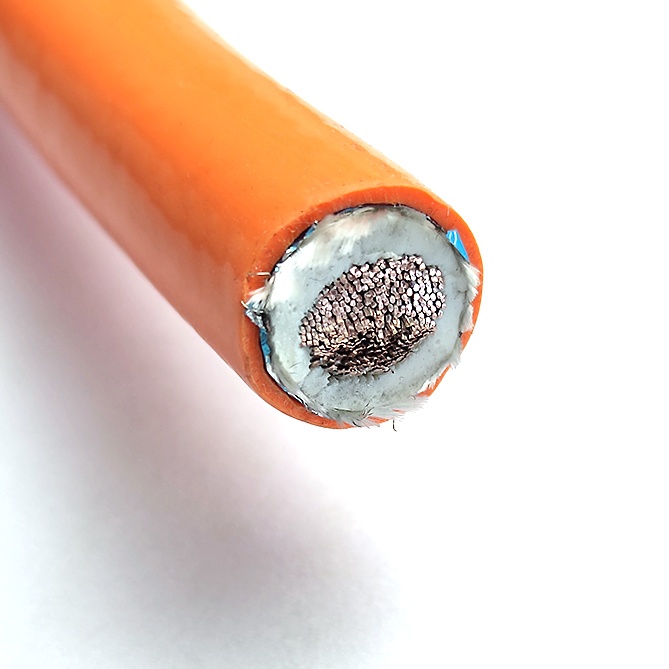
A battery interconnect cable is a flexible single-core or paired DC power cable that connects individual battery cells, modules, or racks in series and parallel configurations to form a battery string or bank at the desired system voltage and capacity. It is a simple cable — a tinned copper conductor with PVC or XLPE insulation — but its specification is critical to the safety and performance of the battery energy storage system (BESS).
The battery interconnect cable operates at low DC voltage (12–1 000 V depending on the system scale) but high DC current — because battery storage systems are designed to deliver their rated power at the battery's nominal voltage, and power = voltage × current. A 48 V telecom battery string delivering 5 kW discharges at over 100 A. A 1 000 V utility-scale BESS delivering 1 MW discharges at 1 000 A — requiring parallel conductors to share the current.
The cable must be sized for:
- Continuous current: The battery's maximum sustained charge/discharge current at the system's rated C-rate (e.g., 0.5 C for a 2-hour discharge, 1 C for a 1-hour discharge)
- Voltage drop: The DC voltage drop in the interconnect cables reduces the available voltage at the load (inverter, DC bus) and wastes energy as I²R heating — for a battery system designed for energy efficiency, the interconnect cable voltage drop should be <1% of the system voltage
- Fault current: A short circuit across a battery bank can deliver thousands of amperes — the interconnect cables must survive the fault current for the duration required for the battery protection device (fuse, DC circuit breaker) to clear the fault without the cable insulation melting or igniting
PVC vs XLPE — Temperature Rating for Battery Environments
| Installation Environment | Recommended Insulation | Reason |
|---|---|---|
| Indoor telecom battery room (20–25°C) | PVC 70°C | Adequate for the controlled indoor ambient; lowest cost |
| Indoor UPS battery cabinet (25–35°C) | PVC 70°C or 105°C | Standard PVC if cabinet is ventilated; 105°C PVC if cabinet temperature is elevated from battery charging and limited ventilation |
| Outdoor BESS container (solar heated, 40–60°C internal) | XLPE 90°C or PVC 105°C | The container internal temperature in direct sun can exceed 50°C; 70°C PVC provides insufficient thermal margin; the conductor temperature = ambient + I²R rise, and at 60°C ambient with 10°C I²R rise the conductor reaches 70°C on a PVC 70°C cable — zero margin |
| High-rate discharge (1–3 C) | XLPE 90°C | High discharge rates generate significant I²R heating; the conductor temperature under continuous high-rate discharge can reach 70–90°C, beyond PVC's rating |
| Utility-scale BESS (>500 V DC) | XLPE 90°C, 0.6/1 kV rated | The higher system voltage requires the 0.6/1 kV insulation rating; XLPE is standard for this voltage class; the 90°C rating provides thermal margin for the container environment |
| Lithium-ion battery (enclosed module, limited cooling) | XLPE 90°C or PVC 105°C | Lithium-ion batteries are temperature-sensitive and operate best at 15–35°C; the battery management system controls the temperature, but the cable routing near battery cells that may reach 40–50°C during charging requires elevated temperature-rated insulation |
Why Choose Yichi Battery Interconnect Cables
- Tinned copper as standard: Every conductor is tinned — because battery terminal environments accelerate bare copper oxidation. The tinning maintains low contact resistance at the crimp lug and bolted terminal interfaces for the battery system's 10–20 year service life
- PVC 70°C, PVC 105°C, and XLPE 90°C — the full insulation temperature spectrum: Select the insulation that matches your battery installation's ambient temperature environment and discharge profile. No single insulation type is correct for all battery applications — Yichi manufactures all three
- Red/black paired cable for clean polarity identification: Custom-extruded paired cables with one red positive and one black negative conductor in a single cable assembly simplify battery cabinet wiring and eliminate the risk of polarity reversal during installation and maintenance
- Crimp lug and Anderson connector compatibility: The conductor stranding, insulation strip characteristics, and overall cable OD are designed for standard battery interconnect termination hardware — copper tube lugs (DIN 46235), Anderson SB/PP series connectors, and bolted busbar connections
- Current rating and voltage drop calculation support: Provide your battery system voltage, maximum charge/discharge current, interconnect cable length, and ambient temperature — we calculate the required conductor cross-section for both thermal rating and voltage drop per IEC 60364 and recommend the appropriate insulation material and temperature class